SW means a surface can be spot-cleaned with either a water-based product or a mild water-free solvent, but it doesn't mean the item can be soaked or machine washed. For Birmingham homeowners looking at a fresh spill and wondering whether to book professional rug cleaning, those letters are a starting point, not a complete cleaning plan.
Perhaps you've found a care tag while checking a coffee stain, or you're trying to decide whether a rental carpet cleaner is safe for an area rug. At Rubber Ducky Rug Cleaning Birmingham, we look beyond the label to the rug's fibers, dyes, backing, and condition. That's how we decide whether a small spot treatment makes sense or the rug needs facility cleaning and controlled drying.
What the SW Code Means and Where It Stops
Cleaning code SW describes permitted spot-cleaning chemistry. It allows water-based upholstery shampoo, foam made from mild detergent, or a mild water-free solvent. Ashley Furniture's care guidance also warns against saturation and recommends testing products in an inconspicuous area before treatment.
The word spot matters. Permission to treat a localized mark isn't permission to immerse the item, run it through a washing machine, or clean its entire surface with an extractor. Those processes introduce different amounts of moisture and mechanical stress.
Upholstery cleaning codes and what each allows
| Code | Cleaning agents permitted | What to avoid |
|---|---|---|
| W | Water-based products only | Solvents, and soaking the fabric |
| S | Mild water-free solvents only | Water-based shampoos and foams |
| SW or WS | Water-based or mild solvent, spot cleaning only | Saturating the material or assuming whole-surface cleaning is permitted |
| X | Vacuuming or dry brushing only | Any liquid or solvent |
These are upholstery-care classifications, not universal rug-washing instructions. American Leather's upholstery-label guide distinguishes water-compatible, solvent-compatible, and dual-compatible fabrics, while emphasizing that the label doesn't make every cleaning process safe.
The system reduces guesswork about compatible cleaning agents. It doesn't rank cleaning strength, promise stain removal, or account for everything that has happened to a textile since manufacture. Previous treatments, wear, and the stain itself still affect the decision.
The limits that matter for rugs
SW doesn't authorize soaking, machine washing, or automatic whole-surface extraction. A removable cover isn't ordinary laundry just because it has a zipper. Likewise, a rug shouldn't go into a home washing machine because a nearby textile carries an SW label.
SW doesn't approve every cleaner within an allowed category. A concentrated solvent and a mild upholstery spotter aren't interchangeable. Neither are a lightly dampened cloth and repeated passes with a wet-cleaning machine.
SW doesn't necessarily cover every component. Fringe, adhesive, backing, and an attached textile may need separate assessment. The visible face can respond differently from the materials underneath.
Practical rule: Read the label as permission to investigate a method, not permission to skip testing.
Say a wool piece has unstable red dye. A carefully selected solvent test might remain stable while a water-based shampoo test releases color. A synthetic rug may tolerate water at the face but retain moisture against rubber backing or a damp pad.
Neither situation can be settled by the letters alone. The useful sequence is to find the applicable instructions, choose a compatible method, and start with the gentlest option likely to work. For full rug cleaning, professional testing determines whether washing is appropriate rather than treating SW as a washing authorization.
How to Check a Rug Before Any Cleaning
Many area rugs carry their own care instructions rather than an upholstery SW code, and some have no readable label at all. Don't borrow a cleaning code from a sofa, cushion, or another rug and apply it to the piece on your floor.
Check the materials before testing a product
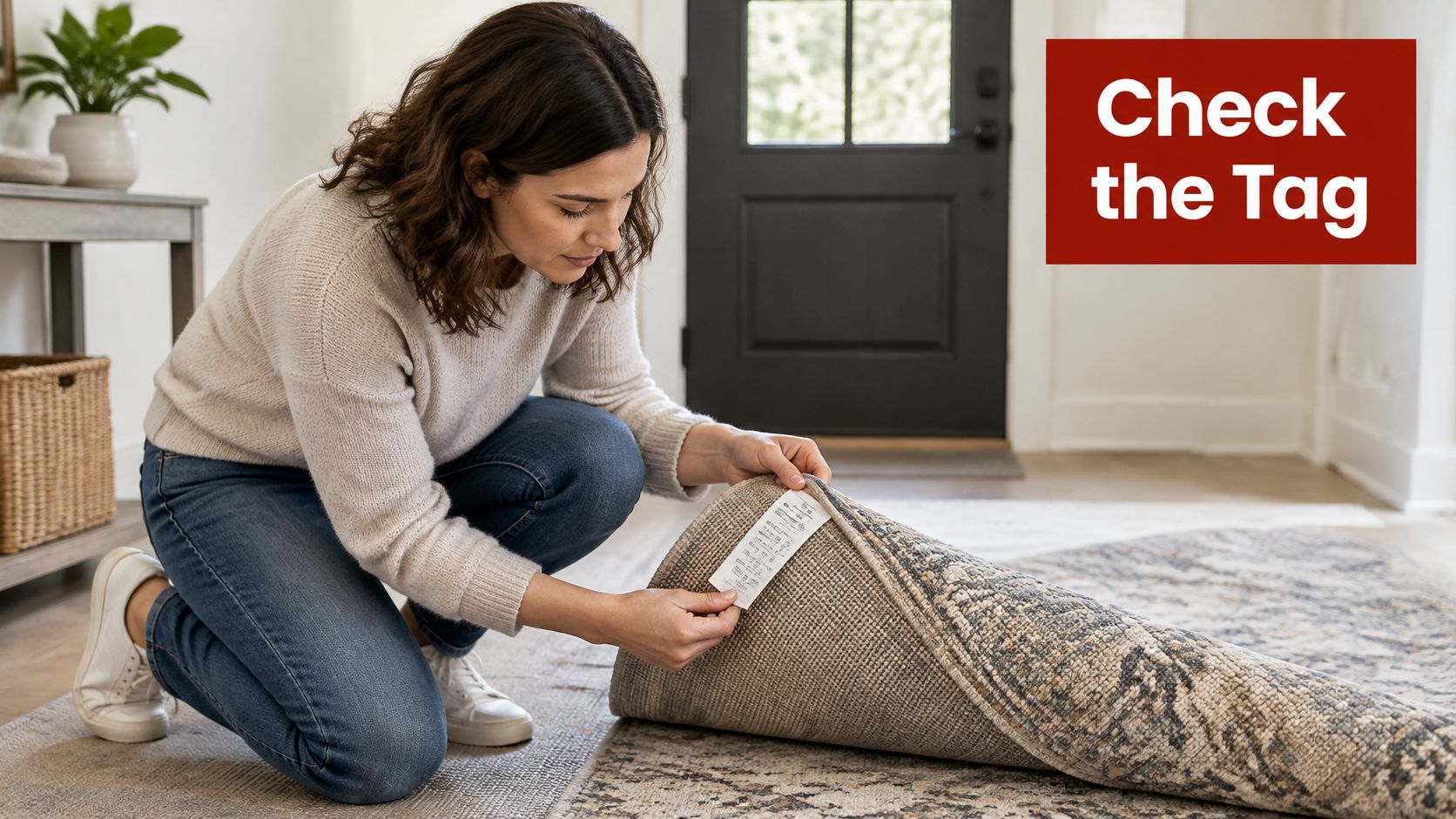
Find the rug's own instructions. Look along the back and edges for a care tag, fiber content, and manufacturer name. If the tag is missing, check the manufacturer's guidance rather than assuming the rug is washable.
Confirm which component a code covers. If the piece includes an attached cushion or upholstered section, its letter code applies to that labeled component. It doesn't automatically describe the rug beneath it.
Record the fiber and backing. Wool can feel springy and crimped, cotton often looks matte, and synthetics may have a more even sheen, but appearance alone isn't reliable identification. Photograph the face, fringe, backing, and pad so we can assess the construction.
Check color stability only when water is permitted. Press a lightly dampened white cloth against a concealed corner, hold it briefly, and inspect for dye transfer. Don't introduce water to an S- or X-coded component, and stop immediately if color moves.
Test the intended product separately. Apply the smallest practical amount to a concealed area and blot without rubbing. Our guide to rug colorfastness testing explains why both the cleaner and the application method need checking.
Let the patch dry completely. Inspect it for a ring, stiffness, changed texture, or a shift in color before considering treatment elsewhere. A patch that looks fine while damp can reveal a problem after drying.
What professional inspection adds
At our facility, each rug is inspected before cleaning and then dusted in purpose-built mechanical dusters. Inspection helps identify weak edges, existing damage, previous spotting, and construction details that a care tag can't describe.
Dust removal also gives the cleaning team a better starting condition for any appropriate wash. It's not a substitute for testing, and a successful test isn't proof that every part of an older rug will behave identically.
If the fiber is unknown, the rug is hand-knotted or antique, or the test releases dye, stop experimenting. Send us photographs and arrange an assessment before a small mark becomes a larger restoration problem.
Choosing a Method for Common Rug Stains
| Stain | First method | If that fails | Call a professional when |
|---|---|---|---|
| Dust, grit, pet hair | Vacuum and dry-dust, no liquid | None needed before assessment | Soil remains embedded after vacuuming |
| Wine or coffee | Blot, then test a compatible water-based upholstery shampoo | Test a mild water-free solvent only if permitted | Dye moves on the patch or a ring remains |
| Ink or oil | Blot, then test a compatible mild solvent | Repeat the same solvent test on a different concealed patch before further treatment | Spreading or color change appears |
| Pet urine | Compatible enzyme-based water treatment and thorough rinse | Reassess before repeating treatment and rinse, allowing full drying | Odor returns after the rug dries |
Treat this table as a method-selection guide, not permission to apply every listed cleaner to every rug. The rug's instructions and test results take priority. If treatment would require saturating the backing or rinsing on the floor, arrange facility cleaning instead.
Why the order of treatment matters
Remove loose dust, grit, and pet hair before adding liquid. Wetting dirty fibers creates a slurry that's harder to remove with a cloth, while rubbing abrasive particles through the pile adds unnecessary friction.
For a compatible food or drink stain, blot from the outside toward the center with a clean white cloth. Use fresh areas of the cloth as it picks up the spill, rather than pressing collected soil back into the rug. Our guide to removing rug stains helps distinguish a manageable surface mark from a stain that needs professional treatment.
Ink and oily marks may call for a mild solvent, but more solvent isn't a better fallback. Stop if the mark spreads, the pile changes, or color transfers. Don't mix products or substitute household degreasers for a textile-compatible spotter.
Pet urine needs a different decision
Pet urine can reach the backing and pad even when the visible spot is small. A compatible enzyme treatment may help, but surface application without adequate rinsing can leave contamination and cleaner behind. Enzyme compatibility also needs checking on delicate fibers.
A stain that disappears while wet and returns after drying needs reassessment, not another round of scrubbing.
Avoid heat on protein-based stains, aggressive rubbing on wine, and repeated wetting around a stubborn edge. Those choices can make the appearance worse without removing the underlying material.
For homeowners in Homewood or Mountain Brook, the practical cutoff is straightforward: dye movement, recurring stains, persistent odor, or unknown backing justify professional assessment. We can address the rug away from the floor and evaluate whether stain removal, odor treatment, or restoration is appropriate.
Why Wet Rugs Need Drying Within 48 Hours
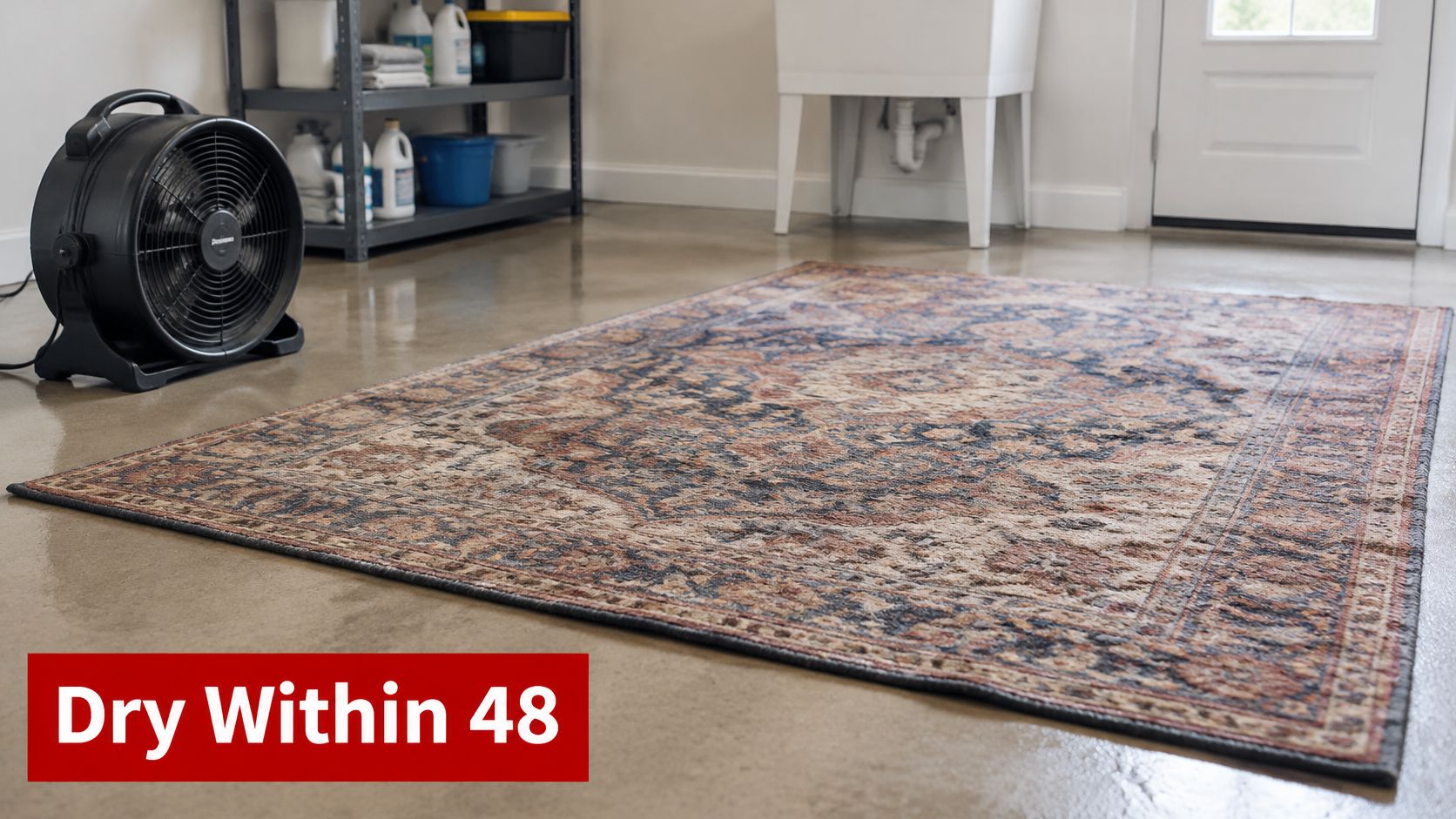
The CDC recommends drying wet household materials within 24 to 48 hours to help prevent mold growth, and says floodwater-exposed rugs, carpeting, and padding that can't be thoroughly cleaned and dried during that period should be discarded. NIOSH likewise advises drying wetted materials within 48 hours or removing them, and identifies mold growth as evidence of a moisture problem requiring immediate attention.
That makes a soaked rug different from an ordinary spot-cleaning job. A clean-looking face can conceal water in dense pile, backing, or the pad underneath, especially when the rug remains flat against the floor.
Respond to the moisture, not just the mark
- Stop the source and remove standing water when it's safe to do so. Don't handle floodwater or electrical hazards as a routine rug-cleaning task.
- Lift and separate the rug from its pad and flooring. A wet pad needs its own assessment.
- Provide moving air around salvageable materials. Don't fold or roll a wet rug into a tight bundle.
- Check the face, underside, and pad for continuing dampness. Don't judge dryness by the tips of the pile alone.
- Contact us promptly if dampness persists or odor returns. Significant soaking warrants assessment immediately rather than waiting for the drying window to expire.
How controlled facility drying differs
Our large centrifugal machines spin rugs so remaining water drains away, leaving them nearly dry before controlled drying begins. Climate-controlled drying then manages temperature and humidity, helping limit shrinkage and backing damage.
The objective isn't to put a fan beside a wet rug. It's to remove water efficiently and dry the construction appropriately without leaving moisture trapped underneath.
Our mold and water-damage remediation guidance can help Birmingham homeowners recognize when restoration assessment is needed. A small spill that stays near the surface may be a stain problem; a leak, flood, or urine saturation reaching the pad is a moisture problem that needs a broader response.
Why Allergens Stay in Rugs After Vacuuming
Rugs hold more than visible crumbs and pet hair. The EPA identifies carpets and furnishings as reservoirs for tracked-in soil, pollen, mold spores, pet dander, dust mites, and other particles, and notes that walking and cleaning can resuspend them into the air.
Vacuuming helps, but removal and inactivation aren't the same thing. In a five-week hospital-residence pilot, daily weekday vacuuming reduced dust-mite allergen Der p 1 by 48.0% per gram of fine dust and 68.5% per unit of carpet area, according to the EPA-indexed study record. Those findings describe a particular cleaning schedule and setting, not a promise for every household rug.
What vacuuming can and can't accomplish
A vacuum removes accessible allergen-bearing dust. It doesn't establish that the remaining allergens have been inactivated, and it may leave material embedded deeper in the rug.
The EPA's indoor-air-quality guide also warns that vacuuming can temporarily increase airborne mite allergens and other biological contaminants. It identifies high-efficiency filtration or outdoor-vented systems as possible controls and explains that regular cleaning reduces, rather than completely eliminates, household allergens.
For allergy-sensitive households: Aim to remove accumulated material without promising an allergen-free rug.
What facility cleaning changes
Our process takes the rug out of the living space for inspection, mechanical dusting, and appropriate washing. Mechanical dusting tumblers release embedded sand, dust, pet hair, and grit that ordinary vacuuming can't reach; compatible rugs then receive washing and thorough rinsing before controlled drying.
That's useful for pet-owning households and busy rooms in Birmingham, Hoover, and Vestavia Hills, where surface maintenance may not address the deeper soil load. We don't describe rug washing as a cure for allergies or guarantee complete allergen elimination.
If dust and pet debris seem to return immediately after vacuuming, request an assessment. Embedded material may justify professional washing rather than increasingly aggressive passes with a home vacuum.
Book Birmingham Rug Cleaning With Rubber Ducky
A rug's SW code describes the spot-cleaning chemistry its manufacturer allows. It does not guarantee that a particular treatment is safe for the whole rug. Fibre, dye, backing, and moisture control all matter, so a test patch and a suitable drying plan help guide the cleaning decision.
Rubber Ducky Rug Cleaning Birmingham inspects area rugs before cleaning. When pickup is needed, Team Members transport the rug to the local cleaning facility and schedule its return to the customer.
From inspection to return
The eight-step process starts with recognition of the rug, followed by pickup and delivery, inspection and dusting, a custom wash tank, thorough brush cleaning, state-of-the-art rinsing, a Pat-Pending Infusion Rinse, and controlled drying.
Mechanical dusters release sand, dust, pet hair, and grit trapped deep in the fibres. Large washing tubs fully immerse rugs, while moving panels distribute the cleaning solution. After soaking, rugs go to a custom-built wash floor for brushing or spot treatment as needed.
Mechanical rinsing flushes away cleaning solution so residue is not left to attract new dirt or dust. The Pat-Pending Infusion Rinse treats lingering odor-causing bacteria within the fibres. Rugs are spun in large centrifugal machines to remove water before they enter a controlled drying chamber.
Arrange the right service for your rug
Rubber Ducky serves Birmingham, AL, including Hoover, Vestavia Hills, Mountain Brook, Homewood, Trussville, Pelham, Alabaster, Gardendale, Helena, and nearby communities. Customers who drop off and pick up rugs at a Rubber Ducky location receive 20% off area rug cleaning.
A useful estimate begins with the rug's size, material, condition, and cleaning needs. For background on how providers create better carpet quotes with Estimatty, see Estimatty's guide. Rug-specific assessment still matters for delicate construction, urine contamination, or damage.
Call (205) 329-6488 or email info@rubberduckyrugs.com to discuss an estimate. A photo of the care tag, the rug's back, and any stained or damaged area can help describe the issue.
Visit Rubber Ducky Rug Cleaning Birmingham to request an estimate and arrange an assessment.