
That small spill or patch of dampness on your area rug is easy to dismiss. But what seems like a minor issue can quickly become a hidden problem, creating the perfect breeding ground for mold deep within your rug's fibers. Often, you will not even know it is there until the damage is already done.
What’s Really Growing in Your Area Rugs?
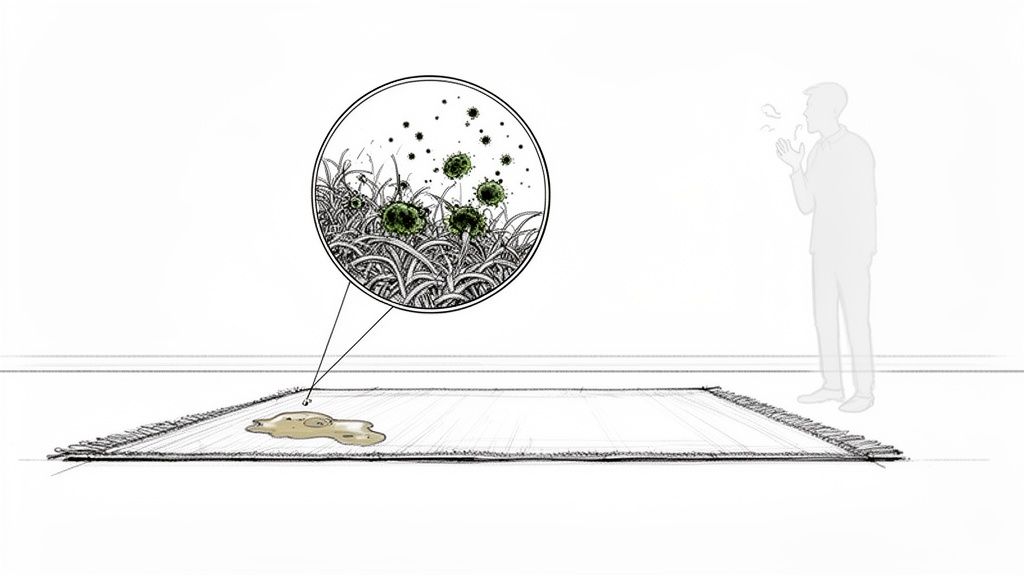
Mold is not just an unsightly stain; it is a living fungus that thrives in dark, damp places. Your area rug offers a five-star hotel for mold. Its dense weave traps moisture for days, and the dust, skin cells, and pet dander caught in the pile provide an all-you-can-eat buffet.
Mold growth happens fast. Once a spore finds a damp spot on your rug, it can start growing and spreading in as little as 24 to 48 hours.
The real problem is what you cannot see. You might spot a small, discolored patch on the surface, but underneath, the mold's root system, the mycelium, is working its way deep into the rug’s backing and foundation. This hidden infestation slowly rots the fibers from the inside out, causing permanent structural damage.
The Invisible Health Risks
Far more concerning than the damage to your rug is the impact on your health. As mold flourishes, it releases microscopic spores into the air you breathe. Inhaling them can set off a host of health issues, especially for children, the elderly, or anyone with a sensitive immune system.
Common problems linked to indoor mold exposure include:
- Allergic Reactions: Constant sneezing, a runny nose, itchy red eyes, and unexplained skin rashes.
- Respiratory Issues: Mold can aggravate asthma, trigger coughing fits, and even lead to more serious conditions like bronchitis.
- Chronic Headaches: If you are dealing with persistent headaches or migraines that have no other cause, poor indoor air quality from mold could be the culprit.
Those mold spores do not just stay in the rug. They get kicked up into the air, circulate through your HVAC system, and settle on furniture, walls, and other surfaces. A single moldy rug can quickly become a whole-house contamination problem.
Where Is the Moisture Coming From?
Pinpointing the source of moisture is the first step in protecting your rugs from mold. It could be a one-time accident or a chronic issue, but either way, it creates the perfect storm for mold to take hold. To fully understand the threat, it is worth reading about the hidden dangers of mold after water damage.
A few common scenarios are usually to blame for a moldy area rug:
- Everyday Spills: A tipped-over glass of water or a pet accident that was not dried completely can trap moisture deep in the rug's core.
- High Humidity: If you live in a humid climate or place a rug in a damp basement, it can pull moisture out of the air like a sponge.
- Hidden Leaks: A slow, sneaky drip from a window, a nearby pipe, or an AC unit can keep a corner of your rug constantly damp.
- Improper Cleaning Attempts: Trying to clean a rug at home often leaves it overly wet, creating an ideal environment for mold to thrive.
At Rubber Ducky Rugs, our specialists see the consequences of these seemingly small incidents every day. Our professional rug washing facilities across the United States, from New York to Los Angeles, are equipped to handle this exact problem. We do more than just clean the surface; we eradicate the mold from the very foundation of your rug, protecting your investment and your family’s well-being. To see just how much can be hiding in your rug's fibers, check out our article on The Hidden Life Inside Your Rug.
Why Professional Mold Removal is The Only Solution
When you first spot mold on a rug, your gut reaction might be to scrub it. This approach almost always backfires. What you are seeing on the surface is just the tip of the iceberg.
Think of it like a weed in your garden. The discolored patch you see is the flower, but underneath, the mold has grown a complex root system called mycelium. This network weaves itself deep into the rug’s backing and foundation fibers, anchoring itself tight. Simply scrubbing the top will not get rid of the roots, meaning the mold is guaranteed to come back.
Worse yet, scrubbing actually launches millions of microscopic mold spores into the air. This does not just spread the contamination to other areas of your home; it turns your air into a real health hazard.
How Professionals Actually Eliminate Mold
Our approach at Rubber Ducky Rugs is entirely different. We do not just clean the surface; we give your rug a full-immersion bath designed to eliminate mold from the inside out. It is a process that is simply impossible to replicate at home.
Here’s a look at how our controlled, specialized wash works:
- Complete Saturation: We submerge the entire rug in a custom-blended, fiber-safe cleaning solution. This is the only way to ensure the cleaning agents penetrate all the way to the foundation and reach that hidden mycelium network.
- Gentle Agitation: Specialized equipment gently massages the solution through the rug. This dislodges the mold, along with deep-seated dirt and allergens, without causing any harm to delicate fibers like wool or silk.
- Thorough Rinsing: We then flush the rug with gallons of fresh, soft water until every last trace of mold, soil, and cleaning solution is gone. This is a crucial step to prevent any residue from being left behind.
A professional immersion wash is the only method proven to remove the mold’s entire root system. Without it, regrowth is not just a possibility, it is a certainty.
The Real Cost of a Moldy Rug
Mold in your home is so much more than an ugly spot on the floor. It brings serious health risks and a surprisingly high financial toll. In the U.S. alone, the annual costs tied to dampness and mold in homes have hit a staggering $22.4 billion.
Even more concerning, an estimated 4.6 million of the 21.8 million reported asthma cases are linked directly to mold exposure in the home. Letting mold grow in a rug means your family is constantly breathing in those spores, which can easily trigger allergies, asthma attacks, and other respiratory problems. Our professional remediation is designed to protect your investment and, more importantly, your family's well-being.
Why Professional Drying Is Not Optional
The single most important step in mold remediation is the drying phase. This is where improper cleaning attempts fail. A dense rug may feel dry on top, but the core and foundation can stay damp for days. That lingering moisture is an open invitation for new mold to grow.
In our facilities, which are expanding nationwide to meet growing demand, we use climate-controlled drying rooms. We carefully manage the temperature, humidity, and airflow to pull moisture out of the rug quickly and completely. This professional drying step is absolutely essential to prevent regrowth. For a deeper dive, our guide on how to handle mildew in rugs and prevent its return offers more helpful information.
Our coast-to-coast rug cleaning expertise is available in your local area, from major cities to small towns. When you trust your rug to our specialists, you are not just getting it cleaned; you are ensuring the mold is gone for good.
How Your Rug and Home Environment Invite Mold
Ever wonder why one rug gets musty while another stays fresh? It is not just bad luck. The risk of mold comes down to a specific combination: what your rug is made of and the environment it lives in. Understanding these two factors is the first step in keeping your rugs safe and healthy.
Think about natural fibers like wool. We love them for their rich texture and durability, but their organic nature makes them a prime target for mold. Wool is incredibly absorbent, so it can lock in moisture from a simple spill or even just a humid day. That lingering dampness is exactly what mold spores need to spring to life.
It is not just the fibers, but how the rug is made that matters. A thick, dense pile feels wonderful, but it is also a perfect trap for dust, pet dander, and tiny organic bits that mold considers a feast. When moisture gets into that mix, you have got the perfect recipe for a mold problem brewing deep in the rug’s foundation, completely hidden from view.
A Rug's Material Makes a Difference
The type of fiber your rug is woven from has a massive impact on its vulnerability to mold. Our specialists see this firsthand every day, and some materials are definitely more troublesome than others.
- Natural Fibers (Wool, Cotton, Silk, Jute): These materials are organic, meaning they provide a natural food source for mold. Wool and cotton are super absorbent, while jute, a common backing material, is notorious for rotting and molding when it gets wet.
- Synthetic Fibers (Nylon, Polypropylene, Polyester): You might think you are safe with synthetics since they are essentially plastics. While the fibers themselves are not food for mold, they are experts at trapping the dust, skin cells, and dirt that mold does feed on.
The key thing to remember is that no rug is truly mold-proof. Even if the fibers are synthetic, the dirt and moisture trapped inside can easily kickstart a thriving mold colony. This is why professional deep washing is so important.
Your Home's Climate is the Other Half of the Story
Your rug's material is just one piece of the puzzle. The conditions inside your home can either shut mold down or roll out the welcome mat. Things like your local climate, your home's age, and even your HVAC system create a unique risk profile.
To give you a clearer picture, we have broken down how different factors can tip the scales for or against mold growth.
Factors Influencing Mold Risk in Area Rugs
This table summarizes the key environmental and material factors that increase or decrease the likelihood of mold growth in household rugs.
| Factor | Higher Risk Conditions | Lower Risk Conditions |
|---|---|---|
| Rug Material | Natural, absorbent fibers like wool, cotton, and jute. | Synthetic, non-absorbent fibers like nylon and polypropylene. |
| Rug Weave | Dense, high-pile, and tightly woven constructions that trap debris. | Low-pile, flatweave, or constructions with good airflow. |
| Humidity Levels | Indoor humidity consistently above 50%. | Indoor humidity maintained between 30% and 50%. |
| Airflow | Poor ventilation, rugs placed in stuffy rooms or basements. | Good air circulation from fans, open windows, or HVAC systems. |
| Home Age | Older homes, which often have higher ambient mold spore counts. | Newer construction with modern moisture barriers and ventilation. |
| Dust & Debris | High levels of household dust, pet dander, and organic soil. | A clean home environment supported by professional rug washing. |
As you can see, it is the interplay between the rug and its surroundings that truly dictates the risk.
Interestingly, research often points to the home itself as a bigger predictor of mold than the rug's material alone. One study on fungal growth found that at low dust levels, wool was more prone to mold. But in a very dusty home, a nylon rug actually supported more fungal growth because it trapped so much debris.
This is why factors like the age of your home matter—older homes often have higher baseline mold levels than newer ones. On the other hand, homes with central air conditioning tend to have fewer issues thanks to better air filtration and humidity control. You can dig deeper into the findings on carpet fungal growth to see how your home’s unique traits play a role.
This is exactly why we at Rubber Ducky Rugs do not believe in a one-size-fits-all approach. Our process always starts with a careful look at your rug's construction and its home environment. By understanding the unique dynamic between the fiber type, weave, local humidity, and airflow, we can give your rug the precise professional care it needs to stay clean and healthy for years to come.
Our Professional Process For Complete Mold Eradication
At Rubber Ducky Rugs, we have seen what mold can do to a beautiful rug, and it is not pretty. Getting rid of it for good is not a simple cleaning job; it is a science. That is why we have developed a multi-step approach that goes far beyond what any household product can achieve. Our goal is not just to remove the stain you see on the surface, but to completely neutralize the mold colony deep within your rug's foundation, making it safe and healthy again.
Our specialists, serving customers throughout the United States, start every mold remediation with a thorough, hands-on inspection. We have to know exactly what we are dealing with. Is it a resilient wool rug or a delicate antique silk? How far has the contamination spread? This initial assessment is everything—it tells us which cleaning agents and which techniques will work best to kill the mold without harming the integrity of your rug.
The Power of Deep Dusting
Before we even think about washing, we have to get the dry soil out. This is a critical step we call deep dusting. Most people do not realize that mold feeds on organic matter, and the pounds of compacted dust, dirt, and pet dander buried in a rug's foundation are an all-you-can-eat buffet for it. Our specialized equipment gently vibrates all of that hidden grit out of the rug.
You would be shocked at how much debris we can pull from a rug that looks clean on the surface. Getting rid of this "food source" immediately weakens the mold and prepares the rug for what comes next.
Full Immersion Washing: The Only True Solution
Spot-cleaning mold is ineffective because it just spreads the spores around. The only way to truly solve the problem is with a full immersion wash. We submerge your rug in a custom bath filled with a pH-balanced, fiber-safe cleaning solution that is specifically formulated to destroy mold and its root-like mycelium network.
This complete saturation guarantees that our solutions reach every single fiber, from the tips of the pile right down to the base of the weave. We use gentle, controlled agitation to work the solution through the rug, which dislodges and breaks down the entire mold colony at its source. Understanding how professionals tackle mold in different materials is key; for example, learning how to remove black mold from drywall shows that deep eradication is always more complex than surface cleaning.
This process flow shows how a rug's natural fibers can trap dust and dampness, creating the perfect conditions for mold to develop.
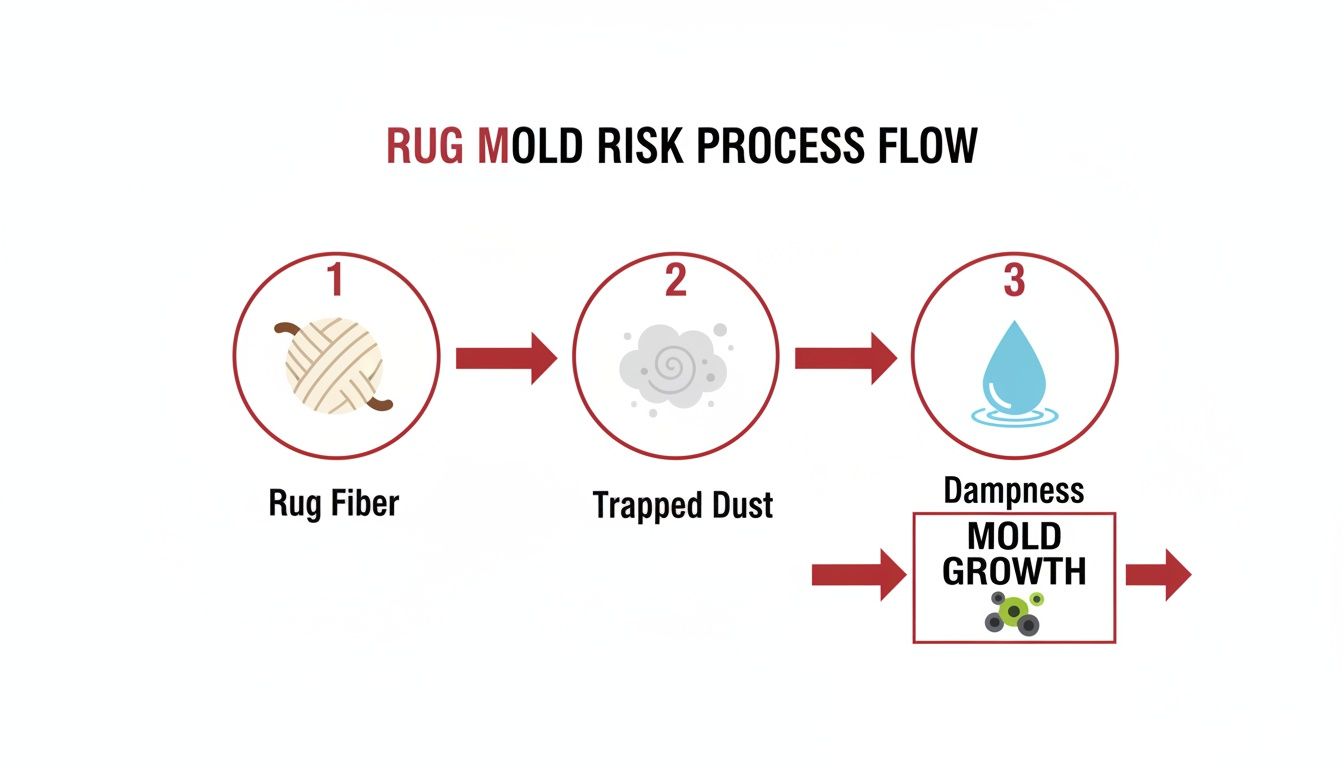
This visual really drives home why a professional approach is non-negotiable. Each stage, the fiber type, the trapped soil, and the moisture, builds on the last, creating a problem that a simple surface clean will never fix.
At Rubber Ducky Rugs, we understand that mold is not just a stain; it is a deep-seated biological problem. Our immersion washing method is the only way to guarantee we reach and neutralize every hidden spore, protecting both your rug and your family.
Controlled Drying: The Final, Critical Step
If there is one place where at-home cleaning attempts fail, it is the drying process. A rug that stays even slightly damp is an open invitation for mold to come roaring back. That is why our final step is arguably the most important.
After a thorough rinsing, we move your rug into our climate-controlled drying room. Here, we have precise control over the temperature, humidity, and airflow to safely and quickly pull every last drop of moisture from the rug’s core. This is not just air-drying; it is a managed process that ensures the rug is 100% dry, leaving no chance for regrowth.
This transparent, expert-led process is why homeowners from coast to coast trust us with their valuable rugs. We are constantly expanding nationwide to meet growing demand, with new locations opening in major cities. Our commitment to delivering consistent, reliable results that protect your rugs and your home remains the same.
Preventing Future Mold Growth In Your Valuable Rugs
The best way to deal with a mold problem is to stop it before it ever starts. When it comes to your valuable area rugs, protecting them is all about proactive care, not last-minute panic. A few smart habits and professional support can turn your home from a potential mold incubator into a safe haven for your finest textiles.
Here at Rubber Ducky Rugs, our specialists across the country always emphasize one core principle: mold only needs two things to thrive—moisture and a food source. If you can take control of those two factors, you effectively shut down the threat. This comes down to managing your home's environment and having your rugs professionally cleaned.
Mastering Your Home’s Environment
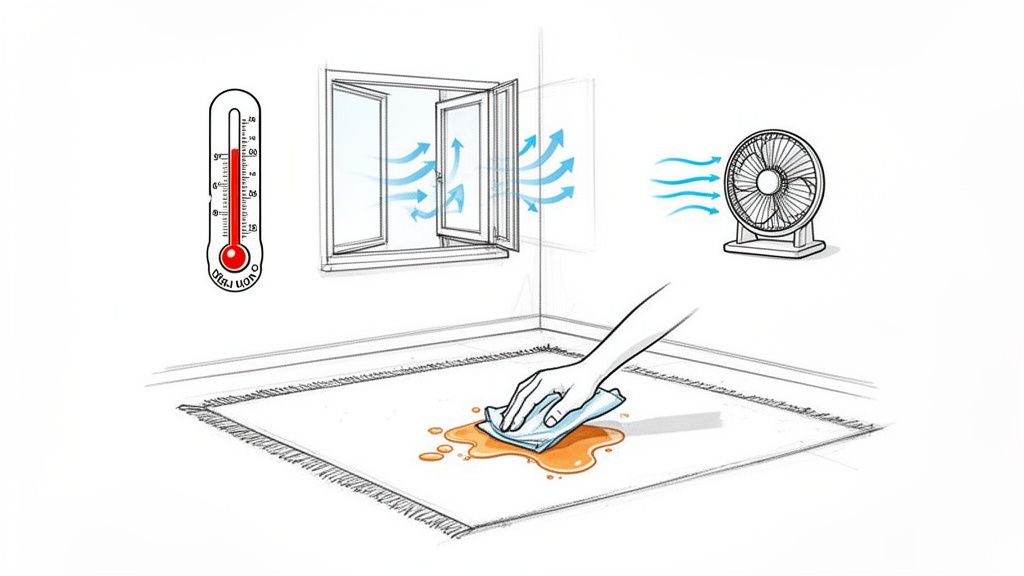
Constant moisture is, without a doubt, the number one enemy of any area rug. Under the right conditions, mold can start growing in as little as 24 to 48 hours, which makes managing humidity and spills absolutely critical. Your first line of defense is creating a healthy, dry environment.
To make your rugs inhospitable to mold, focus on these key areas:
- Keep Indoor Humidity in Check: Try to maintain your home’s humidity level somewhere between 30% and 50%. A good dehumidifier, especially in naturally damp spots like a basement, can make a world of difference.
- Get the Air Moving: Stagnant air is a moisture trap. Use ceiling fans, open windows when the weather is nice, and ensure your HVAC system is circulating air properly to stop damp pockets from forming.
- Address Spills with Professional Care: When a spill happens, it is best to contact a professional. Improperly cleaned spills can leave moisture deep in the rug's foundation, creating the perfect conditions for mold growth.
The single most important thing to remember is that moisture is the trigger. You can have dust and spores lying around, but without water, they stay harmless and dormant. Meticulous moisture control is non-negotiable if you want to preserve your rugs.
The Role of Professional Deep Cleaning
While keeping things dry is vital, that is only half the story. The second ingredient mold needs is food, which it finds in the deep-seated dust, pet dander, and other microscopic organic bits trapped in your rug's fibers. This is where routine professional maintenance becomes your secret weapon.
Scientific research backs this up. One study showed that fungal spore growth was a staggering 1,000 times higher at 100 percent humidity compared to 50 percent. That same study found that the presence of ordinary house dust increased the fungal concentration by 100 times. Considering how much dust a rug can hold, these numbers make it crystal clear why both moisture control and professional deep cleaning are so essential. You can explore more insights into these environmental factors to see the science for yourself.
Our full immersion washing process at Rubber Ducky Rugs is the ultimate hygiene reset for your rug. We do not just skim the surface; we completely flush out the pounds of embedded grime that mold uses for fuel.
By scheduling regular professional rug cleaning, you are doing three critical things:
- Starving the Mold: We get rid of the deep-down organic matter that remains after vacuuming.
- Removing Dormant Spores: Our process washes away existing mold and mildew spores before they ever get a chance to activate.
- Guaranteeing a Dry Finish: Our climate-controlled drying rooms ensure not a drop of residual moisture is left behind to invite regrowth.
This combination of smart environmental control at home and professional maintenance is the most effective strategy for protecting your rugs and your family’s health. With our coast-to-coast expertise and new locations opening in major cities, expert care is never far away. Contact Rubber Ducky Rugs today to schedule the deep cleaning your rug truly deserves.
Your Questions About Moldy Rugs, Answered
When you find mold on a prized rug, a lot of questions pop into your head. We get it. We hear these same concerns from homeowners all the time, so we have put together some straight answers based on our hands-on experience. The goal here is to help you understand the risks and steer you toward a solution that is safe for both your rug and your family.
Can a Rug with Mold Be Saved?
In most cases, yes, a rug with mold can absolutely be saved. The real question comes down to how deep the problem goes and whether the mold has structurally damaged the rug’s foundation. If we are talking about surface mold that was caught relatively early, our specialists can almost always treat it successfully.
The situation gets trickier if the rug was soaked for a long time, like after a flood. That kind of prolonged moisture can cause the backing to rot and fall apart. That is why our process always starts with a careful, hands-on inspection. We will give you an honest assessment of the rug's condition and let you know if a full restoration is a realistic option.
What Kills Mold In a Rug?
To truly kill mold and its root system, you need a professional full-immersion wash. This is not just a surface cleaning; we completely submerge the rug in a specialized, fiber-safe cleaning solution. This is the only method that can penetrate deep into the rug's weave to neutralize every last spore and the underlying mycelium (the root network).
Surface sprays or home remedies simply cannot get the job done. They might clean up the visible spots, but they will not reach the roots buried deep within the fibers, which means the mold is guaranteed to come back.
We cannot stress this enough: please do not try to remediate mold yourself. Scrubbing or even just moving a moldy rug can release millions of tiny spores into the air, creating a serious health hazard and potentially spreading the contamination to other parts of your home.
Is It Safe to Keep a Rug with Mold?
No, it is not safe to live with a rug that has active mold growth. Mold constantly sheds microscopic spores into your breathing space. For your family and pets, inhaling these spores can trigger allergies, make asthma worse, and lead to all sorts of respiratory problems.
Letting a moldy rug sit just allows the problem to fester. The contamination will only get worse, and the spores can easily find new places to grow. The only truly safe option is to have the rug professionally remediated to ensure every trace of mold is gone for good.
How Do I Know If My Rug Has Mold?
Sometimes you can see it, but often your nose will know first. Your sense of smell is one of the best tools for early detection.
Here is what to look (and smell) for:
- A Persistent Musty Odor: If your rug has that classic damp, earthy smell that just will not air out, it is a huge red flag for mold or mildew growing deep inside.
- Discoloration: Keep an eye out for strange stains or patches. Mold can show up as black, green, or even white fuzzy spots on the surface or, more commonly, on the backing of the rug.
- Dampness: If a spot on the rug always feels cool or damp to the touch, you have got a moisture issue. And where there is moisture, mold is sure to follow.
If you suspect mold, the best thing you can do is leave the area alone and avoid touching it. Getting a professional assessment is the safest and most effective way forward. As a nationwide rug care company with new locations opening in major cities, we provide local service backed by national expertise to resolve these issues safely.
Do not let mold compromise your home's health or ruin your valuable rug. The trained specialists at Rubber Ducky Rugs have the expertise and professional equipment to eradicate mold safely and completely. Call, text, or book online today for fast, reliable service. Find out more at https://rubberduckyrugs.com.