
Storing an Oriental rug requires professional expertise, not just a closet space. To ensure its preservation, the rug must first undergo a professional deep cleaning to eliminate hidden contaminants. Following this, our specialists ensure it is dried completely in a controlled environment, rolled correctly (never folded), and wrapped in a breathable, archival-quality material. Finally, it must be stored in a climate-controlled space to prevent permanent damage.
Why Professional Preparation Is Essential Before Storing Your Rug
Before you store a valuable rug, it is critical to understand the hidden dangers. Improper storage is one of the fastest ways to ruin a rug’s beauty, integrity, and value. Tucking away a rug that has not been professionally cleaned is an open invitation for pests and decay.
Invisible culprits like microscopic grit, deep-seated dust, and organic particles become a food source for moths and other insects. Over time, as the rug sits in storage, these abrasive particles grind away at the delicate wool and silk fibers, causing the pile to thin and the foundation to weaken. This is not surface dirt that can be vacuumed away; this is embedded grime that breaks down the rug from within.
The Financial Cost of Improper Storage
The stakes are high. Storing an Oriental rug incorrectly can reduce its market value by as much as 70% in just a few years. These rugs are significant assets, part of a global market expected to grow from USD 1,148 million in 2024 to USD 1,681 million by 2032.
Something as simple as humidity rising above 60% can trigger mold and mildew growth in a matter of months. This type of damage often requires expensive restoration services, if restoration is even possible.
Storing a dirty rug is like putting unwashed dishes in the cupboard. Leftover residue will attract pests and cause permanent problems. Professional cleaning by Rubber Ducky Rugs eliminates this risk entirely.
To illustrate the different outcomes, let's compare a homeowner's attempt with our professional approach.
Improper vs. Professional Storage Preparation
| Risk Factor | Unprepared Storage (High Risk) | Professional Prep by Rubber Ducky Rugs (Low Risk) |
|---|---|---|
| Pest Infestation | Hidden eggs & larvae in fibers hatch in storage. Moths and beetles feast on wool and silk, causing holes. | Our multi-step cleaning process flushes out all contaminants, eggs, and larvae, eliminating the food source for pests. |
| Mold & Mildew | Trapped moisture from humidity or improper cleaning leads to rot, foul odors, and fiber decay. | Rugs are dried in a controlled environment, ensuring 0% residual moisture before wrapping. |
| Fiber Abrasion | Embedded sand and grit grind down the rug's foundation while it is rolled up, causing permanent thinning. | Our specialized process gently removes all deep-seated abrasive particles, preserving the rug's structural integrity. |
| Color Bleeding | Unstable dyes can run when exposed to moisture, staining adjacent areas of the rug. | We test for colorfastness and use pH-balanced solutions to ensure vibrant, stable colors. |
The difference is clear. An upfront investment in professional preparation prevents a massive loss down the road.
Protecting Your Investment with Expert Care
At Rubber Ducky Rugs, our specialists across the United States frequently see the unfortunate results of poor storage preparation. Our entire process is designed to neutralize these threats before they begin.
We focus on two critical steps:
- Deep Contaminant Removal: Our professional rug washing service does more than clean the surface. It flushes out hidden grit, dust mites, and organic residues that moths and other pests find appealing.
- Controlled Drying: We ensure every fiber is perfectly dry in our climate-controlled drying rooms. This is the only way to guarantee that mold and mildew will not gain a foothold and destroy the rug from the inside out.
This is more than a simple cleaning; it is the essential first step in protecting your investment. Our expert approach to professional Oriental rug cleaning ensures your rug is safe from hidden threats, its structure is sound, and its colors remain brilliant for generations.
The Professional Rolling Technique: A Critical Step
Our specialists see beautiful rugs damaged by one simple, avoidable mistake: folding. Folding creates hard creases that can permanently crack a rug’s foundation. Over time, these stress points cause delicate pile fibers to snap, leaving behind irreparable lines of damage.
The only method our trained professionals ever use is rolling. This technique distributes the rug's weight evenly and protects the entire structure from stress, ensuring its longevity whether you are in New York or Los Angeles.
Pile Direction and the Professional Roll
How a rug is rolled is just as important as the act of rolling itself. Our specialists always roll the rug with its soft pile facing inward. This creates a protective cocoon for the delicate fibers, shielding them from dust, pressure, and abrasion during storage.
For expert-level protection, we roll the rug against the natural direction of the pile. To find the direction, our technicians run a hand across the surface. One way feels smooth, while the other feels resistant. Rolling against the smooth grain helps the fibers nestle together snugly and prevents them from being crushed flat.
A properly rolled rug is its own best defense. By turning the pile inward, our team creates a natural cushion that safeguards the intricate knots and vibrant dyes from the outside world.
At Rubber Ducky Rugs, we handle this process with meticulous care. For particularly large or fragile rugs, we often use a supportive, acid-free cardboard tube as a core. This prevents the roll from sagging or becoming too tight, which keeps the rug's structure perfectly intact, even during long-term storage.
This graphic shows the journey a rug takes from being dirty and at risk to being professionally cleaned and ready for safe storage.
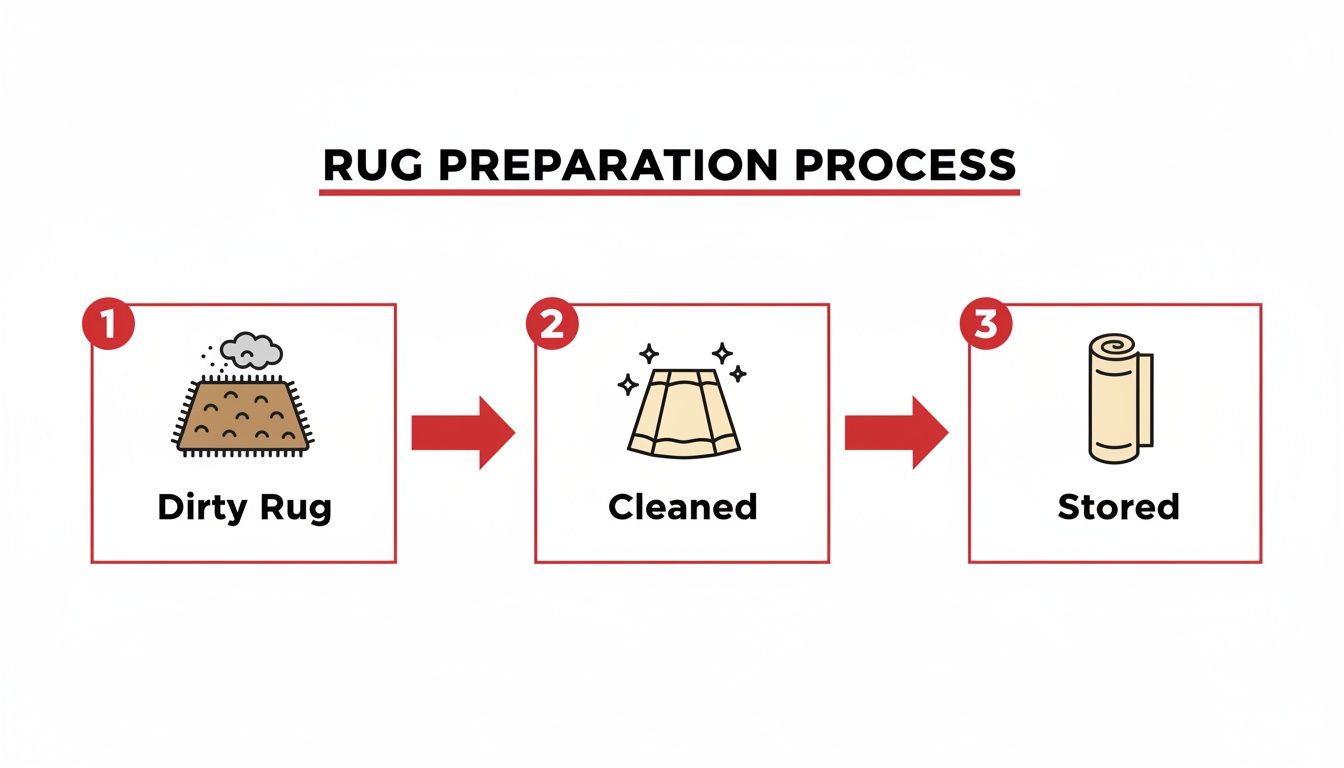
Seeing the rug transition from a contaminated state to a pristine, properly stored piece highlights why this expert preparation is so crucial for preserving its life and value.
This is the standard process we follow across our entire network of locations. As we continue opening new service centers in more cities, our commitment to these time-tested preservation methods remains the cornerstone of our service.
Choosing the Right Wrapping Materials for Protection
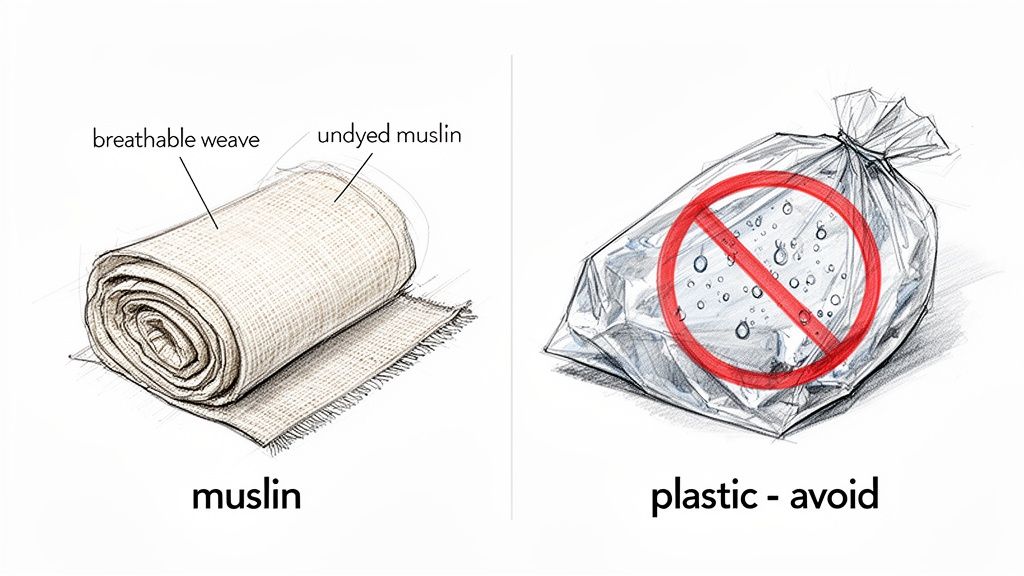
The material used to wrap your Oriental rug is just as critical as the professional cleaning and rolling. A common mistake is wrapping a beautiful rug in standard plastic sheeting. These non-breathable materials are the worst choice for natural fibers like wool and silk.
Plastic traps ambient moisture against the rug's fibers, creating a humid, stagnant environment. This is a perfect breeding ground for mildew, which leads to permanent stains, odors, and fiber decay. It can also cause dry rot, a condition that breaks down the rug’s foundation until it becomes brittle and falls apart.
Why Your Rug Needs to Breathe
Natural fibers are organic and require air circulation to remain stable. Proper airflow wicks away residual moisture and prevents damaging condensation from forming. The purpose of wrapping is to shield the rug from dust, light, and pests, not to suffocate it.
The ideal wrapping material must be both protective and porous. The right choice allows air to move freely while keeping contaminants out. This balance is what keeps the rug's fibers stable and safe, whether it is stored for a few months or several years.
Never wrap an Oriental rug in plastic for long-term storage. You are essentially sealing it in a damp environment, creating ideal conditions for mold and dry rot that can destroy your rug.
At Rubber Ducky Rugs, our teams, from Philadelphia to San Diego, are trained in textile preservation. We are uncompromising in our choice of materials and only use wrappings that meet archival standards, ensuring your rug is protected without risk.
Professional-Grade Materials We Trust
When our specialists prepare a rug for storage, they turn to specific materials proven to preserve valuable textiles. These options provide necessary protection while allowing for essential airflow.
- Undyed Cotton Muslin or Canvas: These are the gold standard for rug preservation. As natural fabrics, they are highly breathable and durable. They form a tough barrier against dust but allow the rug’s fibers to adjust to ambient air without trapping moisture. We always use undyed cloth to eliminate any risk of color transfer.
- Archival-Quality Acid-Free Paper: This specialized material, often called kraft paper, is chemically stable and will not yellow or transfer damaging acids to the rug over time. It offers excellent protection from light and pests while remaining porous enough to breathe.
Using these professional-grade materials is a core part of our commitment to quality. It is one of the details our nationwide network of specialists gets right every time, ensuring any rug we handle is ready for safe, long-term storage.
Finding an Ideal Environment for Rug Storage
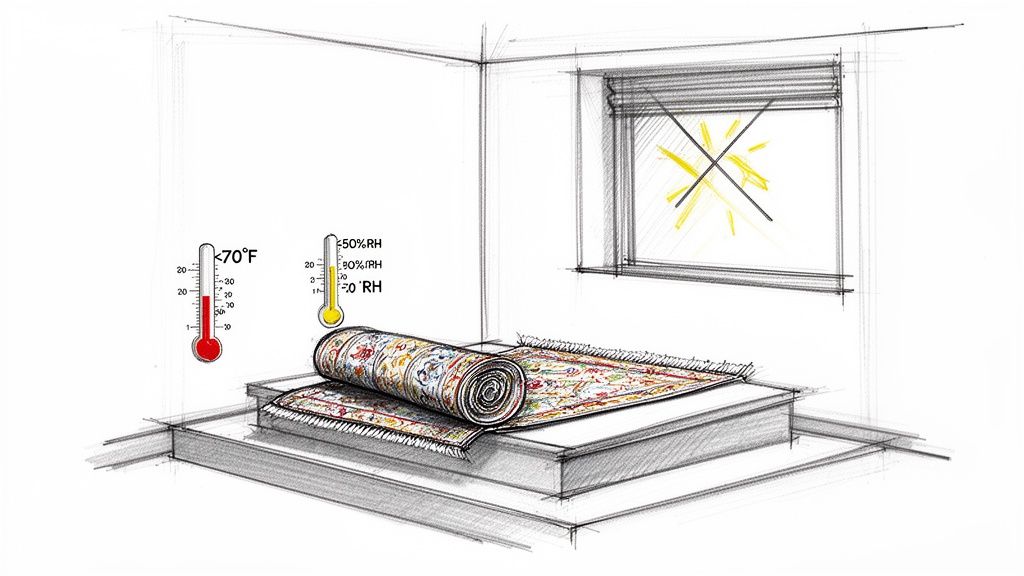
The location chosen for storing your rug will determine its survival. Many beautiful rugs are ruined by being stored in the most convenient but worst possible places: attics, basements, and garages. These areas are known for extreme temperature swings and moisture problems.
A summer heatwave can turn an attic into an oven, while a damp basement after a storm becomes a breeding ground for mold. These constant fluctuations force a rug's delicate fibers to expand and contract, weakening them over time and causing permanent damage.
The Four Pillars of a Safe Storage Space
To protect your rug, the storage location must be stable. The ideal environment is climate-controlled, meaning it stays consistently cool, dry, dark, and well-ventilated. Achieving these four elements is the secret to protecting the rug's foundation, pile, and vibrant colors.
Whether we are advising clients in humid Miami or damp Seattle, our goal is always the same: find a space that actively prevents fiber degradation.
- Cool: The temperature should remain stable and ideally below 70°F. Heat accelerates the aging process in natural fibers, making them brittle.
- Dry: Relative humidity must be maintained under 50%. Higher levels are an open invitation for mildew, which can stain and rot the rug. Our guide on professional rug mildew removal explains how our experts tackle this issue.
- Dark: Sunlight, both direct and indirect, is a rug’s enemy. UV rays trigger a chemical reaction that breaks down dyes, causing irreversible fading and discoloration.
Proper Placement Within the Ideal Environment
Once an appropriate room or climate-controlled unit is secured, the final step is positioning the rug. A major mistake is standing the rolled rug on its end. Over time, gravity will compress the fibers and warp the foundation, causing the rug to lose its shape.
The only correct way to store a rug is to lay it flat. This simple step distributes its weight evenly, preventing stress on the foundation and pile.
For an extra layer of security, our specialists recommend placing the rolled and wrapped rug on a raised platform or clean wooden blocks. This elevates it off the floor, protecting it from potential water damage and allowing air to circulate underneath. It is a standard practice we use to give every rug professional-grade protection.
The Annual Inspection for Long-Term Storage
Storing a valuable rug is not a one-time event, especially for periods longer than a few months. It requires occasional attention to remain in top condition.
Overlooking this simple step is a common mistake. Even a professionally cleaned and wrapped rug can fall victim to pests or a change in humidity.
At Rubber Ducky Rugs, our specialists recommend a simple rule: unroll and inspect stored rugs at least once a year. This yearly check-up is the best defense against slow-moving problems that can cause serious, irreversible damage.
What Our Specialists Look For During an Inspection
When the rug is unrolled for its annual airing, a thorough once-over of the front and back is necessary. This is a detective process, looking for subtle clues that something is wrong.
Here is the professional checklist:
- Pest Activity: Look closely for telltale signs of moths or other insects. This includes tiny, grain-of-rice-sized larval casings, fine webbing, or the small larvae themselves. Early detection is critical.
- Dampness or Odors: A musty smell is a major red flag that moisture has penetrated the storage space. Discolored spots could indicate the start of mildew.
- Pile Compression: Run a hand across the surface. The fibers should feel soft and springy. The act of unrolling the rug annually allows the wool or silk fibers to breathe, preventing them from becoming permanently crushed.
An annual inspection is the single most important action for protecting a rug in long-term storage. It is the difference between catching a small problem and discovering a major disaster requiring costly restoration.
This proactive care helps maintain the rug’s texture and structural integrity, ensuring it remains beautiful for the next generation to enjoy.
The First Step: Partner with a Rug Care Specialist
Safely storing a beautiful Oriental rug is a process that begins long before it is rolled up. The most important step is a professional deep cleaning.
Storing a rug without a proper wash is like putting away fine clothes without laundering them. You trap invisible grit, oils, and microscopic contaminants that act as an invitation for moths, mildew, and fiber rot. Over time, this causes irreversible damage.
At Rubber Ducky Rugs, we are preservationists first. We know the secret to long-term storage is not the wrapping or the location, it is the preparation. Our deep, restorative wash is specifically designed to protect your investment, ensuring it comes out of storage looking as beautiful as it went in.
Local Experts, Nationwide Reach
We are expanding our national footprint, with new locations opening in major cities to ensure our expertise is always close by. Serving customers throughout the United States, our local specialists provide every rug with the same high level of care. They handle the meticulous cleaning and ensure it is dried completely in a controlled environment before it is prepared for storage.
Storing a rug without removing deep-seated dirt essentially seals in the agents of its own destruction. It is the most common and costly mistake a rug owner can make.
No matter where you are, our coast-to-coast rug cleaning expertise is available to help. You can find our professional rug cleaning services near you.
Do not leave the future of your rug to chance. Give your investment the protection it deserves by starting with a professionally cleaned foundation. Reach out to the Rubber Ducky Rugs team today, and let our specialists help you preserve the beauty and integrity of your rug for years to come.
Questions About Storing Your Oriental Rug? We Have Answers.
Our experts have heard every question about storing Oriental and other fine rugs. Here are the most common ones, with straight answers explaining why professional handling is so important.
Should I Use Mothballs to Protect My Rug?
Absolutely not. Mothballs are packed with harsh chemicals that create a noxious odor that can permanently embed itself deep into natural wool or silk fibers. Once the odor is in, it is nearly impossible to remove.
The effective way to prevent pests is to eliminate their food source. A thorough, professional deep cleaning, like the one performed at Rubber Ducky Rugs, flushes out any hidden moth larvae and their eggs. By removing the microscopic dirt, skin cells, and other organic matter they feed on, our process makes your rug an undesirable home for pests.
How Long Can a Rug Stay in Storage?
With professional preparation and a proper environment, a rug can be stored safely for years, even decades. The two non-negotiables are a professional cleaning beforehand and a stable, climate-controlled environment.
For long-term storage, it is essential to check on the rug. We recommend unrolling your rug at least once a year. This allows you to inspect it for any signs of trouble and allows the fibers to breathe. This simple annual ritual helps prevent the pile from becoming permanently crushed and keeps the rug in top condition.
Is a Public Storage Unit a Good Idea?
A public storage unit can be a safe option, but only if it is a climate-controlled unit. A standard, non-climate-controlled unit is no better than an attic or basement. It will expose your rug to extreme swings in temperature and humidity, which is a recipe for disaster.
These fluctuations create the perfect environment for mildew growth and can cause the rug’s foundation to rot. Before renting a unit, get a guarantee from the facility that it maintains a consistent, cool, and dry atmosphere year-round. For a valuable textile like an Oriental rug, this is not a negotiable feature.
Ready to make sure your rug is stored the right way? Trust the nationwide experts at Rubber Ducky Rugs to give your investment the professional cleaning and preparation it needs. Call, text, or book our services online today.