

You've moved the sofa to clean underneath, and the hand knotted rug blue field under it looks a different color from the part in front of the window. Before you reach for a spot cleaner or rent a machine, stop. That difference could be embedded soil, sun fading, dye bleed, or normal variation, and each one needs a different response.
For Birmingham homeowners, the safest sequence is simple. Confirm the construction first, read the blue correctly, test the dye in a hidden spot, and only then decide whether any water should touch the rug. I would start with the five minute check below, because the wrong cleaning method on a true hand-knotted piece can create damage that no wash can undo.
Confirming a Blue Rug Is Truly Hand Knotted
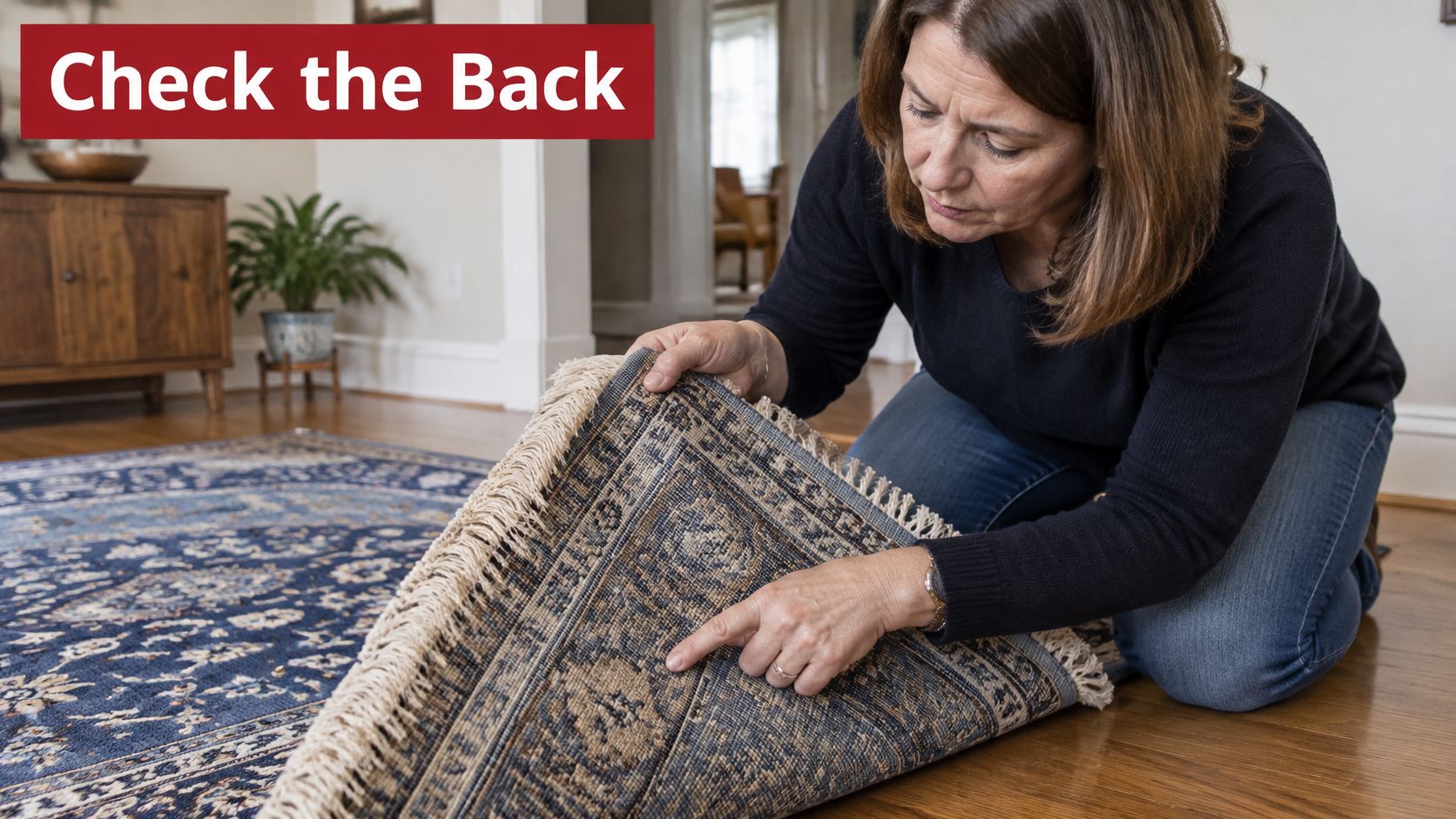
Birmingham owners can settle construction in about five minutes, before asking any question about color. Turn a corner over onto a clean hardwood or tile floor. The back tells you more than the front, and it tells you whether you're handling individually tied knots or yarn held in place by glue or machine weaving.
| Check | Hand-knotted | Hand-tufted | Machine-made |
|---|---|---|---|
| Back of the rug | Individual knot ends visible, pattern slightly soft | Latex or adhesive coating, stitch rows visible | Uniform woven or printed backing |
| Fringe | Warp threads continue into the fringe | Sewn or glued onto a separate backing | Stitched or printed on separately |
| Pattern edges | Slight wobble and small irregularities | Clean but stitched-looking lines | Perfectly regular repeats |
| Blue field | Tonal shifts across the field (abrash) | Flat, even tone | Uniform, machine-dyed tone |
| Weight and flexibility | Heavier, flexes along knot rows | Lighter, stiffer backing | Light to medium, rolls stiffly by backing type |
The Fringe and Pattern Tests
Pull gently at the fringe base. On a true hand-knotted rug, the warp threads run through the rug body and continue into the fringe, so there's no seam to find. On tufted and machine-made rugs, you'll usually see stitching or a glued edge where someone added the fringe as decoration.
Then look across the blue field for repetition. Hand work wobbles slightly. Motifs shift a fraction, lines aren't perfectly identical, and the blue itself may change tone in bands. Perfectly identical repeats, row after row, point to machine production.
Counting Knots
Use a ruler and a phone magnifier on the back. Count knots along one inch horizontally and one inch vertically in a dense area, then multiply if you want a rough knots per square inch figure to compare with a seller's listing. You're not appraising value here. You're checking whether the structure you see matches what's claimed.
Practical rule: If two or more checks point to hand knotting, treat the blue as hand-woven work and test the dye before any wet cleaning.
For a valuable or inherited piece, ask a dealer or appraiser to confirm construction in writing. That note matters for insurance, resale, and any later restoration decision.
Where Rug Blues Come From and What They Reveal
Traditional Persian blues often come from indigo, but a rug's shade alone does not reveal its age or quality. Encyclopaedia Iranica records that indigo was made from the fermented leaves of the plant Indigofera tinctoria. The yarn was dyed in a vat and developed its characteristic blue only after exposure to air. Persian carpet makers used several names for blue, including nil, rang-e kermani, and rang-e wasma.
Dyeing determined the depth of the colour. Repeated dyeing could produce deep navy, while lighter concentrations created medium or pale blue. A pale rug is not automatically faded, and a dark rug is not automatically older or better.
Supply also influenced production. Over time, indigo cultivation in Persia declined, and imported indigo, largely from India, became an important source for later production. Trade connected the use of blue across Persian, Central Asian, and other weaving traditions.
Later rugs often use synthetic blues, which may look more even across a field. Their lightfastness can differ from indigo. Ask the seller about the dye history if it is known. If it is not, record it as unknown and test the dye before cleaning rather than guessing.
Regional colour habits can offer context. Very dark blues are associated with some weaving areas, medium blues with others, and lighter blues with others again. Treat these patterns as clues, not as a label or proof of origin.
Before anything gets wet, photograph the blue field in daylight, including any gentle tonal shifts. These shifts, often called abrash, usually reflect hand dyeing and different dye lots rather than damage. Keep the photographs as a baseline for comparing any later changes.
Telling Dirt, Sun Fading and Dye Bleed Apart
Owners often lump four different conditions into one complaint, that the blue looks wrong. Dirt dulls. Sunlight fades. Bleed migrates. Wear thins. If you treat fading as dirt, you'll scrub a rug that can't get its color back. If you treat bleed as dirt, you'll spread it.
Start with the most common confusion, soil versus fading. Embedded dry soil gives the pile an even, grey dullness, heaviest in traffic lanes and lighter under furniture. It often improves after proper dust removal and washing because you're removing what sits on the fiber, not repairing the dye itself.
Sun fading looks different. You'll see a sharply defined pale area that lines up with a window edge, a sofa line, or the border of a pad or coffee table. Compare that area with the back of the rug or a section that's stayed covered. If the covered blue is richer and the exposed blue has a hard edge, light has chemically degraded the dye. Cleaning won't reverse that.
| Symptom | Likely cause | First check | Realistic fix |
|---|---|---|---|
| Uniform grey dullness across the pile | Embedded dry soil | Vacuum, then compare a small cleaned test patch | Professional washing removes soil and can restore apparent colour |
| Sharp pale patch aligned with a window | UV fading | Compare with the shaded underside or back | Limit light; cleaning cannot restore chemically faded dye |
| Blue marks or halos after dampness | Dye bleed or migration | Repeat the cloth transfer test | Stop wet cleaning and seek a textile conservator |
| Thin or flattened spots in high traffic | Pile abrasion | Feel for flattened pile in the worn area | Repair or reweave; not a dye issue |
| Gradual tonal shifts with no hard edge | Natural abrash | Check the same tones on the back | Normal character; no treatment needed |
Dye bleed announces itself as color in the wrong place. Look for blue halos around a motif, blue smudging into ivory, or a tint on a pad or floor after dampness. That usually follows moisture, a pet accident left to sit, or an unsuitable cleaner.
Pile abrasion is structural. Run your palm against the pile direction in a doorway or in front of a chair. Thin, flat, scratchy spots mean fiber is gone or crushed, not that blue dye has left.
Careful color restoration can improve some faded hand-knotted rugs, but only after a professional assesses dye stability and fiber condition. Don't blame sunlight for every change, and don't expect a wash to fix every pale patch.
How to Test Blue Dye Before Any Cleaning
A hand-knotted rug is a three dimensional structure. Individual knots tied around warp threads trap fine grit between pile rows and at the foundation, and water moves through that structure in ways a flat fabric doesn't. Test first, or you won't know whether moisture will move blue dye with it.
For valuable or uncertain pieces, the U.S. National Park Service textile guidance recommends professional textile treatment and testing dyes and finishes before wet cleaning, because moisture and chemistry can cause bleeding, tideline formation, dimensional change, or damage to weakened fibers. Document fiber type, knot and foundation condition, pile wear, fringe stability, and color-transfer behavior in concealed areas before any aqueous process.
The Six Step Cloth Test
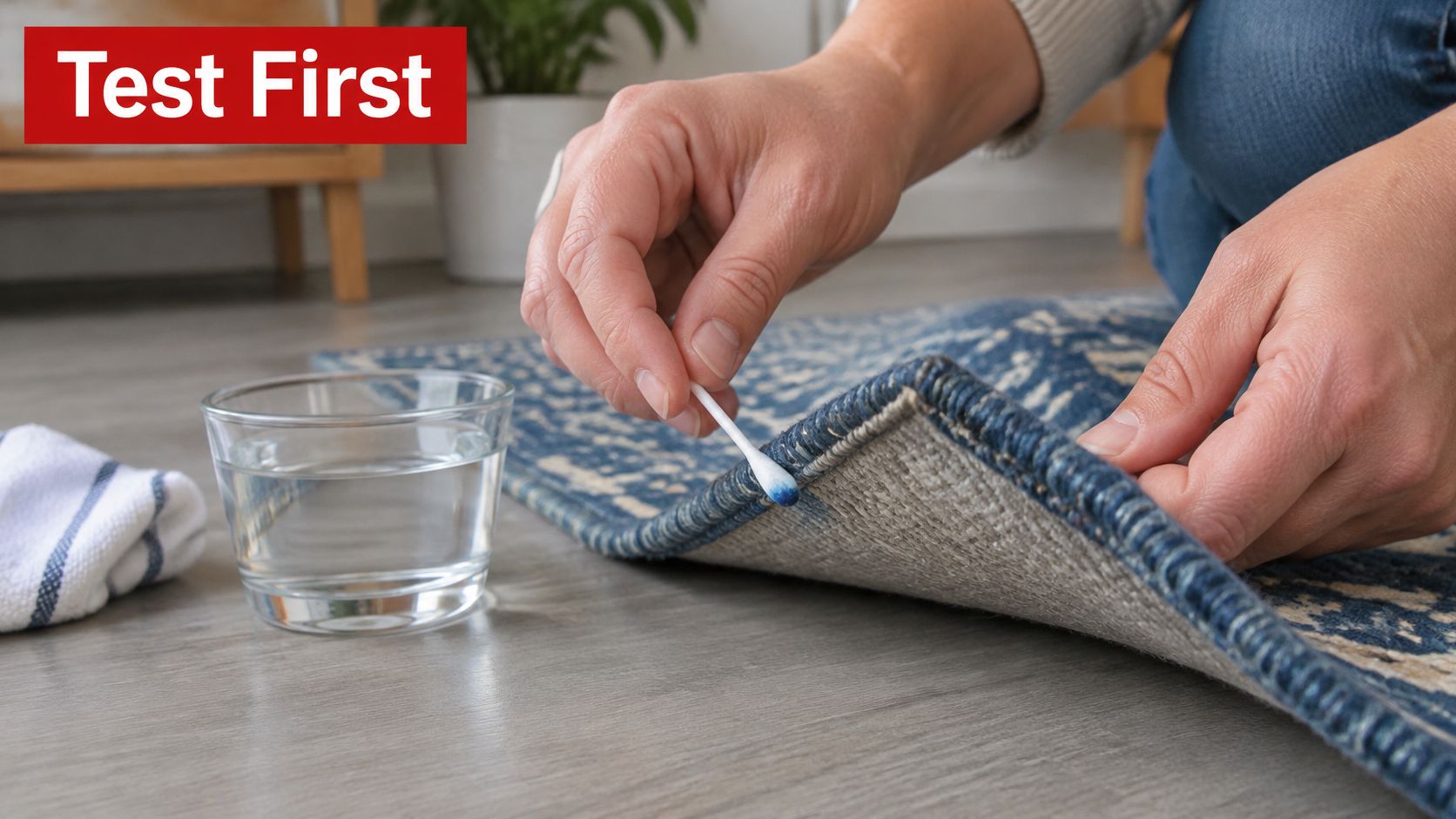
- Choose a concealed spot: Pick an area under a sofa edge, near fringe, or on the back of the pile, and photograph it in daylight. You need a record of the blue before you touch it.
- Blot dry first: Press a dry white cotton cloth firmly into the pile and check for blue transfer. Dry transfer alone is a warning sign.
- Press with distilled water: Dampen a second white cloth, press for about 30 seconds, and lift straight up. Check the cloth, don't rub, because rubbing adds friction that confuses the result.
- Add mild solution only if clean: If step 3 shows no color, repeat with a tiny amount of pH-neutral test solution. Press, wait, and lift.
- Let it dry and inspect the edge: Allow the spot to dry fully, then look for a halo or tideline where moisture stopped. A ring means dissolved material moved and redeposited.
- Stop on any warning: Stop if you see transfer or a halo, if the foundation feels brittle, or if prior water damage has weakened the rug. Postpone cleaning and get professional evaluation.
Use plain white cotton, not a printed towel or microfiber that can hide faint blue. Test every distinct blue in the rug, plus any red border, because one stable color doesn't prove the others are stable. A fuller walkthrough of dye testing before washing is worth reading before you test an antique or silk piece.
Any blue on the cloth means stop. It doesn't mean try a stronger product or less water.
Safe Cleaning Choices for Blue Wool and Silk
Damage can start when someone grabs a strong kitchen cleaner, scrubs hard, and drives both stain and product deep into a rug's knots. On wool and silk, the wrong chemistry can harm the fibres and disturb the blue dye. Before choosing a treatment, identify the stain and check how the rug is constructed.
The University of Georgia textile care guidance warns that ammonia can weaken and sometimes destroy silk and wool fibers. It also explains that alkaline substances may alter color, cause fading or bleeding, and damage wool. Blot rather than rub, and keep aggressive household cleaners off a blue field.
| Stain | Safe first step | Avoid |
|---|---|---|
| Pet urine | Blot gently with a dry white cloth, then call a specialist for odour | Ammonia and strong alkaline cleaners |
| Red wine | Blot with a dry cloth and call a specialist if the stain sets | Scrubbing and hot water |
| Food oil | Blot the excess and leave the rest for professional assessment | Alkaline detergents and rubbing |
| Leak water | Blot and start drying within 24 to 48 hours | Leaving the rug damp on the floor |
Pet urine needs particular care. Surface cleaning may lighten the visible spot but leave salts and odour deep in the foundation. Those residues can draw the animal back to the same area. Professional odour removal must reach the rug's full thickness, then rinse clean, or the smell may return on humid Birmingham days.
What a Professional Sequence Looks Like
- Identify fiber and dye: Check wool, silk, the cotton foundation, and each colour separately. A silk highlight in a wool rug changes which products are safe. Advice on handling a hand woven silk rug explains why its fibres need specific care.
- Match stain chemistry: Protein, oil, tannin, and dye stains need different treatments. Applying a product without identifying the stain can set it permanently.
- Control moisture and rinse: Use enough solution to release soil without keeping the foundation wet longer than needed. Extract and rinse thoroughly so residue does not attract more dirt.
- Dry and verify: Dry the rug in a controlled space and check it before returning it to the floor. A rug put back damp can develop odour, mildew, and dye migration.
The same careful handling applies to other fine natural fibres. If you are familiar with caring for cashmere clothing and accessories, the principle is similar: gentle handling, mild products, and no harsh alkaline soaking. Wool and silk pile both need that restraint.
Call a specialist for a large, set, or oily stain, or one sitting in a dye-sensitive blue area. Cleaning can reduce soil and stains, but it cannot restore colour already lost to fading or safely correct every dye problem. Stop rather than experiment on a hand-knotted rug you cannot replace.
Protecting Blue From Light, Dust and Humidity
A blue rug can look clean while sunlight changes its colour. Natural dyes and many early synthetic dyes can fade or shift under visible and ultraviolet light, according to conservation guidance on textile compensation. Even at 50 lux with ultraviolet filtered out, highly light-sensitive colours may fade within a few years of continuous display. Dye lightfastness is rated on the Blue Scale, and conservation-grade replacement dyes are generally selected at ratings of 5–6 or higher.
Keep the rug out of direct sun where possible. Use sheers, blinds or UV-filtering glazing at the sunniest windows, especially if a saturated navy field would sit in a hard stripe of light. Uneven exposure can show as paneling or gradients across the pile. Window treatments protect the rug itself; the room's colour scheme does not.
Rotate the rug periodically to spread light exposure and foot traffic across different areas. Rotation cannot restore colour already lost, but it helps limit uneven future fading and wear. Photograph the edges before rotating, then compare them with your baseline images for early signs of change.
Dust, Allergens and Humidity
Dust, pollen and fine grit settle between knots, where walking can grind particles against the foundation. Vacuum with suction only, without a beater bar, and keep the vacuum away from the fringe. Give busy living rooms more frequent attention than quiet bedrooms.
Wool does not make a rug allergy-safe. Regular removal of accumulated particles helps reduce what walking, pets and vacuuming stir back into the room. If the pile still feels gritty or looks dull after routine vacuuming, surface cleaning may not reach the soil held between the knots.
Keep indoor humidity moderate, and use a breathable rug pad that does not trap moisture against wood floors. Dampness beneath a rug can encourage odour and biological growth, and may cause unstable blue dye to move. Stop if you notice dampness or colour transfer rather than adding cleaning solution.
In a bright room, choose softer palettes for walls and textiles, but still protect the rug with a suitable window treatment. You can find coastal palettes for your home for decorating inspiration; palette choices do not prevent fading.
Follow a simple care rhythm: vacuum routinely, rotate every few months, and check for pale edges. If odour, dullness or gritty pile persists despite vacuuming, arrange professional cleaning. Cleaning can remove soil, but it cannot replace colour lost to light.
Styling Blue Hand Knotted Rugs in Your Rooms
Shade decides how a blue rug behaves in a room. Deep navy anchors. Pale blue softens. If you choose furniture and paint without reading that shade first, you'll fight the rug instead of letting it lead.
| Blue shade | Pairs well with | Watch for |
|---|---|---|
| Deep navy | Warm ivory walls, oak floors, brass or cream textiles | Can visually shrink a small room; balance with lighter furniture |
| Medium indigo | Grey-greige sofas, terracotta or rust accents | Clashes with cool blue-grey paint; test a swatch first |
| Pale blue | White oak, linen, soft pink or sage accents | Gets lost under bright light; sun exposure shows fading sooner |
| Multi-blue with red border | Neutral rooms that let the pattern lead | Overwhelms busy patterned upholstery and curtains |
A dark saturated blue works best against warm neutrals, where it reads rich instead of cold. Pale blue needs enough surrounding contrast to show its pattern. In a white room with pale floors, a washed out blue can disappear by noon.
Placement Rules That Protect the Rug
- Seat furniture properly: Front legs of sofas and chairs should sit on the rug, or the rug should extend well beyond the seating group. A floating rug that's too small makes even a fine piece look like a mat, so check Miller Waldrop's area rug measuring guide before you move heavy furniture onto it.
- Avoid the sun path: Don't center a valuable blue field in the direct track of a large south or west window. Shift it, rotate it, or shade the window.
- Let one pattern lead: A multi-blue rug with a red border can carry a room when upholstery stays quiet. Add busy curtains and a patterned sofa, and nothing reads clearly.
Test paint and fabric swatches against the rug in both daylight and lamplight. Blue shifts under warm bulbs, sometimes toward green, sometimes toward grey. Check at night, when you'll live with it.
A valuable blue rug deserves placement that shows it off without punishing it. Keep the highest traffic lane off the most worn area, keep hard sun off the richest field, and let the shade set the palette.
Book a Birmingham Professional Assessment for Your Blue Rug
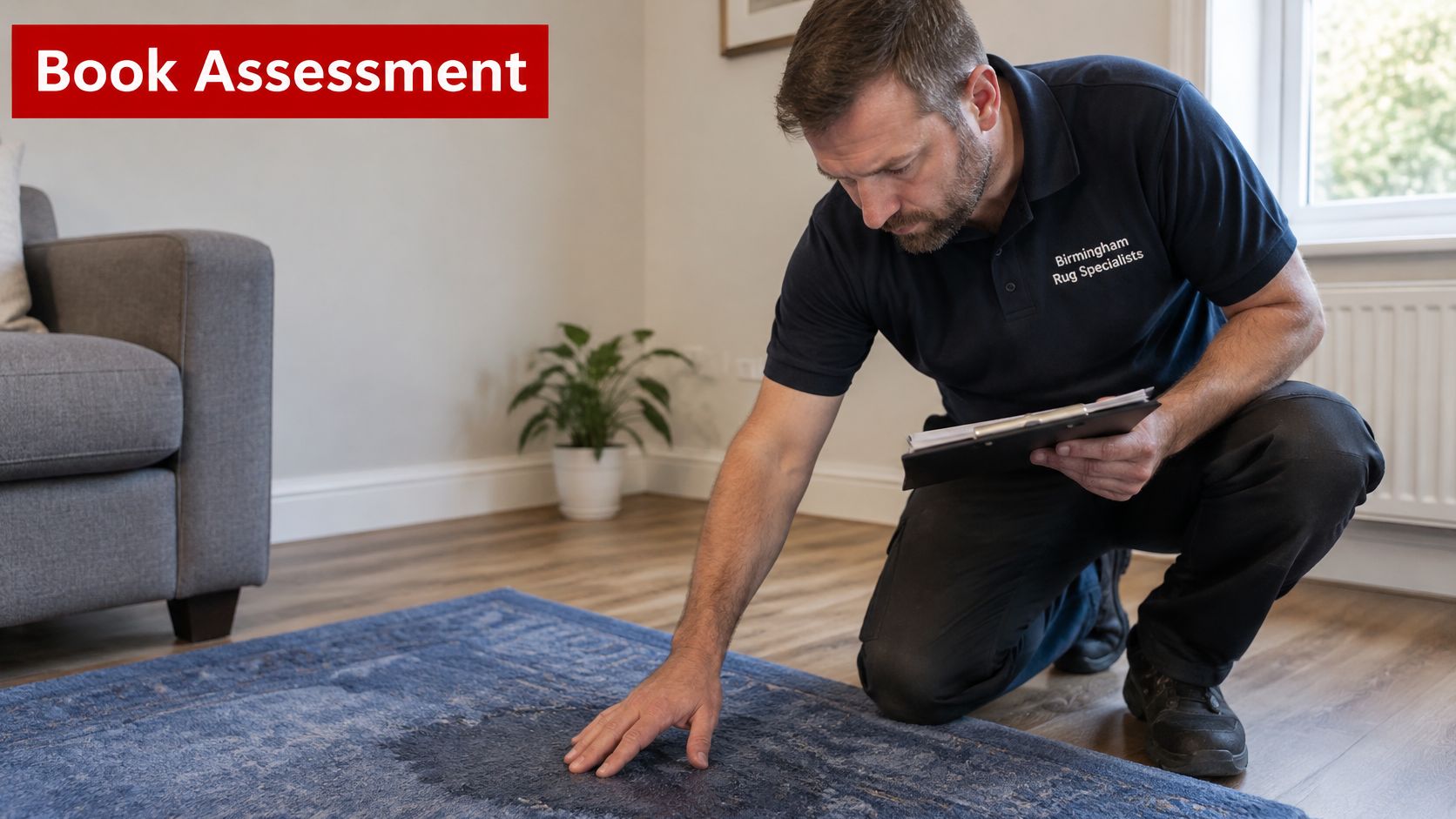
Stop cleaning and arrange a professional assessment if a dye test transfers color, or you see halos, sharp-edged fading, a set stain, persistent odor, or a rug that is drying unevenly. These signs can point to dye movement, light damage, contamination, or moisture held in the foundation. Another DIY product may spread the stain or complicate later treatment.
For a rug wet after a leak, follow the U.S. Environmental Protection Agency guidance on biological contaminants: dry wet materials as soon as possible, ideally within 24–48 hours, and keep indoor relative humidity below 60%, with an ideal range of 30–50%. Don't leave a soaked hand-knotted rug flat on the floor. Its foundation can stay damp after the surface feels dry, allowing odor, mold, and dye movement to become concerns.
What Pickup and Return Includes
Rubber Ducky Rug Cleaning Birmingham offers flexible pickup and delivery for Birmingham-area homes. The rug is inspected, dusted to release embedded soil, washed with methods suited to its fibers and dyes, rinsed, and dried in a controlled space. Grooming helps restore the pile. Delivery brings the cleaned rug back to you, without a promise of placement in a particular room.
This facility process differs from cleaning a fitted carpet. Hand-knotted rugs need dust removal from the foundation, careful washing and rinsing, and controlled drying. For a clearer comparison, read about a professional carpet cleaning service and how carpet cleaning differs from care for a loose rug.
Prepare Before You Call
- Fiber, if known: Note wool, silk, cotton, or unknown. Uncertainty helps the cleaner choose a cautious approach.
- Photos: Send daylight views of the full blue field, back, fringe, and any stains or pale patches.
- Stain history: Describe each stain, roughly when it occurred, and anything already applied.
- Prior care: Mention previous washing, repairs, pet treatments, or water damage.
Choose the next step based on the rug's condition. Ask about pickup for a full wash, request an estimate using photos and dimensions, or arrange an assessment for a valuable, faded, or damaged piece. A fresh spill and a recently wet rug leave more treatment options than a stain or damp foundation left unattended.
If you see dye transfer, halos, odor, or a spill that may worsen with more water, contact Rubber Ducky Rug Cleaning Birmingham before applying another cleaner. Share photos and dimensions to request an estimate or discuss pickup. The rug can be inspected before further water or cleaning products reach the blue fibers.