
You set the mug on the side table, turned to get the door, and came back to a brown pool in the wool pile. If you're looking for professional rug cleaning in Birmingham after that kind of spill, the next few minutes matter more than any bottle under the sink. A wet blot is still mostly liquid. A dried ring has already started to grip the fiber.
Homeowners in Hoover, Vestavia Hills, and Mountain Brook run into the same split. Black coffee, a sweet latte, and yesterday's mark do not take the same first move. Pick the wrong one and you can set the color, fuzz the pile, or leave a ring that looks worse once it dries.
Match Your Coffee Stain to the Right First Response
Start with age and ingredients, not color. Wet coffee is still mostly liquid in the pile; a dry edge has had time to bond and wick downward. Milk, cream, sugar, and syrup leave a film that can look clean while damp, then brown or attract soil as it dries.
Heat can set many stains, so cold or tepid water is the only starting temperature. Keep hot water, steam, irons, and hair dryers away from the spot until the mark is gone and the rug is fully dry. Check the care label and fiber content before mixing anything; wool blends still have protein fiber that can fuzz, bleed dye, or hold a ring. For the measured mixes below, use the order in Woolmark's stain procedure: cool water first, mild treatment second, and a hidden-edge test before anything stronger.
| Stain situation | Right first response | Avoid |
|---|---|---|
| Fresh black coffee, still wet | Rinse with cold running water, then blot from the edge | Hot water, steam, hair dryer |
| Dried black coffee | 1/2 teaspoon baking soda in 1 cup tepid water, dabbed on lightly | Soaking the backing |
| Coffee with milk, sugar, or cream | Neutral wool-safe detergent, then extra blotting rinses | Leaving detergent residue in the pile |
| Stain remains after a first treatment | 3 parts rubbing alcohol to 1 part cold water, tested on a hidden edge first | Repeating strong treatments without a test |
| Large, old, or hand-woven rug | Professional assessment before any treatment | Scrubbing at home |
Find your row before you touch the rug. A small, recent mark on a colorfast, machine-made piece can move to the matching steps. Stop when color transfers to the towel, the pile feels gummy, the ring widens, or the rug is valuable, hand-woven, or wide enough that home drying would stay uneven.
Household Remedies to Keep Off Wool Rugs
The bottle people grab first is the one most likely to hurt the rug. Wool is a protein fiber. Chlorine bleach and strong alkaline cleaners can shift its color and weaken the fiber. Woolmark's sweater care guide reports that post-cleaning wool should generally stay within a pH range of 4.0 to 8.5, and that prolonged alkalinity can damage the fiber and the dyes. The same guidance warns that heat can fix many stains, which is why hot water, steam, ironing, and hair dryers are poor first responses.
WoolSafe's cleaning guidance warns against dishwashing liquid, bicarbonate of soda, salt, bleach, and household concoctions, because leftover residue can speed up resoiling or damage the rug. That warning and a measured baking-soda spot treatment are not the same thing. One is an unmeasured pile of powder worked into the wool. The other is a weak, controlled mix used with light dabbing, then lifted back out.
Readers also see vinegar recipes everywhere. Cartograph Coffee's note on how to remove coffee stains with vinegar is a useful look at why that mix is popular on hard surfaces. On wool, vinegar plus dish soap can look successful while the rug is damp, then show browning or dye shift only after it dries.
| Household product | Risk on wool | Safer swap |
|---|---|---|
| Chlorine bleach | Alters color and damages the protein fiber | Wool-safe neutral detergent, or a professional |
| Dishwashing liquid | Leaves residue that attracts new soil and creates rings | Measured wool-safe detergent with extra blotting rinses |
| Vinegar with dish soap | Conflicting advice; can shift dye and cause delayed browning | Test a hidden edge first and use only cautiously |
| Unmeasured baking soda or salt mixes | Uneven strength and residue that attracts soil | Measured 1/2 teaspoon in 1 cup tepid water, dabbed lightly |
Practical rule: On a colorfast, machine-made wool rug, use only a measured wool-safe product. On a hand-dyed, antique, or already soaked rug, skip home mixtures.
A portable carpet machine is a poor substitute here. It floods the foundation and leaves the rug wet for hours. Our note on a wool rug in a washing machine covers why agitation plus a long soak is a bad trade for area rugs in Homewood and Trussville homes.
Spot-Test Before Any Treatment
A patch test is the only cheap way to see how this dye reacts. Do it before every new solution, including a second, stronger mix.
- Dampen a white cloth. Use a clean white cloth with the exact solution you plan to use. Colored towels can shed their own dye.
- Press a hidden edge. Hold the cloth on an inconspicuous corner or the back edge for a few seconds. Don't flood that spot.
- Wait until it's fully dry. Color change often shows up only after the moisture leaves.
- Read the cloth and the wool. Stop if dye transfers, or if the test spot yellows or darkens.
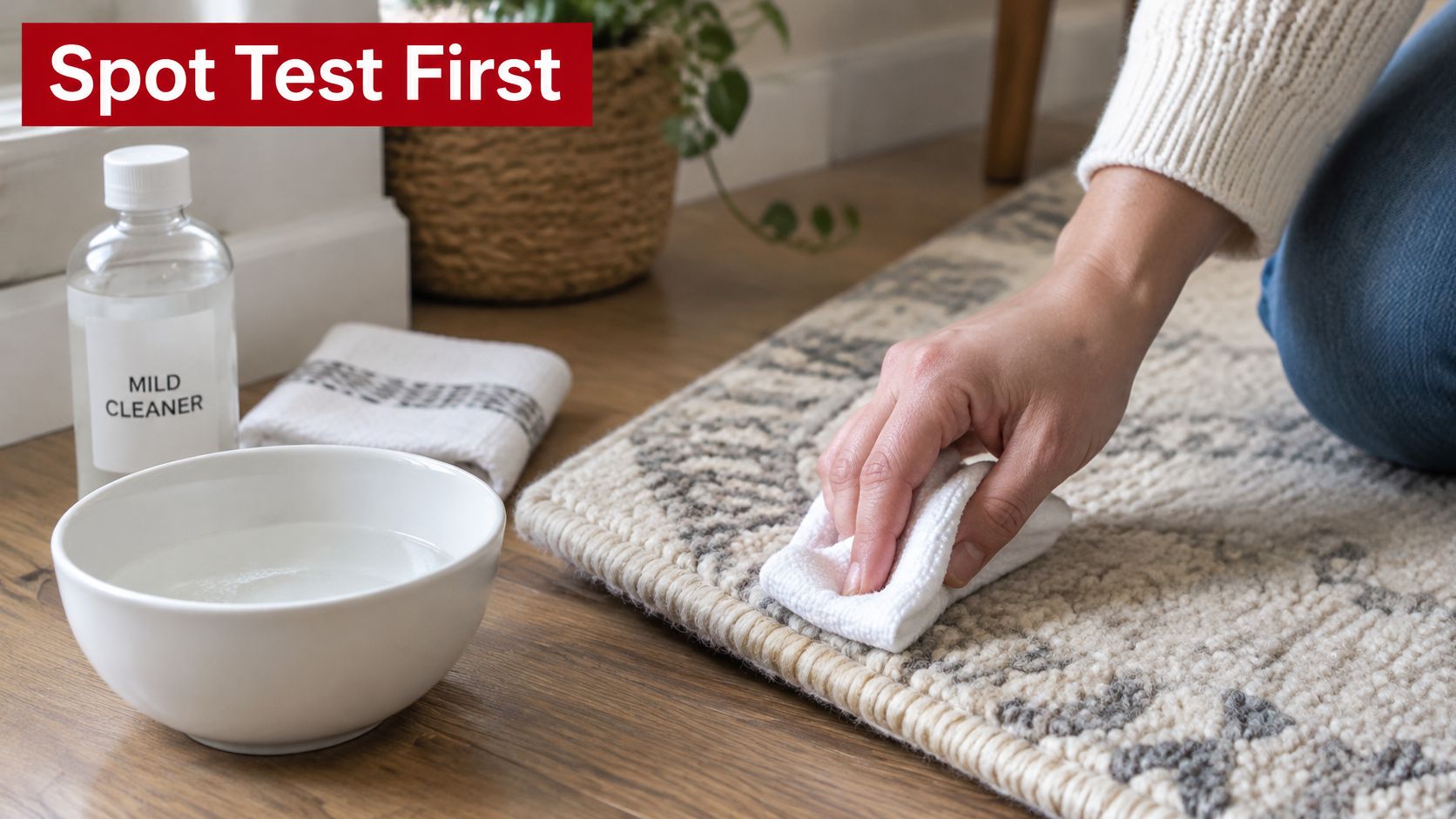
University of Georgia textile guidance flags alkalinity, heat, over-wetting, abrasion, and dye migration as the main risks, and it says to test on an inconspicuous edge with a white cloth, then check for color transfer or yellowing after drying. That check matters most on hand-dyed and oriental pieces. A failed test means you stop. Don't treat the visible stain.
Milk or sugar in the coffee needs a thorough low-moisture rinse later, because leftover organic film attracts soil. After any treatment that does pass, look again once the area is fully dry. You want no ring at the edge, a pile that springs back, and color that matches the rug around it. Write down the product you tested. If you later book a wash, that note saves a second guess. For a fuller walk-through of edge work, see our guide on how to spot clean a wool rug.
Immediate Steps for a Fresh Coffee Spill
Speed beats strength on a wet spill. Dilute the coffee before the color compounds grip the wool, then lift what you loosened. Don't scrub.
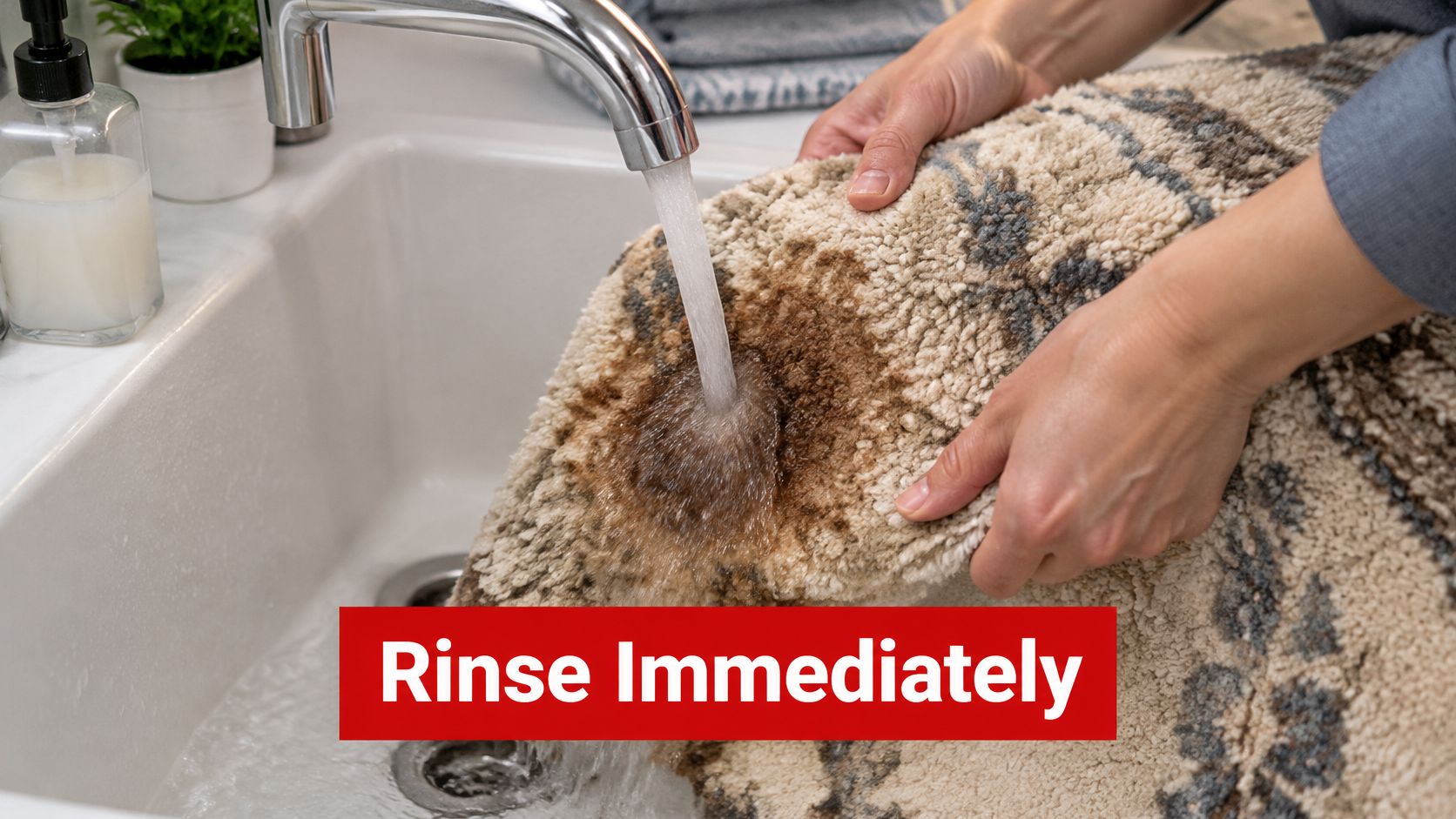
The sequence
- Lift solids first. Use a spoon or a dry cloth. Don't press crumbs or thick crema down into the pile.
- Rinse or dab with cold water. If you can reach a tap, rinse the spot under cold running water. On a rug you can't move, dab cold water from the outer edge inward.
- Blot with a white absorbent cloth. Press straight down. Work from the outside toward the center so the coffee doesn't crawl into clean pile.
- Rotate the cloth. Each time brown shows on the fabric, move to a clean section. A saturated cloth just puts coffee back.
- Switch to a weak detergent only if color remains. University of Georgia stain guidance puts a neutral, non-alkaline detergent at about 1 teaspoon per 1 cup of lukewarm water, applied to the cloth, not poured on the rug. Wool is grouped with other natural and synthetic fibers for that treatment. Dab and lift.
- Rinse by blotting. A second cloth, barely damp with clean water, pulls detergent out. Residue attracts soil and draws a visible ring.
- Press and air dry. Lay dry towels on the spot. Keep the rug off direct heat, including a hair dryer and a sunny window.
What usually goes wrong
Rubbing distorts the pile and spreads the spill sideways. Flooding drives coffee into the backing, where a cloth can't reach it. Heat feels helpful and often locks the tan color in place.
Success looks quiet. Each blot comes up lighter. The wool stays damp, not soaked, and it dries without a tide line. If a mark is still there once the pile is fully dry, stop repeating the detergent and move to a measured dried-stain treatment, or stop entirely if any dye came off on the cloth.
How to Treat a Dried Coffee Stain Step by Step
A dried mark needs a measured solution to rehydrate the coffee, not a bucket of water. Vacuum loose grit first so you aren't grinding sand into the pile while you work.
Woolmark's stain procedure separates a fresh black-coffee spill from a dried one and uses measured amounts instead of scrubbing. For the dried stain it specifies 1/2 teaspoon of baking soda in 1 cup of tepid water, about 2.5 milliliters in 237 milliliters. If color remains, the stronger mix is 3 parts surgical spirit or rubbing alcohol to 1 part cold water, then a thorough rinse and a Woolmark-approved detergent.
| Stage | Solution | Application |
|---|---|---|
| Fresh spill | Cold running water | Rinse at once, then blot from the edge |
| Dried stain | 1/2 teaspoon baking soda in 1 cup tepid water, about 2.5 mL in 237 mL | Light dabbing, then pressing with an absorbent cloth |
| Detergent step | Neutral wool-safe detergent at about 1 teaspoon per cup of lukewarm water | Applied sparingly, then rinsed with clean water |
| Stubborn discoloration | 3 parts rubbing alcohol to 1 part cold water | Only after the hidden-edge test passes |
How to apply it
Dampen a lint-free cloth so it doesn't drip. Dab from the edge toward the center, then press with a dry absorbent cloth to lift what the soda loosened. Swap to a clean section of cloth each time brown transfers, and keep going until the cloth comes up clear. Finish by blotting with clean water, because soda left in the pile dries into a pale, dusty patch that reads as a new stain.
The alcohol mix is a last home step, not a first one. Run it only after the hidden-edge test passes, and rinse thoroughly afterward, since alcohol residue in wool attracts soil the way detergent residue does. Keep every solution low in volume: an area rug holds moisture under the pile, and saturating the backing is how a small ring becomes a foundation stain. If the cloth picks up rug dye rather than coffee tan, set it down and stop.
You can browse coffee stain removal advice gathered from around the web and see how much of it assumes a countertop, a hard floor, or a washable cotton item. Wool pile over a backing behaves differently under every one of those recipes. Judge your result only when the spot is fully dry: no tide line, no stiff patch, and a pile that springs back under your hand.
Clean It Yourself or Book Birmingham Rug Cleaning
Home treatment is fair when three things are true. The rug is a colorfast, machine-made wool or wool blend. The stain is recent, or it's a dried black-coffee mark rather than a wide milky soak. And the first measured treatment lifts most of the color without dye on the cloth.
Call before you treat again when any of these show up.
- Construction: The rug is hand-woven, oriental, antique, or hand-dyed.
- Depth: Coffee has reached the foundation, or the mark is large, old, or still visible after two measured treatments.
- Dye: Color from the rug itself transfers to the cloth.
- Value: You would rather not risk the piece on a second experiment.
Woolmark's general wool-stain method is gentle dabbing from the outer edge with a dilute approved detergent, then blotting, because scrubbing abrades the pile. On a large, old, or oriental rug in a Pelham, Alabaster, Gardendale, or Helena home, that limit is exactly why a rug wash beats more dabbing.
Our team members pick the rug up, take it to the local facility, and schedule the return to the same spot in the house. At the plant, mechanical dusters tumble out grit vacuuming never reaches. Large tubs immerse the rug so the solution reaches the foundation, then mechanical rinsing flushes detergent so residue doesn't pull new soil. Drying happens in climate-controlled rooms, and the pile is brushed once it's dry. You aren't left with a soaked rug on a Birmingham floor.
Customers who drop off and pick up at a Rubber Ducky location get 20% off area rug cleaning. To talk through a coffee mark before you decide, call (205) 329-6488 and describe the stain, the fiber, and the age of the rug. Pickup and return details sit on our wool rug cleaning service page.
Rubber Ducky Rug Cleaning Birmingham picks up wool and other area rugs, washes them in a rug-specific facility, and returns them after controlled drying and grooming. That process is built for coffee, milk, and sugar stains that home blotting can't finish without risking the dyes. If your wool rug still shows a mark, schedule a pickup or request an estimate with Rubber Ducky Rug Cleaning Birmingham.