
A ballpoint rolls off a homework stack in a Homewood living room, lands tip down on a wool area rug, and leaves a dark line before anyone notices. If you need to know how to get out ink stains in Birmingham, don't reach for the strongest cleaner under the sink. Match the ink to the rug first, because the wrong first move can spread pigment, lift dye, or push liquid into the backing.
Ink on Birmingham Rugs and What to Try First
The ink type decides the first move. Find your row before you open any product, because a fresh water-based spot, an oil-rich ballpoint mark, and an aged pigment line don't behave the same way.
| Ink or pen | If the rug is a tested synthetic | Stop and book washing when |
|---|---|---|
| Fresh ballpoint | Blot, then rubbing alcohol on a white cloth from the edge inward | Wool, silk, oriental, antique, failed dye test, or the spot grows |
| Felt-tip or marker | Blot; water on a cloth only if a damp test smears the ink | Permanent marker, unknown dye, or any natural fiber |
| Gel pen | Blot; stop if the binder smears or the pile mats | Smear spreads or color lifts from the rug |
| Printer or pigment ink | Blot only; do not scrub a dried film | Any delicate, wool, silk, or hand-woven rug |
| Stamp pad or India ink | Controlled alcohol transfer only after a hidden colorfastness test | Natural fiber, unknown backing, or transfer stops |
| Aged or oxidized mark | Blot loose debris only; do not rewet | Every rug, especially dark marks that no longer move with water |
Ink isn't one stain. The Tulane exhibit on iron-gall ink explains that carbon inks were made from soot suspended in water with gum, while iron-gall ink combined tannins, iron sulfate, water, and a gum binder, and oxidation progressively creates a water-insoluble pigment. That single fact explains why a fresh spot may still transfer to a cloth while an old mark has bonded and won't move.
Modern pens add another layer. A ballpoint is typically oil rich, a rollerball or fountain pen is water based, and a gel pen carries pigment in a thicker binder. Printer and stamp inks are built to resist fading. When you pour water on the wrong formula, you don't dilute it. You give the pigment a wider path through the pile.
Why the rug changes the answer
A rug isn't a shirt. It has pile, dyes, and a latex or textile backing, and often a pad underneath that traps liquid. Wool absorbs quickly and can lose dye. Silk marks easily and weakens when it's wet and roughly handled. Cotton foundation yarns in a hand-woven piece can wick a stain sideways where you can't see it. A solution-dyed synthetic is the only category where I'd consider a small, tested home transfer, and only after the dye test passes.
Red-clay soil tracked through Birmingham, Hoover, and Trussville homes makes a dark spot look worse because grit is already sitting at the base of the pile. Vacuuming won't lift ink, and running a vacuum over a wet spot can drag it. Leave the vacuum alone until the area is dry.
If your row says stop, stopping is the treatment. A small untouched mark gives a wash plant far more to work with than a large bleached halo.
Use the table to pick a lane now. Blot only if the ink is fresh and your rug checks out. Run a cloth test if you're unsure about dye. Book pickup if the rug is wool, silk, oriental, antique, unlabeled, or already showing a ring. That decision, made in the first two minutes, matters more than any product choice that follows.
How to Check Your Rug Before Treating Ink
Say you're standing over a rug in Birmingham with a pen mark on it and you don't know what the rug is made of. That unknown is the risk. Run this check before any bottle comes out. It takes a few minutes and it tells you whether home blotting is even an option.
The six checks in order
- Read the care label. Look for wool, silk, cotton, nylon, polyester, polypropylene, or a blend. No label means unknown, and unknown means you treat it as delicate. If you bought it locally, ask the seller for the fiber content before you try anything.
- Look at the face in daylight. Wool and silk tend to show a soft natural sheen and slight unevenness in tone. Many synthetics look uniform and smooth, with an even cut across the tufts.
- Check the knots and fringe. If you can see individual knots on the back and the fringe is part of the foundation rather than sewn on, you're likely looking at a hand-knotted rug. That moves it straight to the pickup lane, no home chemistry.
- Turn a corner and read the backing. A stiff latex coating, woven cotton or jute, felt, or a glued secondary backing each moves liquid differently. Latex is the one solvents damage most easily.
- Run a hidden colorfastness test. Press a damp white cloth firmly on an inconspicuous edge, hold it, then check the cloth. Any color transfer means stop. Our guide to colorfastness testing walks through the test in detail if you want to see it step by step.
- Choose your lane. A tested synthetic with a clean, intact backing can take the home steps that follow. Natural fiber, hand-made, antique, or unclear results go to washing.
A rug can look synthetic and still be a natural-fiber piece, especially viscose, which imitates silk and watermarks easily. If any check is unclear, default to pickup. Guessing wrong on fiber is how a one-inch pen line becomes a permanent light patch.
How to Blot Fresh Ink Without Soaking the Rug
This routine is only for a fresh spot on a colorfast synthetic or performance rug that passed the checks above. If the mark is already dry, skip it and use the stop rules in the next section instead.
You need to know what not to copy first. The University of Georgia Extension stain guide gives a clothing method that soaks for 30 minutes in 1 quart of warm water mixed with 1/2 teaspoon liquid hand-dishwashing detergent and 1 tablespoon ammonia, then for 1 hour in 1 quart of warm water plus 1 tablespoon white vinegar, followed by rubbing alcohol over an absorbent pad. That sequence is built for a washable fabric you can immerse and rinse. It is not built for an unlabeled, dyed, antique, wool, silk, or backed rug, and ammonia, vinegar, and alcohol should never be mixed in the same container. Imitating a soak on a rug saturates the backing you can't rinse.
The rug-safe sequence
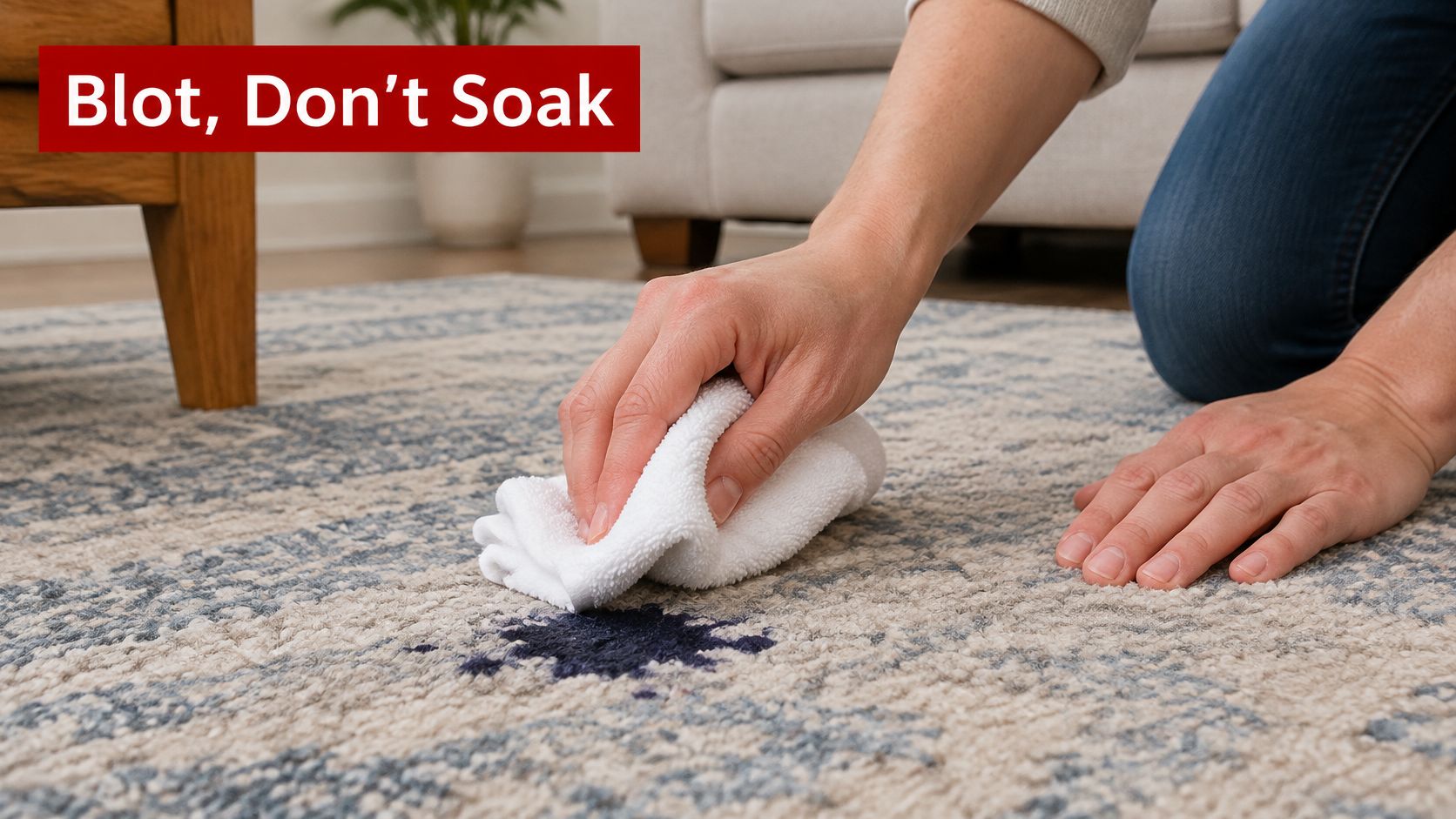
- Blot, don't rub. Press a clean white towel straight down and lift. Rubbing drives pigment deeper and spreads it outward.
- Protect what's underneath. If the rug lifts easily, slide a dry white towel under the spot so ink doesn't print through onto the pad or floor.
- Test on a hidden edge. Dab your product, rubbing alcohol or a drop of mild detergent in water, on an inconspicuous area and wait for any dye change. If you want the background on when alcohol helps and when it harms, read our notes on isopropyl alcohol for carpet stains before you start.
- Put product on the cloth, never on the pile. Dampen the cloth so a pen cap of liquid is all you're using. Blot from the outside toward the center to keep the mark contained.
- Rotate to a clean section fast. As soon as ink transfers, fold to a fresh area of cloth or swap cloths. A loaded cloth redeposits ink.
- Stop when transfer stops. Even if a shadow remains, you're done. Continuing past that point moves dye and water, not ink.
- Clear the residue and dry it. Blot with plain water on a fresh cloth, then with dry towels. Keep airflow moving across the face with a fan. Don't use a heater.
Why the order and the limits matter
Ink formulas combine pigments or dyes with solvents, resins, and additives, and the Smithsonian Museum Conservation Institute stain removal guidance advises using solvents before water-based reagents, one solvent at a time, with each allowed to evaporate fully before a mild water-based follow-up. That order matters because once the binder dries, it can form a film inside the fibers, and water first can spread what a solvent might have lifted in a controlled transfer.
Minimal liquid is the other control. A blot uses transfer. A pour uses gravity, and gravity takes the solution past the pile into backing and pad, where it can wick back as it dries and leave a visible tide ring. Small amounts, one product at a time, and patience between steps protect the dye system you can't replace.
A useful limit: if your cloth is dripping, you're not blotting anymore. You're soaking, and a rug can't be rinsed like a garment.
There's no honest promise here. Results depend on ink chemistry, how long the mark sat, your fiber, and whether the ink has cured. A partial lift with an intact rug is a good home outcome. A clean-looking spot surrounded by a pale ring and a soft backing isn't.
When the Spot Spreads or the Color Lifts
The most common failure starts as a pale ring. You blot, the center looks lighter, and then a halo appears around it that's larger than the original pen mark. That ring tells you liquid wicked outward through the pile and carried pigment, detergent, or soil with it. At that moment, more product makes the ring bigger, not smaller.
Use this chart the moment something changes. Each row gives you one action. Take it, then leave the rug alone.
| What you see | Likely cause | Do this now |
|---|---|---|
| Pale ring around the spot | Liquid wicked through the pile | Stop, blot dry, do not add more product |
| Rug color on the white cloth | Dye is not colorfast to that chemical | Stop all solvents and detergents |
| Spot larger than the pen mark | Rubbing or poured cleaner | Blot only and leave the shadow |
| Damp backing or pad | Saturation past the pile | Blot the top gently, add no liquid, and book pickup if the backing stays wet |
| Matted or stiff tufts | Residue or over-wet fibers | Do not brush hard; book a full rinse |
| No transfer after two cloth changes | Ink has cured or is pigment | Stop DIY attempts |
What clothing guides don't tell you
Most ink advice assumes you can rinse the item under a tap. A constructed rug can't be rinsed that way. The University of Georgia guidance on ink, ballpoint and felt-tip stains warns that solvent-based cleaners can damage carpet backing if the material becomes too wet, and that ammonia can damage silk and wool. Solvent that reaches latex backing can break down the bond holding the layers together, which is why product belongs on a cloth and never poured onto the pile.
Color on your cloth that isn't ink color is the clearest stop signal. It means the rug's own dye is moving. On wool and silk especially, that loss can't be reversed at home, and switching to a second solvent or to bleach only widens the lightened area. Don't run a home carpet extractor over an area rug either. It adds water faster than it recovers it from a backed rug, pushes residue deeper, and can distort the piece.
More alcohol, more scrubbing, and a soaked towel often create a bigger stain than the pen did.
Set your threshold low. For a Mountain Brook oriental rug, a Hoover wool piece, or any hand-woven or vintage rug, one failed hidden test or one sign of bleed is enough to end home treatment. Designers managing client rugs should apply the same rule. The cost of stopping early is a wash. The cost of pushing through a dye failure is a permanent light patch that no washing can restore.
A damp underside deserves the same respect. If you feel moisture under the rug or notice a soft latex smell, cleaner has gone past the pile. Blot the face dry, add nothing, and let a wash plant assess whether the backing is compromised. Persistent marks that won't transfer have usually cured or oxidized into the fiber. Another round of solvent at the kitchen table won't change that chemistry. It changes the rug around it.
Tips So Humidity Does Not Set the Mark
The stain work is done. What happens over the next day in a Birmingham house decides whether you also get a moisture problem. Alabama humidity slows drying, and a rug left damp on a pad gives mold a place to start.
The South Carolina Department of Environmental Services guidance on indoor mold states that wet porous materials, including carpet, fabrics, and rugs, should be cleaned and dried within 24 to 48 hours to help prevent mold growth. Treat that as your clock. If the face or backing got wet, you have that window to get it dry or get it picked up.
Drying and airflow actions
- Keep the rug face up. Run a fan so air moves across the surface, not just around the room. A dehumidifier helps in a closed space.
- Lift it off a soaked pad. If you can do that without folding a wet antique or a stiff backed rug, separate the layers so trapped moisture can escape.
- Check underneath by hand. The face can feel dry while the backing is still holding water. Press a dry white towel under a corner and see if it picks up moisture.
- Skip heat sources. No hair dryer, iron, or steam mop. Heat can set dyes and residues and can distort backing.
- Vacuum only when it's fully dry. Vacuuming a damp spot drives moisture and loosened pigment deeper. Once dry, vacuum entries in Hoover, Pelham, and Gardendale homes regularly so red-clay grit doesn't grind into a softened spot.
Those bans from the earlier steps still apply by name. Don't mix ammonia, vinegar, and alcohol. Don't reach for chlorine bleach on colored pile. Don't try acetone unless a cleaner has approved it for that specific fiber. Don't scrub wet tufts with a brush.
Assume detergent residue remains if you used any. A home machine can't flush a rug the way a wash tank and mechanical rinse can, and leftover soap grabs new dirt, so the spot can look dirty again within weeks. If you want a fuller walkthrough of drying and aftercare habits that protect a cleaned rug, the guide to carpet care after professional cleaning covers airflow and foot traffic while fibers settle.
Here's the practical split. A shadow that's stable and dry can wait for a scheduled pickup. A rug that's still damp the next morning shouldn't wait. Call that day, because the next problem won't be ink. It'll be odor, backing damage, or mold at the base of the pile.
How a Wash Plant Clears Ink and How to Book Birmingham Pickup
A faint shadow after careful blotting counts as a normal outcome. Ink that has cured or oxidized sits inside the fibers where a surface blot can't reach. Research in Scientific Reports on iron-gall ink describes how atmospheric oxygen drives oxidation and produces an increasingly insoluble dark complex, so an aged mark can hold oxidized pigment and acidic residues embedded in the textile while a recent mark still carries mobile, water-soluble components. Modern pen inks may instead contain dyes, pigments, glycols, resins, or solvents, which is why water alone spreads rather than removes them.
A wash plant does a different job than a stronger spray. At Rubber Ducky Rug Cleaning Birmingham, the process runs in eight steps, and each one solves a limit you hit at home.
The eight steps and what each one fixes
- Recognition of the rug. Every piece is identified and sorted before anything else happens, so a delicate hand-woven rug never gets washed like a modern synthetic.
- Pickup from your Birmingham home. You don't wrestle a large rug into a vehicle or fold a wet one. If you've never used the service, our page on area rug cleaning pick up explains how scheduling and return work.
- Inspection and dusting. Mechanical dusting tumblers gently tumble each rug to shake out sand, dust, pet hair, and grit trapped deep in the fibers, removing debris that vacuuming can't reach. Spotting over embedded grit grinds it into the yarn, so dusting comes first.
- Custom wash tank. Large tubs fully immerse the rug while moving panels evenly distribute the cleaning solution. Ink that has wicked past the pile toward the backing needs this kind of immersion, because a damp cloth on your floor never reaches the base of the tufts. The wash itself runs in minutes rather than hours, which limits how long the fibers sit in water and detergent.
- Thorough brush cleaning. After soaking, rugs are spread on a custom built wash floor for scrubbing or spotting. Ink work happens there, where any dye movement is visible across the whole piece and can be controlled immediately.
- State of the art rinsing. Hi-tech mechanical rinsing machines flush out every trace of cleaning solution so no residue is left to attract new dirt or dust. Leftover soap is why a treated spot looks dirty again weeks later, and this rinse is the step a home machine can't match.
- Pat-pending infusion rinse. This applies a treatment that naturally destroys lingering odor-causing bacteria within the fibers.
- Controlled drying chamber. Large centrifugal machines spin the rugs so fast that remaining water drains away, leaving them nearly dry before drying. Each rug is then hung so the fibers settle naturally, and once dry the pile is brushed to restore softness, texture, and shine.
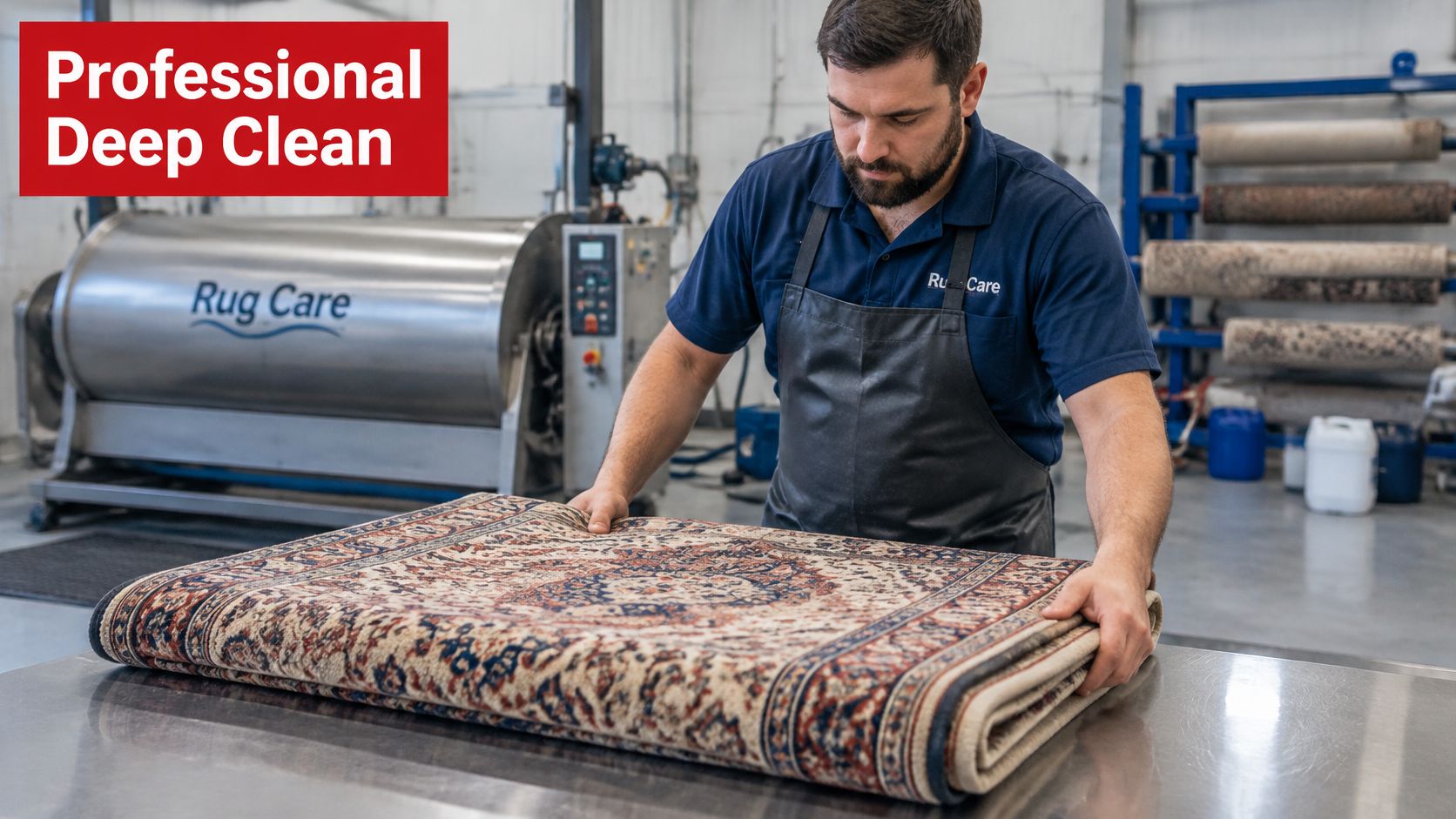
Wool, silk, and oriental pieces with ink belong on that wash floor. So do hand-woven and antique rugs, and any rug where you saw color lift, because controlled immersion and rinsing give a cleaner the ability to work on the mark while watching the whole dye field at once. A home blot can only watch a two-inch circle.
What to tell the scheduler: the ink type if you know it, how long it's been there, every product already applied, and whether the backing got wet. That history changes the chemistry we choose.
When to book instead of trying one more product
Book washing if any of these are true. The rug is natural fiber, antique, hand-made, or unlabeled. You saw dye on your test cloth. The backing or pad is damp. The mark stopped transferring. The spot sits near a light border where a ring would show. Rubber Ducky offers pickup and delivery, so nothing has to ride in your car. Email info@rubberduckyrugs.com or call (205) 329-6488 to schedule. Customers who drop off and pick up at a Rubber Ducky location get 20% off area rug cleaning, though a large or still-damp rug is usually easier to hand over at the door than to fold into a trunk.
Don't wait for a hot week to test your luck. Heat and humidity give a damp backing more time to cause trouble, and every extra solvent round narrows what a wash can recover. If the mark is still recoverable, it's recoverable now. Blot what you safely can, stop at the first warning sign, and let the wash plant finish a job that was never sized for a kitchen cloth.
Ink that won't transfer, dye that lifted on your test cloth, or a backing that stayed damp overnight are all reasons to stop home treatment and book pickup today. Rubber Ducky Rug Cleaning Birmingham will collect your rug, wash and spot it on a controlled wash floor, rinse it residue free, dry it in a climate-controlled chamber, and deliver it back to you. Visit Rubber Ducky Rug Cleaning Birmingham to schedule pickup before heat, humidity, or one more solvent sets what's still recoverable.