
If you're staring at a rug in Birmingham that's been scrubbed twice and still shows a burgundy shadow, you already know the problem. The spot looks better when it's wet, then darkens again as it dries, and every pass with a household cleaner seems to push it deeper into the pile.
That's the point where stubborn stain removal stops being a simple cleanup and starts being a judgment call. On area rugs, especially wool, hand-knotted, and synthetic blends, the wrong retry can spread the stain, set the dye, or leave residue that attracts more soil later.
Why Stubborn Stains Linger in Birmingham Rugs
A Birmingham homeowner usually notices the pattern after the third round of DIY effort. The stain fades while the rug is damp, then comes back with a brown or gray halo once the fibers dry, and the temptation is to scrub harder or add more soap. That's usually the wrong move, because repeated surface treatment doesn't pull contamination out of the rug's foundation, it just drives it around.
Why the surface lies
Area rugs aren't built like wall-to-wall carpet. They have a face fiber, a backing, sometimes a secondary foundation, and often fringe or a delicate border, so water and cleaner behave differently in each layer. A spill on the face can migrate downward, and if the rug sits through Birmingham humidity, the moisture lingers long enough for the stain to wick back upward as it dries.
Red clay makes the situation worse. It tracks in from yards, driveways, and job sites, then sticks to any residue left by soap or spot cleaner. Pet traffic adds another layer of trouble, especially in family homes where urine, saliva, and muddy paw prints all hit the same spots over and over.
Practical rule: if the stain looks larger after each home attempt, the issue usually isn't more elbow grease, it's deeper contamination.
There's also a health side people forget. Residue and trapped moisture can create indoor air and fiber problems that outlast the spill itself, which is why it's worth reading up on carpet off gassing health risks before flooding a rug with another round of product.
For Birmingham homeowners dealing with tracked-in clay or a spill that keeps returning, the better question isn't what soap to pour on it next. It's whether the rug needs fiber-safe treatment before the damage becomes permanent, especially on pieces that deserve more than a quick surface fix, like the kinds discussed in this local guide on removing red clay stains from rugs.
Identify the Stain and the Fiber Before You Touch Anything
The fastest way to turn a fixable spot into a permanent one is to clean before you identify. A wine stain on cotton doesn't behave like wine on wool, and a pet stain on synthetic fiber doesn't react the same way as the same spill on silk or viscose. Before any cleaner touches the rug, the homeowner needs two answers, what the stain is, and what the rug is made of.
Read the stain first
Look at the color, the source, and the age of the spot. Tannin stains usually come from wine, coffee, or tea. Protein stains usually come from blood, vomit, or urine. Oil stains look slick or darkened, and biological staining often carries odor, discoloration, or that dull patch that never quite dries right.
That matters because one cleaner can help a tannin mark and worsen a protein stain, or it can spread an oil spill deeper into the pile. A rug that has already been blotted a few times may also have a cleaner residue layer sitting on top of the original spill, which confuses the eye and the judgment.
Then confirm the fiber
The care label is the cleanest answer if it's still attached. If not, the fringe can give clues, and a discreet test in a hidden corner tells you more than guesswork ever will. Wool, silk, cotton, viscose, and synthetics all accept moisture and solvent differently, and antique or hand-knotted rugs in Birmingham homes can carry dyes that run with surprisingly little agitation.
Test the hidden corner first, even if the stain looks familiar. If the dye shifts there, the visible area will usually shift too.
A homeowner who wants a deeper local explanation can compare the testing process with this guide on colorfastness testing. The point is simple, the stain and the fiber have to be matched together, because skipping either check is the most common reason a small spill becomes a costly repair.
What Household Remedies Can and Cannot Do on Rugs
Household remedies can buy time, but they're not interchangeable. In practice, they work best as first aid on the right rug and the right spill, and they become risky as soon as the fiber is delicate, dyed with natural color, or backed with materials that don't like moisture.
The good, the bad, and the risky
White vinegar can help with light tannin spots on synthetics, but it's a poor choice for wool and can bother certain dyes over time. Baking soda is useful for absorbing fresh moisture, but if it's piled on and left to cake into the fibers, it becomes another residue problem. Dish soap lifts oil, but soap that isn't fully rinsed out can grab Birmingham red clay right back into the same area.
Hydrogen peroxide can lighten some stains, yet it can also bleach or shift color on natural fibers and should never be treated like a universal answer. Rubbing alcohol can help with ink, but on a dyed rug it needs extreme caution because it can move pigment as quickly as it removes the spot. Club soda is fine as a quick response to a fresh spill, but it won't rescue a stain that's already set into the backing.
| Household Remedies vs. Rug Fibers | Works On | Damages | Verdict for Wool/Silk |
|---|---|---|---|
| White vinegar | Light tannin on synthetics | Can yellow wool, affect dyes | Use cautiously, often avoid |
| Baking soda | Fresh moisture absorption | Cakes into pile when overused | Limited use only |
| Dish soap | Oil lift on hardy fibers | Leaves residue, attracts soil | Usually not ideal |
| Hydrogen peroxide | Some light organic stains | Can bleach or shift color | High risk |
| Rubbing alcohol | Ink and some dyes | Can pull dye from rug | Test only, often avoid |
| Club soda | Fresh spills | Weak on set stains | Safe as first aid, not a fix |
A lot of Birmingham homeowners ask whether one of these products is enough on its own. Sometimes the answer is yes for a fresh, shallow spill on a synthetic rug. Once you're dealing with wool, silk, natural dyes, jute backing, or repeated treatment, the pattern that matters is residue, color shift, or spreading at the edges, and that's the point where home treatment has outgrown its usefulness.
Matching the Method to the Stain Chemistry
A stubborn stain gets easier to treat when you stop guessing and start matching chemistry to chemistry. Red wine, coffee, and tea behave differently from pet urine, and neither behaves like grease, ink, or mildew. That's why the first move on a rug isn't “use a stronger cleaner,” it's “use the right response for the soil.”
Stains that want water first, and stains that don't
Tannin stains usually respond to cool water and mild detergent, never heat. Heat can lock the color into wool and silk dyes, which means a hot cloth or steam pass can make the job harder, not easier. The controlled textile studies in the verified research also show that coffee lifted more easily than ink, which is consistent with what technicians see in the field, beverage stains often give up before pigment-heavy ones do.
Protein stains from pet urine, vomit, and blood need cool treatment and thorough moisture extraction. In Birmingham, humidity makes that extraction step even more important because the backing can hold odor long after the face of the rug looks clean. Oil and grease from food, shoe polish, or candle wax need a solvent-minded approach, applied carefully so the soil doesn't smear wider with each blot.
Ink and dye stains demand patience and controlled solvent application. They often need repeated flushing rather than one aggressive scrub. Mold and mildew are different again, because the moisture source has to stop first. Once the rug is dry, the biological growth can be addressed, but not before.
Practical rule: if the stain is dark, oily, smelly, or older than the rug owner remembers, the chemistry is probably more complicated than a spray bottle can handle.
For homeowners who like to compare methods, it helps to think of stain categories the same way pros do with exterior cleaning problems, where one treatment doesn't fit every surface. A useful example is rust stain remover for driveways, which shows the same principle outside the rug world, the stain type dictates the chemistry.
| Stubborn Stain Categories and the Right First Response | Common Examples | Correct First Response | What to Avoid |
|---|---|---|---|
| Tannin | Red wine, coffee, tea | Cool water, mild detergent, blotting | Heat, rubbing, soaking too long |
| Protein | Pet urine, blood, vomit | Cool treatment, moisture extraction | Hot water, scrubbing, heavy fragrance |
| Oil | Grease, candle wax, shoe polish | Solvent-based spot handling, blotting | Rubbing, spreading, over-wetting |
| Ink and dye | Pen marks, dye transfer | Controlled solvent application, repeated flushing | Random household chemicals |
| Mold and mildew | Damp-storage growth, wet-season spotting | Dry the rug first, then treat | Covering the stain with more moisture |
When the stain has already spread into the foundation, or the rug starts to smell again every time the room gets humid, that's the stop point for most homeowners. At that stage, the stain isn't just sitting on the rug, it's embedded in it.
How Professional Rug Washing Lifts Stubborn Stains
Once a rug has survived spot cleaning and still shows a shadow, the answer usually lives in the wash process, not the bottle. A professional rug cleaner doesn't treat the face of the rug as the whole problem. The rug gets handled as a layered textile system, and every layer gets a different kind of attention.
What happens before the wash
Pickup starts the process. The rug is inspected, photographed, and tested so the technician knows what fiber and dye structure are in play. That matters because wool, silk, cotton, viscose, and synthetic blends all tolerate water, agitation, and stain agents differently. A Birmingham homeowner can't reasonably make those calls from the living room floor.
Dusting comes next. Industry rug-cleaning equipment is built for this step, including dusting tumblers, rollers, rinse wands, wash floors, towers, and centrifuges used to remove dry soil before any wet chemistry begins. Once the gritty soil is out, the stain agents can touch the residue instead of fighting through a layer of sand and dust.
Why immersion beats spot re-scrubbing
After dusting, the rug is immersed in a controlled wash with fiber-appropriate detergents. Targeted stain treatments can be used on wine, pet, or oil spots, but they work inside the wash system instead of on a dry tabletop. That difference matters because controlled rinsing removes leftover cleaner, which is a major reason home spots reappear.
One Birmingham service that follows this kind of multi-stage process is Rubber Ducky Rug Cleaning Birmingham, which uses rug-specific cleaning and controlled drying rather than generic carpet treatment. The final dry happens in a monitored room so the rug can dry flat and evenly, which helps prevent the wicking lines and browning that can show up after DIY work.
A rug that's been treated properly should come back clean, dry, and balanced, not stiff, crunchy, or carrying a soap smell.
After the wash, grooming and fringe cleaning restore the finish before the rug is wrapped for return. For families in Birmingham, Hoover, Homewood, and Mountain Brook, that means the rug comes back ready to lay flat again, instead of waiting for a second round of guesswork.
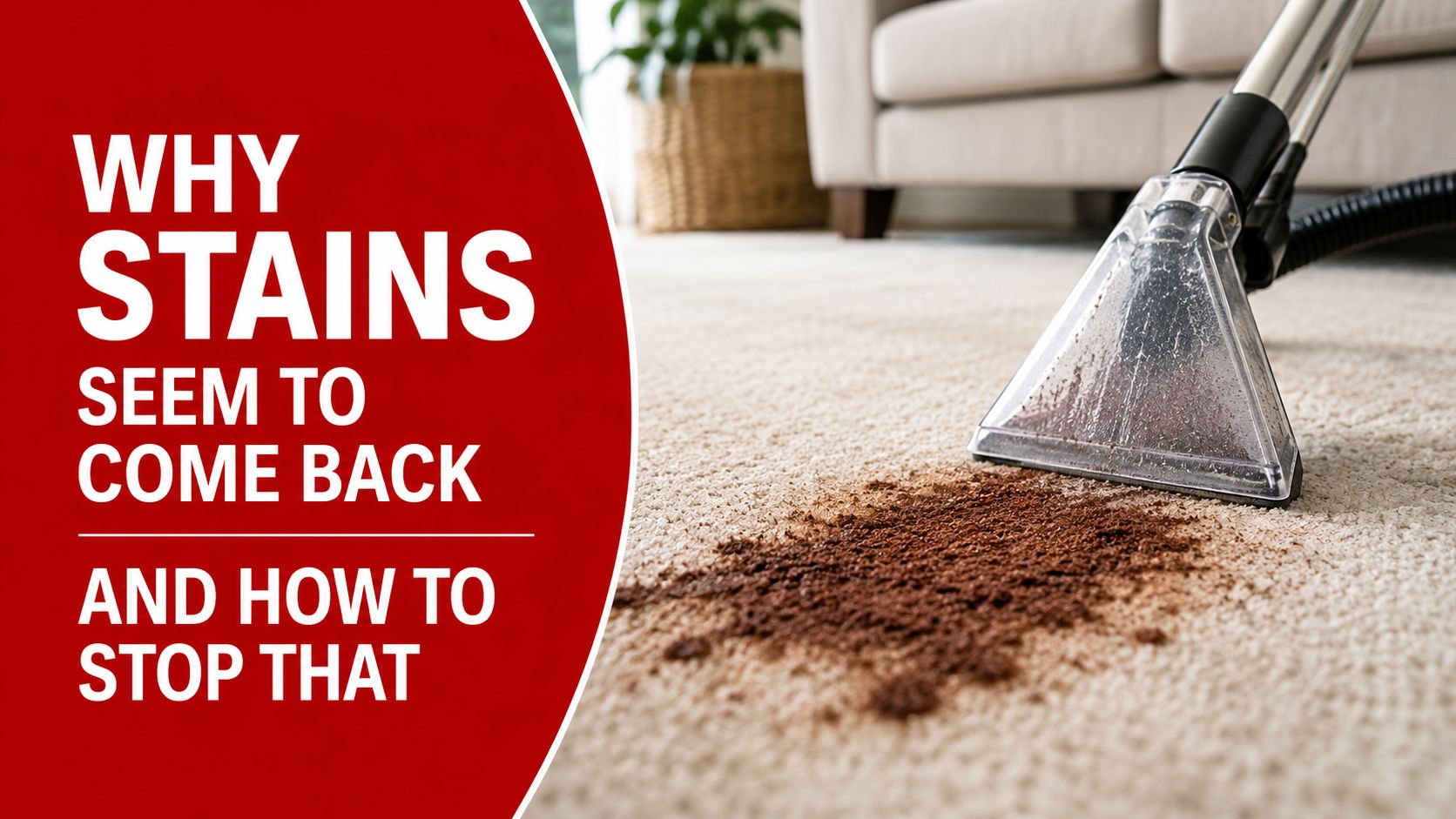
Why Stains Seem to Come Back and How to Stop That
Most “returned” stains never fully left. They were either left behind as residue, pulled back to the surface while the rug dried, or reactivated by moisture and odor compounds in the backing. That's why a rug can look acceptable right after spot treatment and still throw a shadow a few days later.
Three reasons the shadow comes back
Soap residue is one common cause. If detergent stays in the fiber, it acts like a soil magnet, so the area darkens again as the room gets used. Wicking is another. Moisture carries old spill material up from the foundation while the rug dries, which leaves a yellow or brown ghost where the original spill lived.
Pet odors are the third reason. Urine crystals can sit deep in the pile and reactivate with humidity, which is a familiar problem in Birmingham homes during muggy stretches. A surface spray may make the room smell better for a short while, but it won't reach the embedded source.
Only a full wash, neutral rinse, and controlled dry address all three at once. That's why a rug can look like it needs another spot treatment when what it really needs is extraction from the base up.
If the stain changes shape every time the rug gets damp, the issue is deeper than the visible mark.
That's also why professional neutralization matters after pet work. Without it, the odor and stain cycle can keep returning each time the rug re-encounters moisture.
Schedule Rug Pickup and Bring Your Rug Back to Life
If the stain has survived two DIY attempts, the odor keeps coming back after drying, or the edges are starting to bleed, the rug has crossed into pro-cleaning territory. At that point, one more household product usually costs more in time and fiber risk than a proper wash cycle.
What Birmingham homeowners can expect
Pickup is straightforward. A homeowner calls or books online, the rug is tagged and tracked through the wash cycle, and the cleaner handles the heavy lifting from the home to the facility and back again. Turnaround depends on the rug, the stain severity, and the fiber, but a normal window is typically a few days rather than a long stretch of downtime.
When the rug returns, it should be pre-inspected, dust-free, immersion-washed, pH-balanced, controlled-dried, and groomed. Stubborn stains are often removed fully, but natural fibers can sometimes keep a light shadow where the spill penetrated. What they shouldn't come back with is bleach damage, crunchy residue, or a lingering cleaner smell.
Households across Birmingham, Vestavia Hills, Trussville, Pelham, Alabaster, and Helena often spend money piecing together spray bottles, spotters, and odor products before they finally call for help. A single professional wash can end the cycle, especially on rugs that carry wine, pet accidents, red clay, or oil that's already gone past the surface.
The best time to stop DIY is before the rug starts looking thinner, duller, or misshapen from repeated scrubbing.
If you're done gambling with the rug, the next step is simple. Schedule pickup, ask for a stain review, and let the rug be cleaned in a controlled setting instead of on the living room floor.
If your rug in Birmingham has a stain that keeps returning, don't keep feeding it more soap and more rubbing. Rubber Ducky Rug Cleaning Birmingham handles pickup, fiber-safe rug washing, stain removal, and controlled drying for rugs that need more than a home spot clean. Visit Rubber Ducky Rug Cleaning Birmingham to schedule service and get the rug out of the repeat-stain cycle.