
That musty, earthy smell coming from your rug is more than an unpleasant odor, and those discolored spots are not merely stains. They are warning signs of mildew, a living fungus that feeds on natural fibers like wool and cotton, causing deep and often irreversible damage to your rug's foundation. This is not a situation for do-it-yourself attempts; professional intervention from a specialist rug cleaning company is crucial to neutralize the growth and preserve your valuable rug.
At Rubber Ducky Rugs, our trained specialists provide expert rug cleaning services throughout the United States. With a growing national presence and strong local service capabilities, we are equipped to handle complex issues like mildew contamination safely and effectively.
How Mildew Destroys Your Rug From the Inside Out
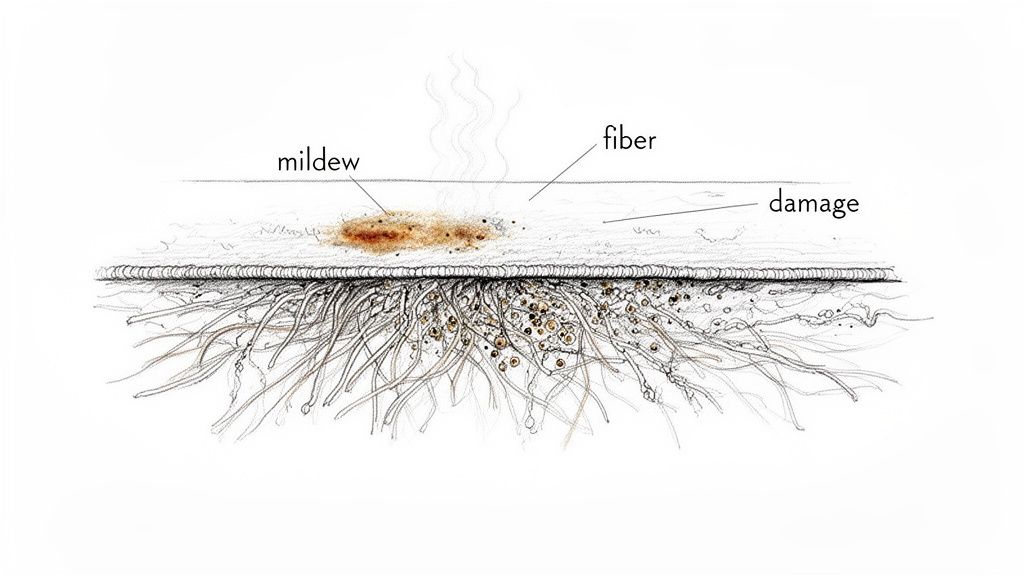
Mildew on a rug is a much bigger problem than what is visible on the surface. A small, fuzzy patch is often just the tip of the iceberg, with the real damage occurring out of sight, deep within the rug's backing and foundation. The fungus establishes a complex root system, burrowing into the rug’s core and digesting the very fibers that provide its structure.
As this destructive process continues, the rug’s integrity is severely weakened. The fibers become brittle and fragile, leading to rips, holes, and premature wear. Colors can also be permanently altered, leaving behind bleached or darkened patches that professional cleaning cannot reverse.
What Creates the Perfect Environment for Mildew?
Mildew requires a few key ingredients to take hold, and many homes provide the perfect conditions without the owners realizing it.
- Persistent Moisture: This is the primary catalyst. A spill that isn't professionally dried, constant high humidity, or improper cleaning can create the dampness mildew needs to flourish.
- Organic Material: Rugs made from natural fibers like wool, cotton, or silk are a food source for this fungus.
- Poor Airflow: Stagnant air is a significant contributor. Placing a rug directly on the floor without a proper pad can trap moisture underneath, creating an ideal incubator for mildew.
That distinct "musty" smell is not just unpleasant, it's the odor of active destruction. It is caused by microbial volatile organic compounds (MVOCs), gases released as the fungus consumes the rug's fibers.
A Silent Threat to Your Investment
Every year, countless area rugs, from priceless antique Oriental pieces to modern synthetics, are damaged by mildew, especially in humid regions. Ignoring the first signs is a significant risk. What starts as a small spot can spread across a large section of your rug in just a few weeks, destroying its beauty, value, and affecting your home's environment.
At Rubber Ducky Rugs, our specialists are trained to identify the exact type of fungal growth and assess the extent of the damage. With new locations opening in major cities, we offer expert rug washing services across the United States, providing a professional solution that stops mildew in its tracks.
Why an Expert Evaluation is Your First Line of Defense
Before our specialists begin any cleaning process for a mildew-affected rug, we conduct a thorough, hands-on assessment. This deep evaluation is essential to determine the extent of the fungal contamination and the stability of the rug's fibers and dyes. Attempting to clean a rug without this critical diagnosis can cause more harm than good.
Our first step is to identify the specific type of mildew and measure how far its roots have penetrated the rug’s foundation. This tells our technicians how severe the problem is and informs the specific treatment protocol required. An incorrect assessment can lead to an incomplete cleaning, allowing fungal spores to reactivate later.
It's All About the Fibers and Dyes
Every rug has unique characteristics. Our specialists closely examine the fibers, whether it's delicate silk, absorbent wool, or a durable synthetic. Each material has a different tolerance for moisture and cleaning solutions. Wool, for instance, can be easily damaged by improper treatments, while synthetics may hold their color but can still suffer structural weakening from fungal growth.
Part of this analysis involves testing the dyes for stability. Many rugs, especially hand-knotted Oriental and antique pieces, are colored with natural dyes that can bleed or fade if exposed to the wrong cleaning agents or pH levels.
Our evaluation process protects your investment. We develop a custom washing plan that is powerful enough to eliminate mildew but gentle enough to preserve your rug's color, texture, and structural integrity.
This professional approach is the direct opposite of a risky at-home attempt. Trying to treat mildew with household chemicals often leads to permanently set stains, color run, or torn fibers.
Seeing the Bigger Picture
If you suspect mildew on a rug, the first call should be to a professional. For severe situations, such as large-scale contamination or health concerns, an occupational hygienist mould assessment can identify the full extent of the problem and recommend a remediation plan.
Mildew is a leading cause of rug damage. Internationally, it's common for hand-knotted rug shipments to see 15-20% rejection rates because of mildew that grew during transit. These figures highlight a clear fact: ignoring mildew destroys value, while professional care restores it.
At Rubber Ducky Rugs, our process begins with a crucial technician assessment. With new locations opening in cities like Philadelphia, San Diego, and Dallas, we're expanding nationwide to bring our coast-to-coast expertise to your neighborhood. Our local specialists are prepared for any mildew situation, ensuring your rug is returned clean, fresh, and structurally sound.
How Our Specialists Eliminate Mildew
When dealing with mildew, a simple surface clean is ineffective. Wiping or scrubbing the top layer of a rug leaves the fungal network deep within the fibers, allowing it to grow back. That is why our specialists utilize a full-submersion washing process, conducted in a controlled environment, to stop mildew at its source.
Our process begins with the painstaking removal of all dry soil and debris. This is done first because adding water to a dirty rug creates an abrasive paste that can damage delicate fibers during the wash.
Going Deep: Fiber Saturation
With the dry soil removed, our technicians apply specialized, pH-balanced neutralizing agents. These are not harsh, off-the-shelf chemicals. We carefully select the correct formula based on your rug’s unique composition, whether it's wool, silk, cotton, or a synthetic blend.
The goal is deep penetration. We ensure the solution works its way down into the rug’s foundation to kill the mildew where it lives. This critical part of the process happens far beneath the surface where it cannot be seen. Our detailed rug evaluation provides the blueprint for this tailored approach.
This systematic check allows us to create a treatment plan that not only eliminates the mildew but also protects your rug’s structure and colors.
The Full Submersion Wash
After the neutralizing agents have worked, we move the rug to our specialized wash pool. Your rug is completely submerged in a process designed to flush out every contaminant, including dead mildew, lingering spores, dirt, and residual cleaning agents. We do not just clean the top; we cleanse the entire rug, from the face fibers to the backing.
This is followed by several clear-water rinses. The rinse cycle is repeated until the water runs completely clear, indicating that only clean fibers remain. This deep-washing method gets rid of the visible problem, the musty odor, and the hidden allergens that mildew can introduce into your home. The principles behind neutralizing such a stubborn problem are detailed in this comprehensive guide on how to remove mildew from other materials.
Expert Insight: Surface cleaning often pushes mildew spores deeper into the rug, making the problem worse over time. Our full submersion technique guarantees a complete flush, which is absolutely essential for preventing regrowth and making the rug truly hygienic again.
Our method is the definitive solution to a complex problem, delivering a level of clean that home-based approaches cannot achieve. You can learn more about our overall philosophy on our page detailing the best way to clean rugs.
With new locations opening in major cities from Houston to Seattle, Rubber Ducky Rugs is expanding to meet growing consumer demand. We pair our national expertise with dedicated local service, so when you find mildew on your rugs, you can trust specialists who have perfected the remediation process.
Controlled Drying: The Secret to Preventing Mildew's Return
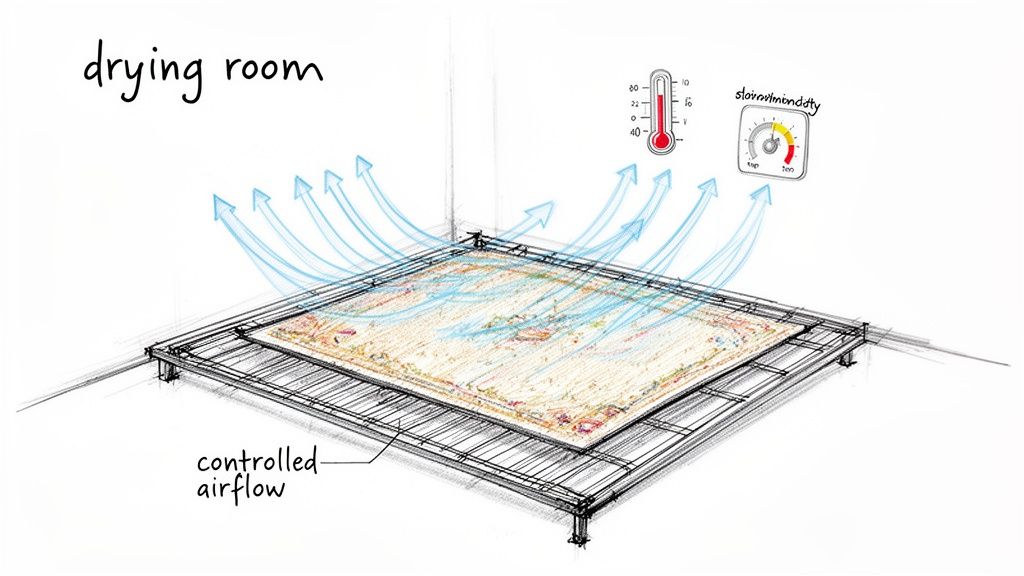
The fight against mildew is not won in the wash; it is won in the drying process. This is where most at-home cleaning attempts fail. A rug that is not dried quickly and completely creates an ideal environment for mildew spores to reactivate. A rug that feels dry to the touch is often still damp deep within its foundation, which is the perfect breeding ground.
That is why our job is not finished after the rinse cycle. The moment a rug is cleaned, it is moved to our climate-controlled drying room. We do not just hang it and hope for the best; we manage the environment with scientific precision.
The Art and Science of a Perfect Dry
Our specialists create the ideal conditions to remove all moisture from your rug without harming delicate fibers. It is a careful balancing act that involves three critical elements.
- Controlled Temperature: We raise the temperature just enough to speed up evaporation without using high heat, which can make natural fibers like wool brittle or cause them to shrink.
- Low Humidity: Powerful, commercial-grade dehumidifiers work continuously to pull moisture from the air and, in turn, from the rug itself. This actively wicks water out of the dense pile and the tightly woven foundation.
- Constant Airflow: High-velocity air movers are strategically placed to create a vortex of air that circulates through the rug's fibers, ensuring every square inch dries at the same rate.
This system is the only way to guarantee a rug is bone-dry right down to its core. Left to air-dry at home, a dense rug can take days to dry fully. Any rug that remains damp for more than 24 hours is at high risk for new mildew growth.
When a rug is drying on a floor at home, it traps a layer of humid air underneath. This hidden moisture pocket is exactly where mildew restarts its colony, often leading to bigger problems like dry rot that can destroy the rug's foundation.
Professional Drying vs. At-Home Air Drying
The difference is stark. This seemingly simple step can determine the health and longevity of your rug.
Professional vs At-Home Rug Drying Methods
| Drying Factor | At-Home Air Drying (High Risk) | Rubber Ducky Rugs Controlled Drying (Professional Solution) |
|---|---|---|
| Drying Time | 2-4 days or more, creating an ideal window for mildew regrowth. | Under 24 hours, eliminating the risk of new microbial growth. |
| Moisture Removal | Surface-level only. Traps moisture deep in the foundation and backing. | Complete and thorough. Pulls moisture from the core for a 100% dry result. |
| Air Circulation | Uneven and inconsistent, relying on household fans. | Engineered, 360-degree airflow ensures every fiber dries uniformly. |
| Damage Risk | High risk of dye bleeding, fiber warping, foundation rot, and foul odors. | Prevents all common drying-related damage, preserving the rug's shape and color. |
Simply put, professional drying protects the integrity of your rug.
More Than Just Mildew: Avoiding Other Drying Disasters
A slow, uncontrolled dry does not just invite mildew back; it can cause other irreversible problems.
Our controlled environment is specifically designed to prevent these common pitfalls:
- Dye Bleeding: By removing moisture quickly, we lock the dyes in place, preventing colors from running.
- Warping and Buckling: When a rug dries unevenly, it can ripple or lose its shape. Our method ensures it lays perfectly flat.
- Weakened Foundation: Trapped moisture is the enemy of the cotton or jute foundation threads. We prevent the rot that can lead to tears and holes.
Understanding the critical role of moisture management is key. To learn more, check out our insights on why a fast, safe dry is a non-negotiable part of any professional cleaning process.
To meet the growing need for specialized care, Rubber Ducky Rugs is expanding across the country, opening new facilities in cities like Nashville, Boston, and Miami. Our nationwide expertise ensures that you have access to a team that gets it right, from the initial wash to the final, all-important dry.
Expert Tips for Rug Protection and Mildew Prevention
Once your rug has been professionally cleaned, sanitized, and properly dried, the goal is to prevent a recurrence. Long-term mildew prevention is about managing the environment around your rug. The principles are simple: moisture control and airflow. These are the same concepts our specialists share with clients from coast to coast.
Give Your Rug Room to Breathe
One of the most effective tools against mildew is not applied to your rug, but placed under it. A high-quality, breathable rug pad is essential. It creates a small but critical gap between your rug and the floor, allowing air to circulate underneath. This circulation whisks away ambient moisture that can get trapped and cause problems. When a rug lies flat against the floor, it creates a dark, stagnant pocket where condensation can build, providing an ideal environment for mildew.
A good pad acts as both a protective barrier and a ventilation system. It is the single best investment you can make to protect your rug, especially in rooms with concrete slab foundations or significant temperature fluctuations.
Location, Location, Location
Where a rug is placed is just as important as how it is cared for. Some areas in a home are naturally humid, making them high-risk zones for mildew growth.
Our specialists advise against placing valuable natural fiber rugs, like wool or silk, in these problem areas:
- Full Bathrooms: Constant steam from showers creates a perpetually damp environment.
- Basements: Unfinished or poorly ventilated basements are known for high humidity and poor airflow.
- Entryways: A rug placed by a door will absorb rain, snow, and mud.
- Under Potted Plants: Overwatering can lead to a chronically damp spot that seeps into the rug's foundation.
Placing prized rugs in drier, well-ventilated living areas drastically reduces the chance of mildew finding a place to grow.
A small spill may seem to air-dry on the surface within a few hours, but moisture can remain locked deep in the rug’s foundation for days. This gives mildew spores the 24 to 48 hours they need to activate and colonize.
Professional Handling of Spills
When a spill occurs, professional attention is the safest course of action. At-home attempts to clean stains often push moisture deeper into the rug's fibers and can cause permanent damage. Using household spot cleaners can set stains, cause dyes to bleed, or leave behind a sticky residue that attracts dirt. When a rug gets wet, only a professional can confirm its core is 100% dry and safe from fungal growth.
As Rubber Ducky Rugs continues to grow, with new locations opening nationwide to serve more communities, our core mission remains unchanged. We are here to share our expertise and provide the professional services necessary to protect your beautiful rugs.
Common Questions About Mildew on Rugs
When our specialists receive a call about a rug with mildew, the owner's concern is clear. Customers often have the same urgent questions, and getting expert answers is the first step toward saving a valuable textile. Here are the most common questions our specialists hear every day.
Can I Clean Mildew Off My Rug Myself?
This is the most frequent question, and our answer is always a firm no. Attempting to treat mildew on a rug at home is a significant risk to your textile. DIY methods cannot address the root of the problem and often cause more harm than good.
Household cleaners and scrubbing can create a disaster:
- Permanent Dye Bleed: Harsh chemicals can destabilize rug dyes, causing them to run and blur the pattern.
- Fiber Degradation: Scrubbing can fray and break delicate wool, silk, or cotton fibers, permanently weakening the rug's structure.
- Foundation Damage: Applying water without professional drying equipment traps moisture deep in the foundation, which can lead to dry rot.
Most importantly, cleaning the surface does nothing to kill the fungal network rooted deep inside the rug. The visible spots may disappear temporarily, but the spores remain, ready to bloom again. This incomplete approach almost guarantees the mildew will return.
That musty smell is the sound of the fungus actively consuming your rug’s organic fibers. Spraying a deodorizer only masks the odor without stopping the ongoing destruction.
Ultimately, a DIY attempt often turns a solvable problem into a permanent one. Professional care is the only safe way to protect your investment.
What Does Professional Mildew Removal Involve?
Our professional mildew remediation is a meticulous, multi-step process conducted in a controlled, specialized environment to ensure the treatment is both thorough and safe for your rug.
First, the rug undergoes a detailed pre-inspection where our specialists analyze the fiber type, dye stability, and construction to create a custom treatment plan. We then use specialized equipment to remove all dry soil before any washing begins.
Next, we apply a fiber-specific, pH-balanced neutralizing agent that penetrates deep into the rug's foundation, killing the mildew at its source. This is followed by a full submersion wash, which completely flushes out all dead spores, dirt, allergens, and cleaning residue.
The final and most critical step is drying. The rug is moved to a climate-controlled drying room where we precisely manage temperature, humidity, and airflow to guarantee it dries completely, from the surface fibers to the core of its foundation. This expert-led process is the only way to ensure the mildew is gone for good.
How Do I Know If My Rug Has Mildew or Just a Stain?
Telling mildew apart from a simple stain can be tricky. However, a few tell-tale signs usually indicate a fungal issue. Mildew almost always has a distinct, musty odor that worsens with humidity. Visually, it often appears as splotchy or powdery patches of gray, green, black, or even white.
However, visual cues are not always definitive. What looks like an old water stain on the surface could be hiding a thriving mildew colony deep within the rug’s foundation. The discoloration you see may just be the tip of the iceberg.
The only way to know for sure is to have it professionally inspected. Our trained specialists can assess the rug's texture, smell, and foundation to accurately diagnose the problem. We can determine the extent of the fungal growth and check for any underlying structural damage. A professional evaluation ensures you are treating the right problem and protecting the long-term health of your rug.
Do not let mildew destroy your rug. The trained specialists at Rubber Ducky Rugs have the expertise and equipment to safely neutralize fungal growth and restore your rug's health. With our national scale and expanding local service in cities across the United States, professional help is just a call, text, or click away. Contact us today for fast, reliable service.