You've stopped the leak, blotted the rug, and turned on a fan, but the room still smells damp. If you're searching for professional rug cleaning in Birmingham right now, the important question isn't whether the rug looks better. It's whether water remains in its backing, pad, or the floor beneath it.
Mold after water damage requires prompt assessment, not panic or automatic disposal. At Rubber Ducky Rug Cleaning Birmingham, our pickup, rug-specific cleaning, and controlled drying process lets homeowners address a wet rug without trying to transport or wash it themselves. The first decision is whether the rug needs drying, restoration, or removal because it can't be safely cleaned.
How Fast Mold Grows in a Wet Rug and Why Drying Controls It
The U.S. Environmental Protection Agency advises drying wet or damp materials within 24 to 48 hours, which prevents mold growth in most cases. For Birmingham homeowners, that means arranging assessment and drying while the rug is still wet, rather than waiting for spots or a strong odor.
The clock starts when the rug gets wet, not when you discover the problem. If you find a supply-line leak after returning home, tell the cleaning team both when you noticed it and when the room was last known to be dry.
Mold risk by time since water damage
These stages are practical response categories, not a test that can prove whether mold is present. Material, contamination, and drying conditions affect what happens inside an individual rug.
| Time since water damage | What is happening | What to do |
|---|---|---|
| 0 to 24 hours | Water is still held in the backing, pad and subfloor; spores can settle on damp fibers | If safe and free of visible growth, lift the rug, separate it from the pad, and start drying |
| 24 to 48 hours | Growth becomes possible on damp backing and pad if drying is incomplete | Finish controlled drying and book a professional inspection |
| 48 to 72 hours | Growth may already be established in trapped moisture; odor can appear | Assess the backing for mold and decide whether to restore or replace |
| Beyond 72 hours | Treat persistent wetness as suspected contamination, rather than proof of established growth | Assume contamination for handling purposes until a professional inspection shows otherwise |
Mold spores need available water on or inside a material to germinate, so the job is removing water from the whole rug system, not making the face look fresh.
For a recent clean-water incident, stop the source if you can do so safely. Keep people off the wet rug, photograph the affected area, and arrange pickup. Don't lift a heavy, saturated rug alone, and don't disturb a rug with visible growth or sewage exposure.
Check the whole rug system
A technician checks face fibers, backing, and the pad or floor beneath. These layers don't necessarily dry together. Dense pile can conceal a damp foundation, while a pad against the floor can retain water after the exposed fibers feel comfortable underfoot.
A hair dryer or sunny window can make the face feel dry while moisture remains underneath. Concentrated heat also gives you little control over how different parts of the rug respond. Our wet area rug drying guidance explains why lifting, extraction, airflow, and moisture checks matter more than surface warmth.
The EPA's moisture-control guidance recommends indoor relative humidity below 60%, ideally between 30% and 50%. Use a hygrometer to monitor the room, but don't mistake an acceptable room reading for proof that the rug is dry.
Our drying rooms are large, climate-controlled areas where temperature and humidity are balanced to protect fibers during drying. That control matters when the alternative is leaving a wet rug flat against the same damp floor.
Practical rule: The underside and pad should feel dry, not just the top. Touch is a useful warning check, but professional moisture assessment is stronger evidence that drying is complete.
Warning Signs a Rug Already Has Mold
| Warning sign | Likely cause | Next step |
|---|---|---|
| Musty smell that returns after vacuuming | Moisture or contamination trapped in the backing or pad | Stop vacuuming; schedule pickup and drying assessment |
| Dark spots or fuzzy patches on the underside | Suspected mold growth in the backing or pad | Isolate the rug, don't scrub, and call a professional |
| Stiff, cupped or peeling backing | Moisture damage in the latex or foundation | Arrange professional drying and inspection before cleaning |
| Dye bleed onto the pad or floor | Water carrying dye through the fibers | Stop wet cleaning and arrange assessment |
| Sneezing, itchy eyes or a stuffy head at home | Possible airborne irritants from the rug or room | Keep sensitive household members away; seek medical advice if symptoms persist |
A warning sign isn't a diagnosis. Dark staining can have causes other than mold, and peeling backing can reflect adhesive deterioration. Either finding after a leak still warrants inspection because the cleaning method must account for damaged materials.
A musty smell that disappears briefly after vacuuming doesn't mean the problem is resolved. Likewise, dye on a pad signals that more wet cleaning could worsen color migration. Don't add water to see whether the stain will rinse away.
The EPA's mold and health guidance identifies allergic reactions and irritation as possible effects of exposure. Symptoms that ease away from the room deserve attention, but they don't establish that the rug is the cause.
A low-disturbance self-check
Only check a rug yourself if there's no sewage exposure, obvious growth, or reason that handling it would put you at risk.
- Lift a corner gently. Stop if the rug is heavy, fragile, or stuck to the floor.
- Look in daylight. Check for unusual patches, foundation distortion, and backing separation.
- Notice the room's odor. Don't put your face against the rug or deliberately inhale from it.
- Press the pad with a gloved hand. Dampness means the drying job isn't complete.
If any check fails, stop cleaning and book an inspection. A clean-looking top doesn't clear the backing or pad.
Saving or Replacing a Water-Damaged Rug
| Water type and timing | Likely outcome | Why it matters |
|---|---|---|
| Clean supply-line leak, dried promptly | Often restorable | Effective drying can prevent growth from taking hold |
| Clean water, wet beyond the initial drying window | Inspect before deciding | Backing and pad may still hold moisture |
| Floodwater or sewage | Usually replace | Contaminated water is difficult to remove reliably from porous fibers |
| Visible mold through the backing or pad | Often replace | Growth has penetrated layers that surface cleaning can't reach |
| Hand-knotted or heirloom rug, clean water, dried promptly | Professional assessment first | Dyes and foundation yarns can shrink or bleed |
The drying window is a risk threshold, not an automatic discard deadline. The FEMA homeowner and renter mold guide advises that items that can't be properly cleaned and dried within 24 to 48 hours may need to be discarded, and identifies rugs among porous materials that can absorb contaminated water.
That doesn't make every delayed clean-water rug unsalvageable. It does mean that a restoration decision needs more evidence than the rug's value or appearance.
The questions that settle the decision
- What kind of water was it? A clean supply-line leak presents a different problem from sewage or contaminated floodwater.
- How long did the fibers stay wet? Include time before discovery and any period spent rolled up or sitting on a saturated pad.
- Did contamination reach the foundation? Surface spotting and embedded growth aren't equivalent cleaning problems.
- Can the rug be cleaned and fully dried without unacceptable damage? Shrinkage, dye bleed, delamination, and lasting odor all affect the outcome.
For a Mountain Brook heirloom or a Homewood wool rug, sentimental value justifies careful evaluation. It doesn't justify returning contaminated material to a living space.
Saving the rug is worthwhile only when the result is a properly cleaned, fully dried rug, not a better-looking surface over an unresolved problem.
Photograph the face, backing, pad, and affected floor before disposal. Ask your insurer whether inspection or additional documentation is needed, and retain the rug only where that can be done safely. Don't keep contaminated material in an occupied room solely to preserve evidence.
Why DIY Cleanup Can Spread Mold Through a Home
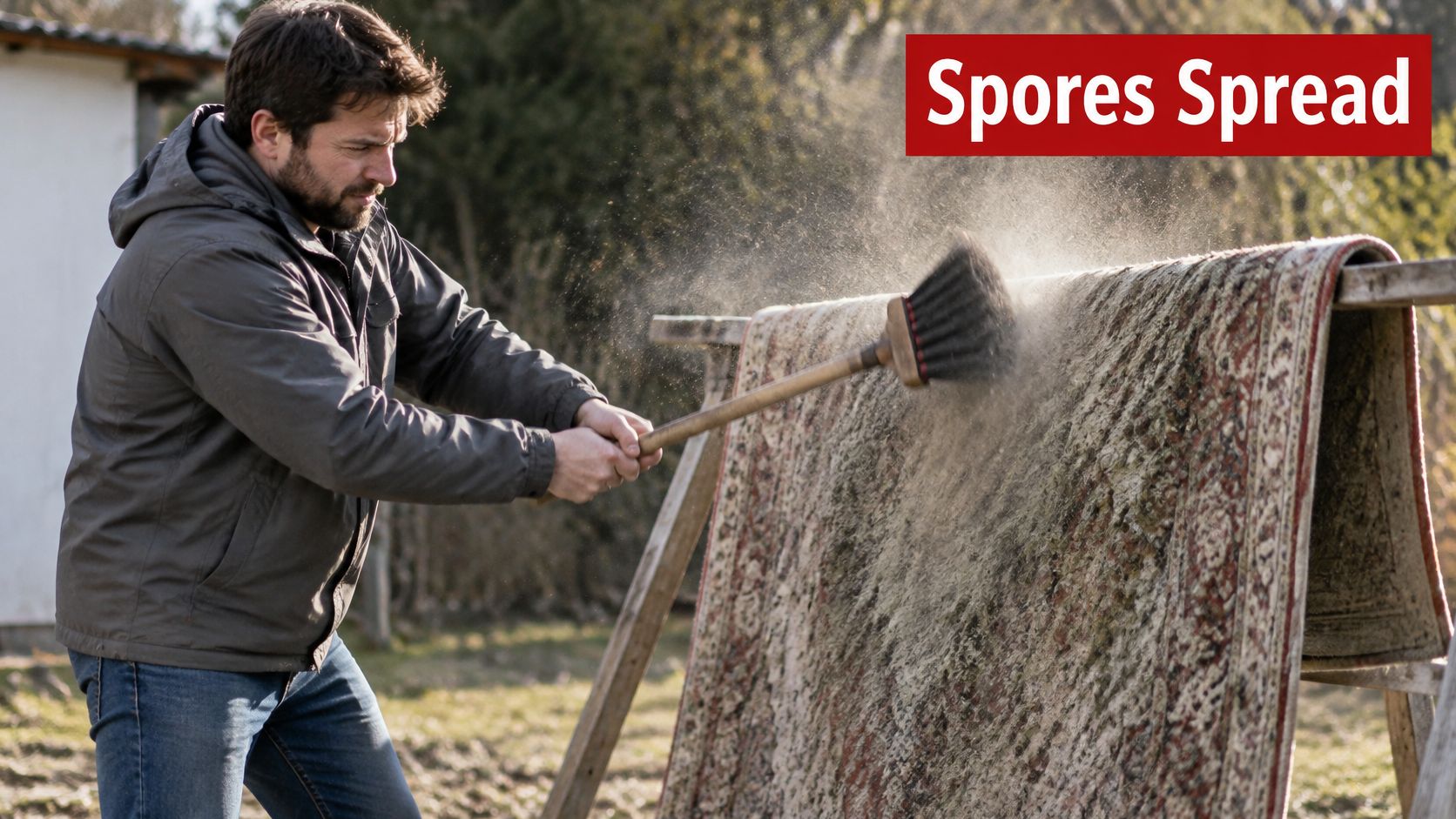
Brushing, beating, vacuuming, or dragging a moldy rug can release particles and carry contamination into other rooms. A household vacuum isn't a safe substitute for a mold-cleanup system, and beating a rug outdoors doesn't make embedded growth disappear.
The action shown below is not a recommended way to handle a suspected moldy rug.
Why sprays and rental machines fall short
The CDC's mold cleanup guidance recommends at least a NIOSH-approved N95 respirator for cleanup and gives a maximum bleach concentration of 1 cup per 1 gallon of water. That general cleanup dilution is not a recommendation to bleach a rug. It doesn't establish that embedded contamination can be removed from a particular backing or pad.
Bleach may damage dyes, and antimicrobial sprays don't correct a leak or remove contaminated material. Adding a chemical solution can also leave more moisture to extract.
A rental extractor presents another trade-off: it can remove some water while adding cleaning solution that the rug's foundation retains. Our explanation of area rug cleaning machine limitations addresses why equipment intended for installed carpet isn't interchangeable with facility rug washing.
Isolate rather than disturb
- Restrict access. Close the room's doors and keep children and pets away.
- Leave transport to the team. Don't drag the rug through the house. Arrange controlled removal rather than moving it yourself.
- Avoid ordinary vacuuming. Don't brush, beat, or scrub suspected growth.
- Don't store it damp in plastic. Sealing it traps moisture; professional containment for transport is a separate handling decision.
Cleanup protection also includes gloves and fully protective goggles. Valuable, delicate, or heavily wet rugs need assessment before any aggressive cleaning begins.
When Mold Spreads Beyond the Rug
You generally don't need to identify the mold species before taking action. The CDC's mold guidance emphasizes removing visible mold and correcting the moisture source, and advises people with asthma, COPD, or compromised immunity to avoid moldy spaces during cleanup.
A rug problem may also be a room problem if the odor persists after removal, baseboards swell, the exposed floor is stained, or damp patches return. Cleaning the rug won't resolve moisture beneath it.
When to escalate beyond rug cleaning
- Document the affected area without disturbing it. Note visible growth on the rug and surrounding floor.
- If the rug alone appears affected, arrange professional rug assessment. Mention suspected mold when booking so handling can be planned.
- Arrange room remediation when growth is extensive or affects building materials. The EPA's brief guide to mold recommends consulting its professional guidance when mold covers more than about 10 square feet.
- Reassess persistent odor before returning the rug. The floor and room must be ready, not merely empty.
Return condition: A restored rug belongs on a dry, corrected surface, not back over the source of the original problem.
Keep vulnerable household members out of the affected room until it has been assessed. Anyone with persistent symptoms should seek medical advice rather than using odor or visible staining to judge exposure.
Our rug inspection addresses the textile. If the subfloor or walls are affected, a building-remediation professional needs to address that separate scope before return delivery.
What Professional Rug Restoration in Birmingham Involves and How to Book
Professional restoration starts with a decision about what the rug can tolerate. Not every wet rug should be immersed, scrubbed, or restored, and suspected mold changes how a rug should be handled before routine cleaning begins.
For homeowners in Birmingham, Hoover, Vestavia Hills, and surrounding communities, pickup removes a difficult practical obstacle: transporting a heavy wet rug without spreading moisture through the home.

From pickup to a restoration decision
Home pickup and separate pad handling. Tell our team about the water source and suspected growth before arrival. The rug and pad need separate consideration, and homeowners shouldn't have to carry a saturated rug to a vehicle. Our rug cleaning pickup process explains the convenience of collection and return.
Inspection comes before wet work. We examine the face, backing, fringe, and foundation for dye movement, deterioration, and separation. Findings determine whether cleaning is appropriate and which areas need stabilization or special attention.
Water extraction reduces the drying load. Where suitable for the rug, large centrifugal machines spin it so fast that remaining water drains away, leaving it nearly dry before controlled drying. Equipment selection must follow the rug's condition, not the other way around.
The exact washing and extraction sequence is material-specific. Extraction may be needed to stabilize a wet rug, while further extraction follows washing and rinsing when those processes are appropriate.
Washing, drying, and finishing
Fiber-safe washing and targeted spotting. For rugs approved for washing, specialized detergents lift embedded soil while protecting fibers and dyes. After soaking, rugs are spread out on a custom-built wash floor for scrubbing or spotting needs. Deep stain and odor removal requires treating the affected material, not covering it with fragrance.
Controlled drying follows extraction. Temperature, humidity, and placement are managed to protect the rug while residual moisture leaves the foundation. Dense wool and synthetic constructions need an approach suited to their structure; uncontrolled heat isn't a shortcut.
Grooming and return placement finish the work. Brushing restores the pile's presentation, and inspection checks the result before delivery. We return the rug to its original location once the receiving area is dry and any underlying moisture problem has been corrected.
That pickup-and-return arrangement is especially useful for households in Trussville, Pelham, Alabaster, Gardendale, and Helena that can't safely move a wet rug themselves. It also keeps a restoration decision separate from the pressure to make a damaged rug usable immediately.
Give the booking team useful details
Photograph the damage before pickup. Have the water source, approximate discovery time, rug material if known, and any backing changes ready when you call. Mention sewage exposure, visible growth, and vulnerable occupants at the start of the conversation.
Clear intake matters for cleaning businesses handling urgent requests. Operators comparing ways to capture those details can browse maid service answering options from Recepta.ai; homeowners should provide the damage details directly when scheduling.
Our booking form lists food or drink stains such as wine and coffee, pet urine or odors, mold, mildew or water damage, and fraying edges or moth damage. Select the relevant problems and describe the leak rather than submitting the rug as routine maintenance.
Call Rubber Ducky Rug Cleaning in Birmingham to schedule pickup, request a rug cleaning estimate, or book a restoration assessment. Waiting for the smell to disappear can allow a manageable drying problem to become a more difficult contamination and odor problem.
Rubber Ducky Rug Cleaning Birmingham offers home pickup, professional rug washing, controlled drying, and return placement for rugs that can be restored after water damage. Visit Rubber Ducky Rug Cleaning Birmingham to request an estimate and schedule pickup, and include the water source and any signs of mold so the team can plan the assessment.