
A sheepskin by the sofa in a Mountain Brook den looks indestructible until the family dog trots in with red clay on its paws, or a glass of red wine tips over mid-book-club. Then the softest thing in the room becomes the one you're afraid to touch. How to clean a sheepskin rug without turning that creamy fleece into a stiff, cracked mat comes down to one principle: a sheepskin is wool and leather at the same time, so every decision about water, heat and detergent has to satisfy both materials at once.
Birmingham makes that harder than it sounds. Red clay sits in the pile until it's ground in, summer humidity slows drying inside a closed house, and a pet accident that would be a minor annoyance on a synthetic carpet can wick straight into the hide on a sheepskin. Homeowners from Hoover to Trussville ask the same thing in different words: can I just wash it, or will I wreck it? The answer depends on the label, the backing and the condition of the hide. Read all three first and you'll know whether this is a fifteen-minute spot clean or a job for a proper wash floor.
Check the Label and Backing Before Any Water
Six checks, done on the floor before the rug moves an inch.
- Read the care label. A tub symbol with a hand means limited hand washing is tolerated; a tub with a cross through it means dry clean only, and that instruction wins over anything you read online.
- Turn the rug over and identify the backing. Bare tanned leather, a cotton or synthetic fabric layer, or a glued foam bonding layer all behave differently once saturated.
- Shake it outside and vacuum on suction only. Grit left in the pile rubs against the fibers during washing like sandpaper.
- Press a damp white cloth into a hidden corner. Colour on the cloth means the dye is not stable and the rug should never be immersed.
- Feel the hide with your fingers. Dark patches, a stiff board-like feel or a papery, brittle surface mean the leather has already lost its natural oils.
- Choose the route. Wash at home, spot clean only, or book an assessment.
What each result means is blunt. A cotton, synthetic or glued backing rules out a full wash, because those layers shrink and swell differently from the hide and the rug will never lie flat again. Dye transfer on the test cloth means spot treatment only, and anything larger than a dinner plate goes to a professional. A brittle or papery hide should not be soaked at all, at any temperature, with any detergent.
The contrarian point: a complete bath is not automatically gentler than targeted cleaning. Delicate wool and hide are harmed by excess water even when the detergent is mild, so dry soil removal plus controlled spot treatment is often the lower-risk option.
"Sheepskin" is also not one uniform material. A rug may be vegetable-tanned, chrome-tanned, dyed, naturally coloured, or a set of smaller skins stitched together with the seams hidden under a fabric layer, and each construction changes the risk of shrinkage, stiffness, dye bleeding or delamination, as this comparison of sheepskin cleaning risks sets out. Vintage and hand-finished pieces deserve the most caution, because "clean but permanently altered" is a poor trade.
If all six checks pass, move to the washing steps. If any one of them fails, stop and book a professional assessment before water touches the rug.
Safe Washing Temperatures for Sheepskin Rugs
A sheepskin sits between the sofa and the fireplace in a Homewood living room. The dog sleeps on it every night, someone tracked red clay across it on Saturday, and now it's rolled up by the back door waiting for a decision. The first question is never which detergent. It's how warm the water can be.
Water temperature is where most home washes go wrong, because the hide reacts long before the wool looks any different. Sheepskin is a wool-and-leather material, so cleaning has to control moisture and temperature together. Woolmark's sheepskin product guidance puts the limit at a maximum of 60°C for washing and a maximum of 60°C for tumble or hang drying, and notes that these are ceilings rather than targets. It also points out that fleece crushed by washing can be restored by combing with a coarse metal comb.
Published care guides don't agree, which is exactly why you read them as upper limits:
| Source | Maximum wash temperature | Drying guidance |
|---|---|---|
| Woolmark sheepskin guidance | 60°C | Hang or tumble-dry, maximum 60°C |
| Kiwi Sheepskins 2026 care guide | 40°C (104°F) | No dryer instruction, so air dry flat and away from heat |
| The Sheepskin Shop 2026 care guide | 38°C (100°F) | Flat or line dry, no tumble drying |
| Sheepskinhouse 2026 care instructions | 30°C (86°F) | No dryer instruction, so air dry flat |
| Kramer 2026 sheepskin FAQ | 30°C (86°F) | Dryer setting no higher than 30°C |
| Helpling 2026 cleaning guide | Below 30°C | Air dry only, since higher heat can harden the leather |
Read the Kiwi figure against the Sheepskin Shop figure and you'll see the trap. A rug washed happily at 40°C by one owner may be a rug whose hide stiffens for another, because tanning method and age differ. The strictest credible ceiling in that table is the one to follow.
Practical rule: for a home rug, hold the wash bath at 30°C (86°F) or below unless your own care label clearly permits more, and keep every rinse at the same temperature or cooler.
Heat gets in through more than the tap. Hot household washing, radiators, hair dryers, tumble settings on high, a sunbaked patio in July, and a car boot on an August afternoon in Pelham all count. Woolmark's guidance also states that sheepskin articles needing dry cleaning should go to a specialist dry cleaner, and specifically advises against coin-operated machines.
If the label gives no number at all, stay at or below 30°C and dry the rug flat, away from heat.
How to Wash a Sheepskin Rug Step by Step
For a rug that passed all six checks, this is the sequence. It runs on cool water, minimal agitation and patience rather than strength.
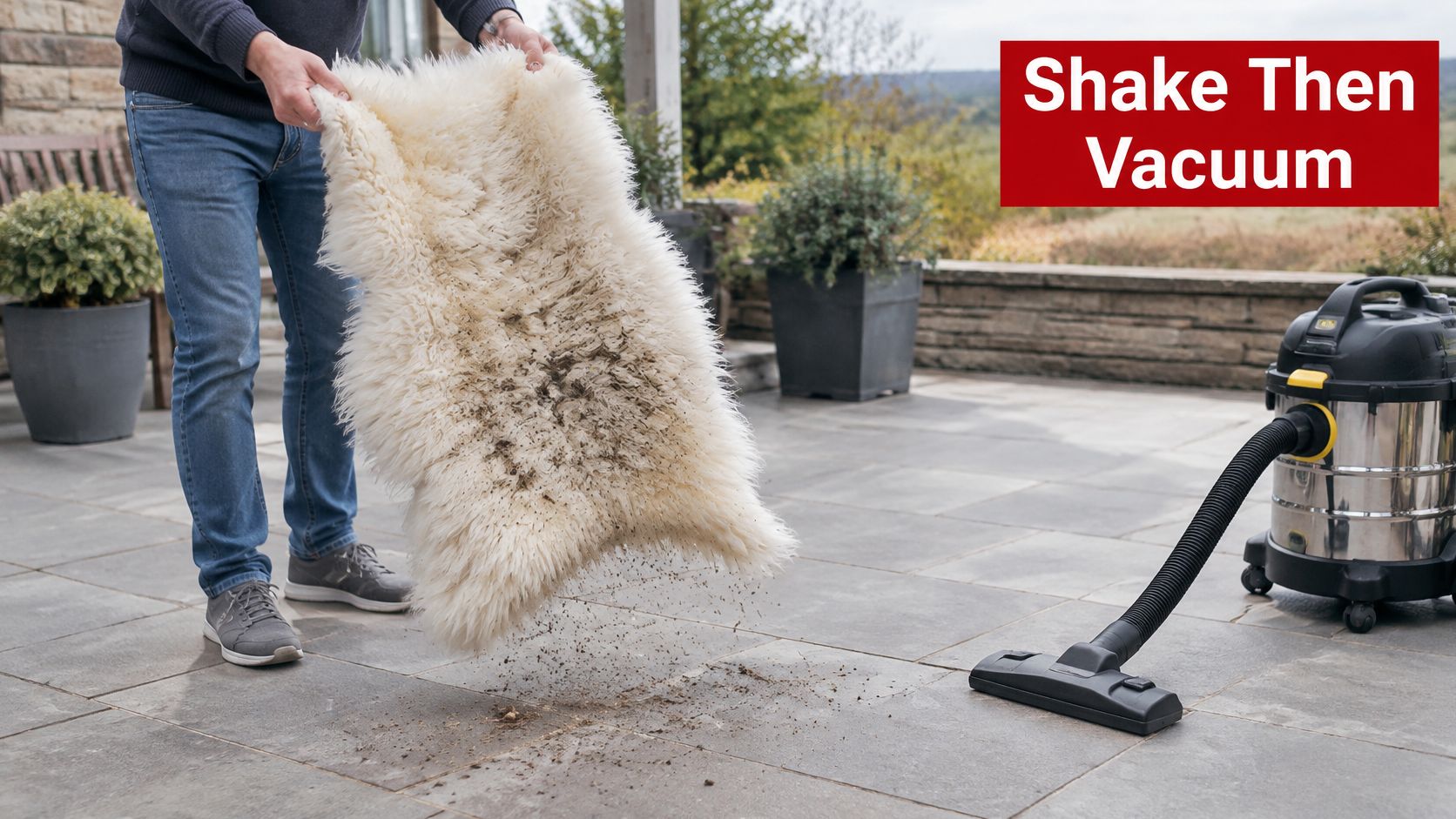
Start outside, because the dry step does more work than many expect.
- Shake and vacuum dry. Shake the rug outdoors, then vacuum with suction only and no beater bar. Grit left in the pile grinds into the fibers while you wash.
- Fill a tub with cool water at 30°C or below, checked with a thermometer rather than your hand. Your hand reads 30°C water as lukewarm and 40°C water as comfortable, which is how hides get cooked.
- Add a wool- or sheepskin-approved, non-bleaching detergent. Leave out enzyme detergents, alkaline powders and fabric softener. Wool is protein, and enzymes designed to break down organic matter don't distinguish between a stain and the fiber.
- Lower the rug in and work the solution through with your hands. Gentle kneading, no scrubbing, no twisting, and a short soak. Sierra's sheepskin care guide describes this low-moisture-to-rinse approach and warns that hide and wool respond poorly to heat, harsh chemistry, twisting and abrasion.
- Drain and rinse in clean cool water until no suds remain, changing the water as often as it takes. Detergent left behind attracts new dirt and stiffens the wool.
- Press the water out between clean towels, or roll the rug inside a towel and press. Never wring it. Wringing distorts the shape and can crack the backing.
- Dry it flat on a clean towel or hang it in still air, away from radiators, hair dryers and direct sun, without stretching or folding it while damp. Full drying usually takes a day or more indoors, so it's worth knowing how long a rug takes to dry before you plan the room around it. Check the hide side with your palm before you put it back down.
- Comb the fleece once it's fully dry. A coarse metal comb or a slicker-style brush, worked in long strokes with the grain, lifts the pile back to softness. Brushing a damp rug just mats it.
Three mistakes that undo a careful wash
Hot household water. It strips the natural grease that keeps wool soft and drives the hide toward shrinkage. Fix: a thermometer and 30°C.
Drying on a radiator or in a hot car. The wool dries fast and the hide dries hard, and the rug comes back board-stiff. Fix: flat, room temperature, moving air.
Skipping the dry-soil step. Wetting a gritty rug pushes clay into the base of the pile, where it's much harder to lift. Fix: shake and vacuum first, every time.
One more thing: a wool rug doesn't need a heavy detergent to get clean. A 2022 study of sheep-wool washing found raw wool carrying roughly 35% impurities by mass including soil and wool grease, and noted that aggressive detergents or repeated hot washing can strip too much of that grease and leave the pile harsh (IOP Conference Series, 2022). The industrial numbers don't translate to your living room, but the principle does: clean thoroughly, strip minimally.
Whole-rug washing is off the table entirely when the label prohibits it, or when the backing is cotton, synthetic, glued, cracked or already brittle.
Treating Pet Urine and Stains Without Over-Wetting
The most common mistake isn't the wrong product. It's volume. Homeowners spray, soak, spray again and then steam, and by the time the smell fades the hide is saturated, the drying takes four days, and the risk of stiffness and mildew has multiplied.
Fresh urine is a surface problem only for the first few minutes. Blot it as dry as possible with plain paper towels, lift any solids, then test whatever product you intend to use in a hidden spot and only use it where its label permits. An EPA-registered urine treatment label spells out the reason: urine in carpet should be blotted as dry as possible and then treated at full strength through the carpet and into the pad, with treated surfaces left visibly wet for 60 seconds before drying (EPA-registered product label). Contamination below the surface is the whole problem, and a light mist on top of the wool never reaches it.
| Problem | Why it is hard | Safe first step |
|---|---|---|
| Fresh pet urine on the surface | Liquid reaches the backing and hide | Blot as dry as possible, then a hidden-spot test before any labelled product |
| Old odor that returns after drying | Contamination has penetrated the hide | Stop home treatment and book professional cleaning |
| Wine or coffee spill | Liquid sinks into the wool | Blot, then dab with minimal lukewarm water and neutral wool detergent |
| Red-clay soil and grit | Embeds deep in the fibers | Dry vacuum on suction, then shake outside |
| Mold or mildew | Damp fleece and hide | Dry at once, and get professional help if it returns |
Repeated spraying, steam cleaning and soaking all spread contamination outward, extend drying time and raise the chance of a stiff or musty rug. Alkaline cleaners and enzyme products are not automatically safe on a wool and leather composite either; guidance on wool carpet stains consistently favours low-alkalinity products, minimal moisture and no chlorine bleach, and enzyme treatments should only go on after a hidden test. Where odour has travelled further than a rug, a service that handles hotel pet urine odor removal shows how much of the job is extraction and drying rather than surface spraying.
For wine or coffee, blot first and dab with a tiny amount of lukewarm water and neutral wool detergent. Never rub, and never scrub across the pile.
The fix-or-stop rule: if the rug still smells after it has dried completely, the problem is below the surface and home treatment is done. Repeated attempts won't reach it, and they'll keep the hide wet.
That is the point where a controlled process such as a pet urine odor and stain remover beats anything you can do with a spray bottle, because it treats the rug as a whole rather than the fibres you can see.
Professional Cleaning and Booking in Birmingham
Birmingham conditions stack the odds against home washing. Red clay is heavy and settles deep, humidity in July and August keeps a wet hide damp for days, and a rug that took on water during a storm is already on a clock. That last point is the one homeowners underestimate most: the CDC's guidance on cleaning up after flooding calls for cleanup and drying to begin within 24 to 48 hours, notes that mold may develop within one to two days, and advises removing porous materials, including carpeting and carpet padding, that stayed wet longer than 48 hours and can't be thoroughly cleaned and dried.
The rest of the decision is usually about the rug itself:
| Rug situation | Risk of home care | Professional approach |
|---|---|---|
| Lightly soiled, label permits washing | Low if kept at or below 30°C | Optional, spot cleaning may be enough |
| Large or heavily soiled rug | Uneven drying causes stiffness and shrinkage | Recommended, with controlled drying |
| Hand-finished, vintage or valuable hide | High risk of permanent change | Specialist cleaning after inspection |
| Cotton, synthetic or glued backing | Full immersion can distort or delaminate | Assessment before any wet cleaning |
| Water damage, rug wet for 24 to 48 hours | Drying may not be complete at home | Immediate professional drying, and discard if unsalvageable |
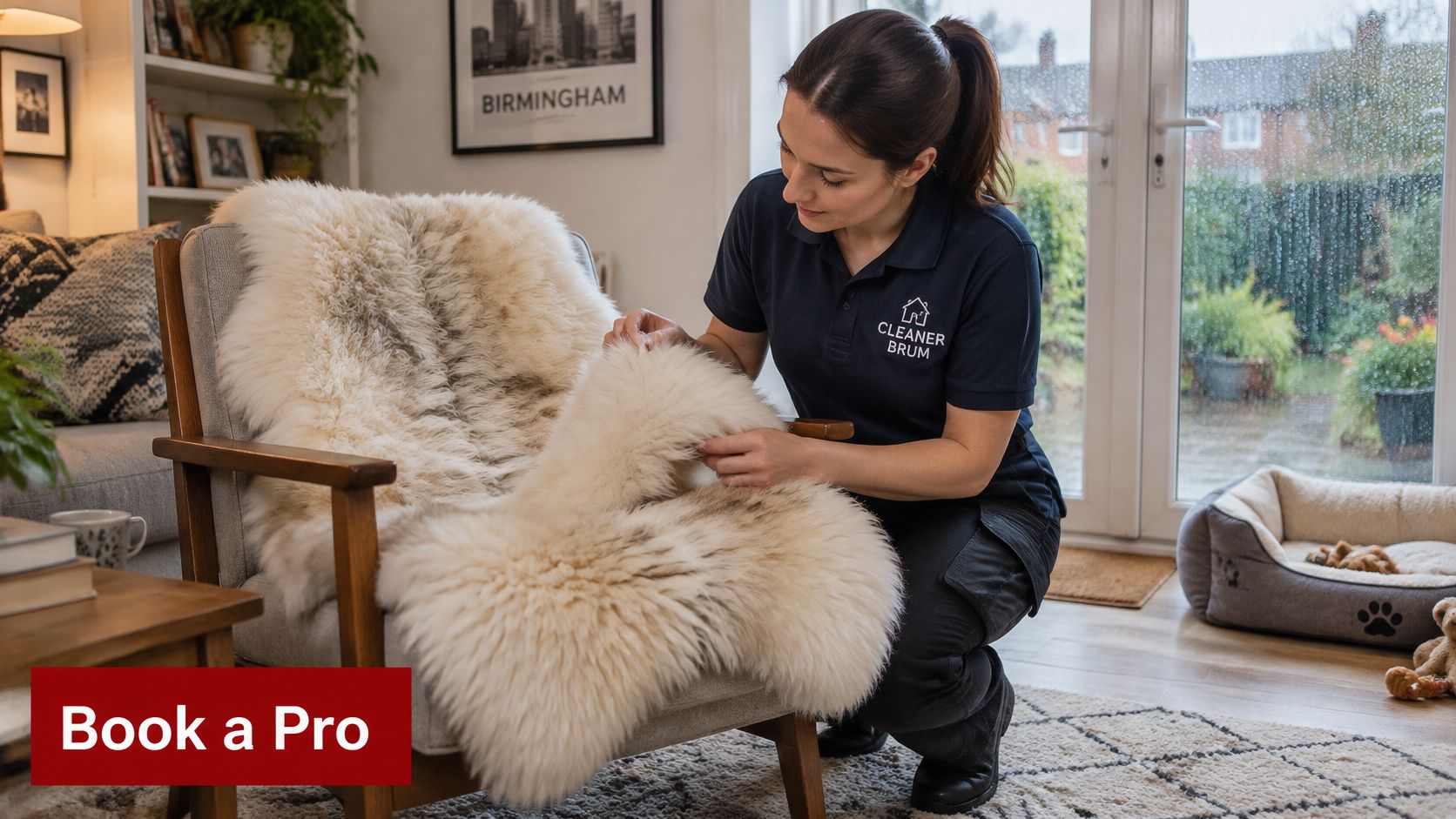
Coin-operated machines don't belong in this conversation, and neither does a borrowed wet vacuum. What a sheepskin needs is inspection, then a wash matched to the hide, then drying that stays ahead of the humidity. At Rubber Ducky Rug Cleaning Birmingham, every rug is inspected before cleaning and then dusted in purpose-built mechanical dusters, which pulls out the grit a household vacuum leaves behind. Drying happens in large, climate-controlled rooms where temperature and humidity are balanced to protect the fibers, and each rug is hung so the fibers settle naturally before the pile is brushed to restore softness, texture and shine.
Pickup and return are the part most customers care about, and the area rug cleaning pickup service works like this. We collect rugs from your home, clean them at our local facility, and bring them back to the exact spot they came from, so nobody is wrestling a wet sheepskin into a car or leaving it folded in a hallway. The booking form accepts area, throw and outdoor rugs, and we serve Hoover, Vestavia Hills, Mountain Brook, Homewood and the wider metro. Customers who drop off and pick up at a Rubber Ducky location get 20% off area rug cleaning. If a spill has also reached upholstery nearby, the fabric cleaning guidance from Giorgi Bros is a sensible read before you treat both at once.
Call (205) 329-6488 or email info@rubberduckyrugs.com for a rug cleaning estimate. Book pickup before a stain sets, and certainly before a damp rug spends another night damp.
A sheepskin that's been shaken out, spot tested and kept away from heat will last for years, but the rugs that come to us stiff, cracked or smelling of old accidents are almost always the ones that got soaked and dried too slowly. Rubber Ducky Rug Cleaning Birmingham offers pickup from your door, fiber-appropriate washing, climate-controlled drying and return to the same spot in your home, which is the difference between a sheepskin that comes back soft and one that never lies flat again. Visit Rubber Ducky Rug Cleaning Birmingham to book a pickup or request an estimate, and let us assess the hide before you reach for the bucket.