A wet-cleaned area rug in a Birmingham home usually dries in about 6 to 12 hours when the water has been extracted properly and air moves across both faces. The same rug lying flat on the floor can stay damp for 24 to 48 hours or longer, because the backing never gets air and the moisture has nowhere to go.
That gap of a few hours versus a couple of days is set by the setup, not by luck. Two rugs of identical fiber can leave the same wash tank and finish drying a day apart, one on a rack with a fan underneath and one folded over a porch rail.
Drying is a deadline, not a convenience. The EPA water-damage guidance treats 24 to 48 hours as a prevention target rather than a guaranteed cutoff, and notes that mold can still develop in materials dried inside that window. So the useful question isn't only how long does a rug take to dry. It's whether your rug's setup gives it a chance to dry at all.
Typical Drying Times for Each Rug Type
A thin synthetic flatweave and a dense hand-knotted wool piece can come out of the same cleaning and finish a day apart. Construction sets the starting point: fiber, pile depth and backing decide how much water a rug holds, and the setup decides how fast that water can leave. Guidance on carpet cleaning drying times frames the ranges in the same terms and explains the mechanics behind them.
No universal number fits every rug. Room temperature, indoor humidity and how thoroughly the water was extracted all move the finish line, which is why the table below pairs each rug type with the conditions around it.
What each setup actually delivers
| Rug type or setup | Typical drying time | What slows it |
|---|---|---|
| Thin flatweave or synthetic rug, elevated with air moving underneath | About 6 to 12 hours | Humid room or heavy saturation |
| Thin flatweave or synthetic rug, lying flat on a floor | 24 to 48 hours or longer | Backing stays against the floor |
| Dense wool, shag or thick pile, with airflow | Often beyond 12 hours | Dense fibers hold water |
| Rubber-backed rug, any setup | Often beyond 12 hours | Backing traps moisture |
| Heavily saturated rug after any cleaning | Beyond 12 hours | Insufficient extraction; investigate |
The single most useful distinction in that table is whether air reaches both faces. Elevation moves moisture off the backing as well as the pile. A rug pressed flat against hardwood can only evaporate upward, so water collects where it has the least chance to leave.
Rubber-backed and dense wool rugs are the two cases Birmingham homeowners underestimate most. A rubber backing is a vapor barrier, so the rug can feel dry on top while the underside stays cool and damp far longer. Dense wool, shag and thick pile hold water deep in the pile base long after the surface looks finished.
A rug still damp well past its expected window has a setup problem, not a patience problem. At that point the answer is more airflow, better extraction or professional drying, not more waiting. If a rug stays damp overnight, I'd stop adding time and start changing the conditions around it.
Treat every figure here as a planning range, not a promise. Professional setups compress the interval with centrifugal machines that spin water out before drying starts, racks that hang rugs so air reaches both sides, and climate-controlled drying rooms that balance temperature and humidity. Dense natural fibers and a humid room stretch it, and a Birmingham July supplies the second one for free.
What Changes How Fast a Rug Dries
Speed comes down to a handful of variables, and they stack.
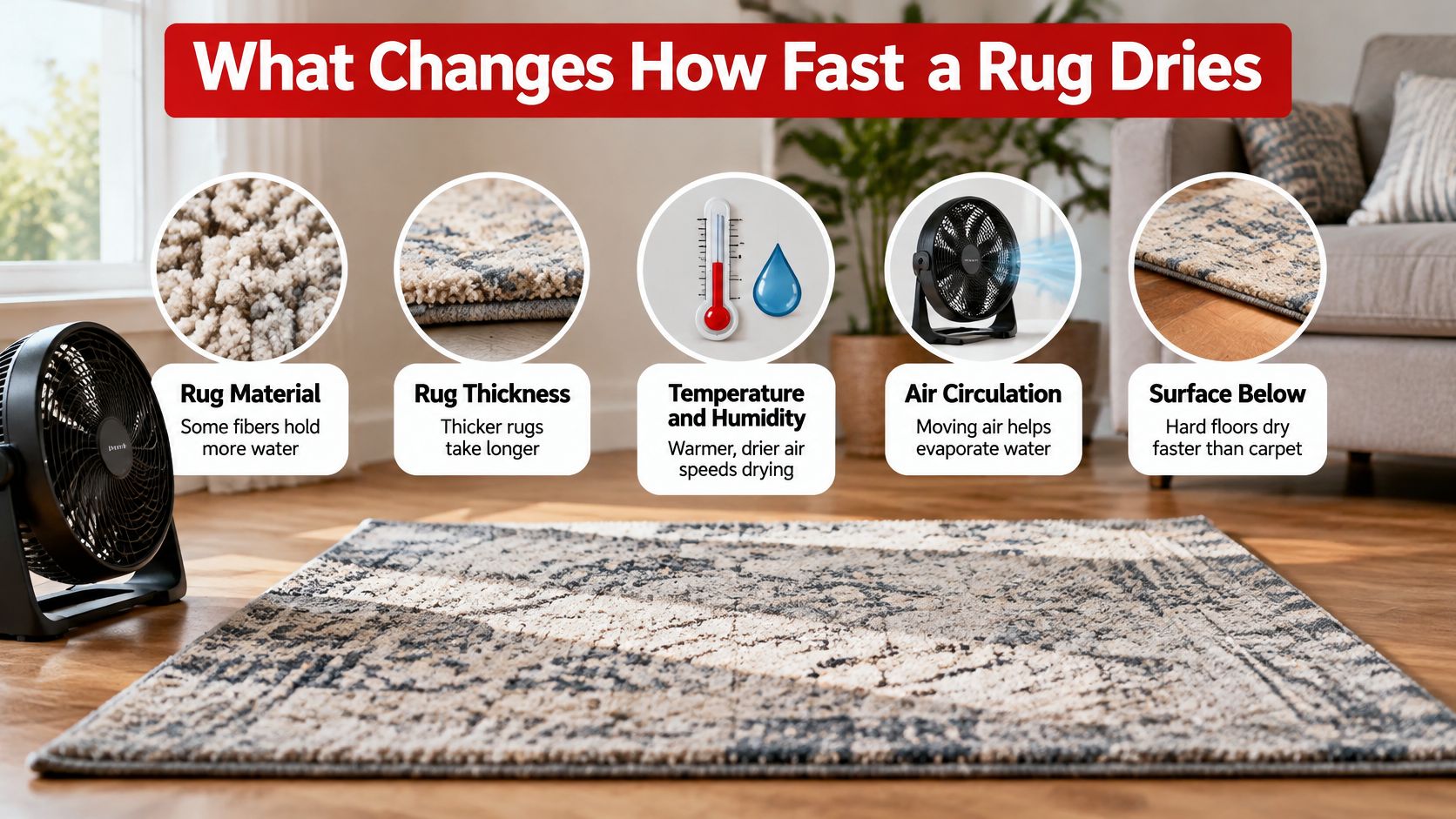
The Environmental Protection Agency names three mechanical factors that govern carpet drying: water extraction, air circulation and humidity control. Its recommended order is to remove water with an extraction vacuum, use fans to accelerate evaporation, then run a dehumidifier to lower ambient moisture. The same guidance states that increasing air circulation and temperature generally increases drying speed (EPA mold remediation guide, Chapter 4).
| Factor | Effect on drying | Target or action |
|---|---|---|
| Water extraction | Removes most water before drying starts | Extract thoroughly; a dripping rug adds hours |
| Air circulation | Speeds evaporation from both faces | Elevate the rug and move air underneath |
| Indoor humidity | High humidity slows evaporation | Below 60 percent, ideally 30 to 50 percent |
| Temperature | Warmer air generally speeds drying | Warm, moving air without high heat |
| Fiber density and thickness | Dense, thick pile holds more water | Expect a longer drying window |
| Backing | Rubber or dense backings trap moisture | Lift the rug so the underside can dry |
Extraction deserves first place on that list. A rug that goes into drying still heavy with water adds hours before evaporation even begins, which is why spin-out matters more than fan count. Air circulation comes second because a fan blowing across the pile does less than a fan that also reaches the backing. Humidity comes third: in a closed room where the air is already loaded with moisture, evaporation slows no matter how many fans run.
Where a professional setup changes the math
Large centrifugal machines spin rugs fast enough that the remaining water drains away, leaving them nearly dry before drying even starts. That shortens the window in which dye can travel and the foundation can dry unevenly. From there, drying rooms hold the rug in a climate-controlled space where temperature and humidity are balanced to protect the fibers throughout the dry.
Facility managers working through this carpet care guide for facility managers will recognize the same sequence: extract hard, move air, control humidity, then verify. It's the same physics whether the textile is a 9 by 12 wool rug or a ballroom's broadloom.
Not every fiber tolerates the same pace. Viscose and other cellulose-based rayons are far more fragile when wet, which is why how to clean viscose rugs is a separate conversation entirely. A rug saturated at home and a rug dried in a controlled facility differ because one case manages these variables and the other leaves them to chance.
Why Slow Drying Invites Mold in Birmingham Homes
Mold works on a deadline. The U.S. Environmental Protection Agency states that, in most cases, mold will not grow when wet or damp materials are dried within 24 to 48 hours, and its recommended response for carpet and backing is to extract water with a wet vacuum, lift the carpet and pad off the floor where needed, run fans, and pull room humidity down with a dehumidifier (EPA mold course, Chapter 4). The same guidance recommends holding indoor relative humidity below 60 percent, ideally between 30 and 50 percent.
Normal-feeling air is the most misleading signal in rug drying. A room can feel perfectly comfortable while the rug's foundation is still holding water.
That gap between air and material is where rugs get into trouble. Pile, backing and any pad underneath are porous, so they keep holding moisture long after the room itself reads dry. A rug can feel finished to the hand while its foundation is still inside that 48-hour window, and a rug left flat on the floor traps that moisture exactly where mold wants it: against the surface below, with no air moving through. The setup decides the drying time as much as the rug does.
Birmingham raises the stakes rather than lowering them. Summer humidity stays high for months, and homes sealed against the heat or a cold snap exchange little air, so the margin for slow drying shrinks. A rug cleaned in July needs the same scrutiny as one cleaned in January, and usually more time.
Wiping a damp rug with a household disinfectant does nothing for the moisture inside the foundation, so do disinfectant wipes kill mold is the wrong first question. The risk ends when the rug is fully dry; a wiped surface changes nothing underneath. If a rug is still damp at the 48-hour mark, stop waiting and treat it as a moisture problem. Thick natural-fiber pieces, water-damaged rugs and anything already carrying a musty smell need extended drying or a professional assessment, and mold and water damage remediation is a different job from routine washing.
How to Confirm a Rug Is Dry Underneath
A rug that feels dry on top is not dry. Surface feel is an unreliable endpoint for thick, wool, hand-woven or densely tufted rugs, because moisture stays in the backing, the pile base, the seams and the pad underneath. The EPA recommends drying water-damaged furnishings and materials within 24 to 48 hours to reduce mold risk, while emphasizing that items must be dried completely and that more air circulation, higher temperature and dehumidification speed the process (EPA brief guide to mold, moisture and your home).
What homeowners need isn't a fixed hour count. It's a decision rule.
The rule I use: if the underside feels cool or damp, smells musty, or transfers moisture to a dry towel, the rug stays off the floor.
The five checkpoints
| Checkpoint | Ready to return | Not ready |
|---|---|---|
| Underside or backing | Dry, with no cool or damp patches | Cool, damp or musty |
| Pile base near the backing | Dry when pressed | Damp when pressed |
| Edges and seams | Firm and dry | Soft or wet |
| Area in contact with the floor | Dry, no odor | Musty smell or moisture |
| Dry towel test | No moisture transfers | Moisture transfers to the towel |
Check several spots, not one. A rug can be dry in the middle of the field and still wet at a corner where the fringe holds water or at a seam where two pieces of backing meet. Press with your palm and hold for a few seconds; coolness against your hand is moisture you can't see.
Then check again after the surface feels dry. This is the step often skipped. Indoor humidity and limited winter ventilation in Birmingham homes can keep a rug's interior wet well past the point where the pile reads dry to the touch, and the gap is widest on thick wool and hand-knotted pieces with a cotton foundation.
Returning a rug while its backing is still damp is how odor comes back. The rug goes down over a floor, the pad traps what's left, and two weeks later there's a smell under the coffee table that no amount of vacuuming fixes.
How to Speed Up Drying at Home
Drying time is set as much by the setup as by the rug. The same soaked piece that takes days lying flat on a floor can be ready in a fraction of that once air reaches both faces and the room's humidity has somewhere to go. Work the steps in order.
- Pull the water out first. Run a wet/dry vacuum flat over the pile with no beater bar, working with the nap rather than against it. Press clean towels into the pile instead of rubbing, because rubbing drives water deeper and can move dyes at the edges.
- Get the rug off the floor. Sawhorses, a drying rack or the backs of two chairs give the underside clearance. A rug that stays flat keeps its backing pressed to the floor, and the backing is the face that takes longest to dry.
- Aim fans at both faces. One fan across the top of the pile, one angled underneath at floor level. Moving air strips moisture off a backing far faster than warm still air does.
- Take the humidity out of the room. A dehumidifier, or air conditioning running dry, gives the evaporated water somewhere to go. In a closed Birmingham house in July, fans alone just push damp air in circles.
- Keep the room warm. Warm moving air speeds evaporation. Direct heat from a space heater or a hairdryer can distort wool, set stains and drive dyes into lighter areas, so leave the high heat out of it.
- Turn the rug every couple of hours. Flipping gives the face that was down its turn in the airflow and evens out drying across the whole piece.
- Test the underside at about six hours, then again at twelve. If the backing is still damp at twelve hours, treat that as the cutoff and get the rug professionally dried.
The slips that undo the work
- Laying it flat to let it dry. The floor is the one surface that guarantees slow drying, because it blocks the backing completely.
- Closing the door on the room. A sealed, humid room stalls evaporation even with a fan running.
- Hairdryer on the backing. It feels productive and isn't. Heat on a damp wool foundation risks shrinkage and dye movement without reaching the water held deep in the pile base.
- Leaving the pad underneath. A damp pad holds moisture exactly where you don't want it, against the rug's underside.
A finished rug has a specific signature: a backing that's dry and no longer cool to the touch, a pile that springs back under your palm, and no musty smell when you put your face close to the foundation rather than the surface. If any one of those three is off, the rug stays up. Hanging it back on the rack another day costs nothing; laying it down damp is how the odor problem starts.
Book Your Rug Pickup in Birmingham
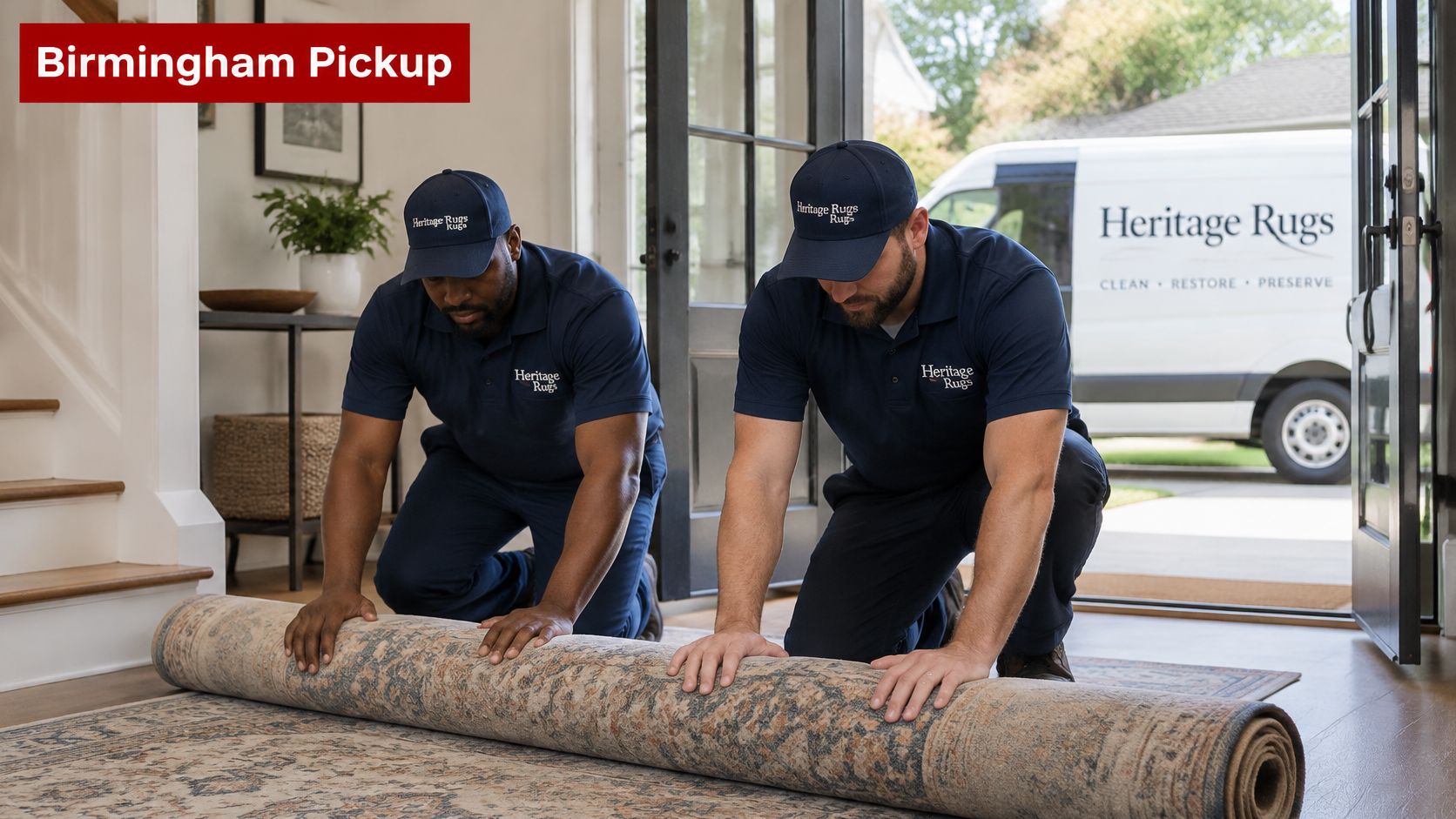
The simplest way to take the drying wait off your calendar is to let the drying happen somewhere built for it. Pickup is handled by Team Members who collect the rug, transport it to the local cleaning facility and schedule its return to your home, so the rug leaves damp and comes back dry, groomed and ready to lay down.

Inside the facility, each rug is hung in a climate-controlled drying room so the fibers settle evenly, with temperature and humidity balanced to protect the piece while moisture leaves the pile and backing. Once dry, the pile is brushed to restore its softness, texture and shine before the rug comes back to you. Homeowners dealing with a soaked rug right now can read about same day rug cleaning before deciding whether to wait.
Booking is straightforward. The form accepts area rugs, throw rugs and outdoor rugs. Customers who drop off and pick up at a Rubber Ducky Rug Cleaning location get 20 percent off area rug cleaning. For an estimate, call (205) 329-6488, and the service reaches Birmingham, Hoover, Vestavia Hills, Mountain Brook, Homewood, Trussville, Pelham, Alabaster, Gardendale and Helena.
Call or book pickup if a rug is still damp after 12 hours, carries a musty smell at the foundation, or still holds pet odor after cleaning. Those are the three signals that the drying phase, not the washing phase, is where the problem sits.
Rubber Ducky Rug Cleaning Birmingham handles the part of rug care that is hardest to get right at home: the wash and the controlled dry that follows it. Rugs are dusted, washed, spun nearly dry in large centrifugal machines and then hung in the drying room so nothing goes back on your floor with moisture trapped underneath. If your rug has been damp for a day or more, or you would rather not spend another afternoon flipping it in front of a fan, visit Rubber Ducky Rug Cleaning Birmingham to schedule pickup and get an estimate.