
A leak under the sink, a damp rug edge, or a musty smell that returns after you've cleaned the room can leave you wondering whether the problem is on the rug or underneath it. For Birmingham homeowners, a useful mold and water damage inspection starts with the water source, then follows moisture through the rug pile, backing, pad, and floor. A home check can reveal warning signs, but it can't prove every concealed area is dry.
Signs of Mold and Water Damage to Check First
When a leak reaches a rug, the key question is whether moisture remains in the pile, backing, pad, or floor beneath it. Check the likely water source, then follow the signs outward. Look under sinks and around tubs, windows, exterior walls, and nearby flooring. A stain's location and shape can help identify where wetting occurred, but appearance alone cannot confirm that the layers below are dry.
| Sign | Where to look | What it suggests |
|---|---|---|
| Tide lines or stains on walls | Baseboards, lower drywall, behind furniture | Past or repeated wetting |
| Musty smell that returns after cleaning | Closets, under sinks, rooms above crawl spaces | Hidden growth or trapped moisture |
| Bubbling or peeling paint | Exterior walls, bathroom ceilings, window sills | Moisture behind the finish |
| Cupped or warped flooring | Hardwood and laminate near doors and sinks | Moisture reaching the subfloor |
| Discolored or sticky rug backing | Rug underside, pad, floor beneath the rug | Water wicked through the rug |
| Dark spots or fuzzy growth | Grout, caulk, vents, rug edges | Visible growth that needs its moisture source addressed |
| Soft drywall or swollen trim | Around tubs, toilets, under windows | Prolonged or repeated wetting |
A musty odor that returns after cleaning deserves attention. Deodorizer can mask an odor, and fresh paint can cover a stain, but neither removes moisture trapped behind a surface. A visible mark may not show the full extent of a damp area; learn more about finding hidden mold inside walls.
Active leaks versus old damage
Fresh staining or a damp surface points to active or recent wetting. Stop the source before cleaning the rug or covering the mark. Dried rings, lifted paint, and warped trim may indicate an earlier event, but check for remaining dampness where a rug covers the floor.
Inspect the rug's face and underside. Stiff or crusty pile, dye bleed, tide lines, sticky or discolored backing, a sour smell after airing, and curled or shrunken edges are warning signs. Photograph each one and note its location before moving or cleaning the rug. A home check can flag concern, but it cannot confirm whether moisture remains inside the rug or beneath it.
Tools for Moisture and Mold Inspection
Each tool answers a different question. A meter can help locate damp material, a hygrometer measures room humidity, and an infrared camera shows temperature patterns. None of them proves by itself that a rug or wall cavity is dry. Use suspected readings as a reason to investigate further, not as a final verdict.
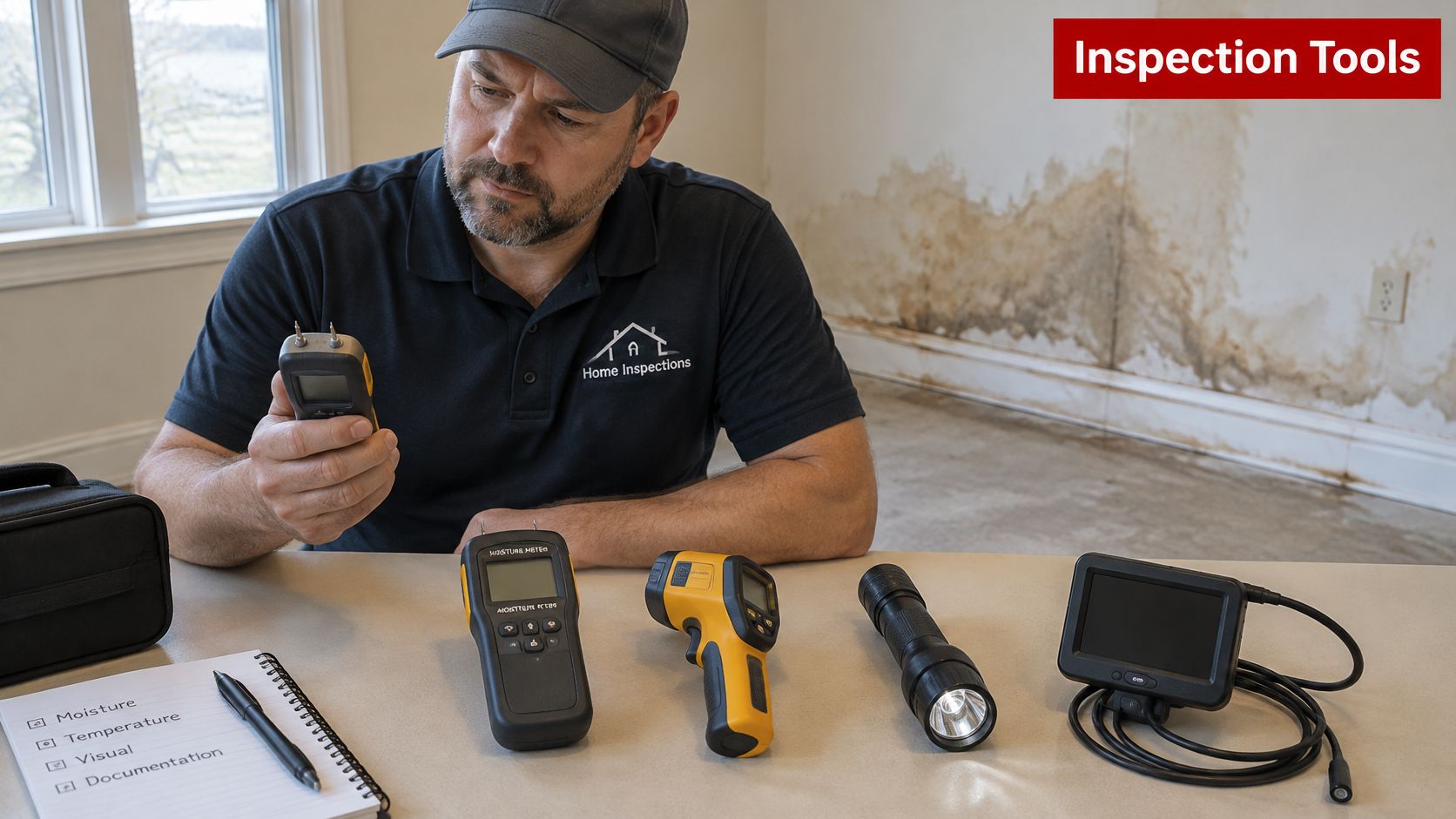
| Tool | What it tells you | How to use it |
|---|---|---|
| Pin-type moisture meter | Moisture content at depth in wood, drywall, and subfloor | Compare the suspect spot with a dry control area of the same material |
| Pinless moisture meter | Surface moisture across a wide area without holes | Scan quickly, then confirm hot spots with a pin meter |
| Thermo-hygrometer | Indoor relative humidity and temperature | Keep humidity under 60 percent, ideally 30 to 50 percent |
| Infrared camera | Temperature differences that can point to wet cavities | Scan walls and floors, then verify with a meter |
| Borescope or inspection camera | Inside of wall cavities and under flooring | Pass through a small opening and look for wetting or growth |
| Flashlight and mirror | Staining under sinks, behind appliances, and on the rug underside | Use low-angle light to reveal marks and edges |
| Tape lift or swab kit | Surface sample for lab analysis | Use only when the result would change a decision |
A meter gives comparative readings, not a stand-alone diagnosis. Take a reading from an unaffected, dry area made of the same material and compare it with the suspect spot. A reading from drywall shouldn't be treated as equivalent to one from wood, and a scan of a rug's face doesn't tell you whether the backing or floor below is damp.
A thermo-hygrometer helps you keep track of indoor conditions. The CDC's mold and moisture guidance recommends keeping indoor humidity below 60 percent, ideally between 30 and 50 percent. For a basic home check, a flashlight, mirror, and simple humidity meter are a reasonable starting kit. Leave cavity inspection, interpreting conflicting meter readings, and decisions about sampling to a qualified professional.
How to Run the Inspection Step by Step
After a leak or spill, a rug can feel dry on top while moisture remains in the pile, backing, pad, or subfloor. Inspect each layer and record what you find. The EPA's guide to mold, moisture, and your home emphasizes tracking down moisture and comparing affected materials with unaffected areas.
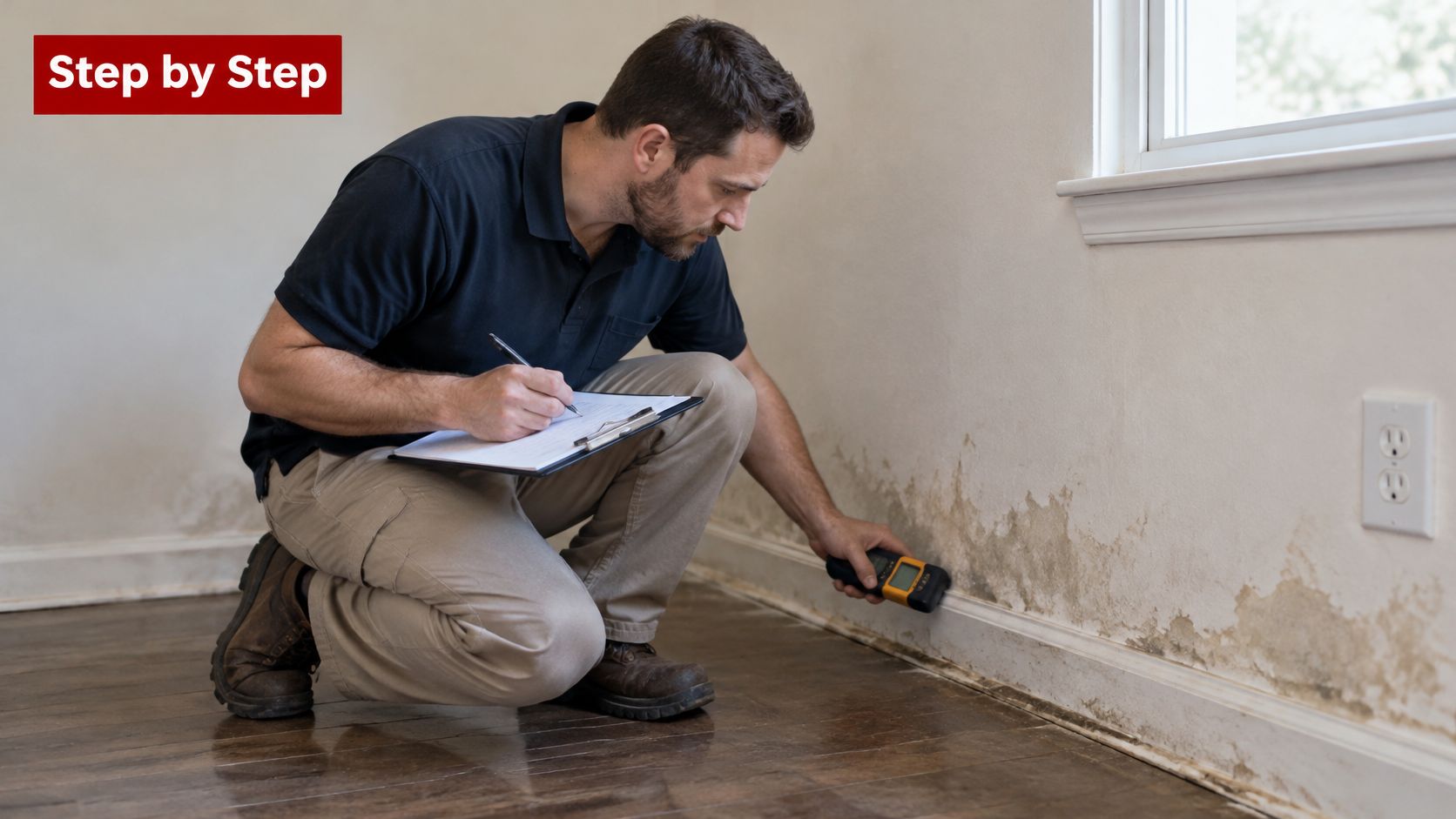
Record the event. Note when the leak or spill happened, what you observed, how long water was present, and the suspected source. If the duration is unclear, record it as unknown.
Stop the water source. Shut off or repair the leak before taking readings. If you cannot identify or safely stop it, contact the appropriate repair professional.
Photograph the room and rug. Record stains, lifted finishes, odor, and visible growth. Include the rug's location and affected edges in your photos. Cleaning or repainting first can erase useful evidence.
Take a dry control reading. Compare the suspect area with an unaffected spot made of the same material. A reading without that comparison may be difficult to interpret.
Check the whole rug assembly. Inspect the rug face and backing, pad, nearby flooring, wall bases, and accessible subfloor. A dry surface reading does not establish that the layers beneath are dry.
Track room humidity. Check conditions at more than one point as drying continues. The EPA's inspection guidance describes keeping humidity under 50 percent during drying. A reading near a doorway may not reflect conditions beside a wet rug or inside a closed cabinet.
Look at accessible hidden spaces. Check behind cabinets, under sinks, around outlets, and beneath loose or accessible baseboards. Don't cut into a wall or disturb suspect material unless you can assess the risk and make the opening safely.
Set a drying boundary and recheck date. List which materials need drying, where you will compare readings, and when you will inspect again. For The Public Adjusters inspection guidance explains why clear damage records matter when describing water damage.
The water damage restoration process for area rugs provides a rug-focused overview. Keep the record practical: photographs, a floor-plan sketch, readings with locations, actions taken to stop the source, and the date of each check. The EPA's guide to mold, moisture, and your home recommends drying flooded materials within 24–48 hours where possible. Porous items that cannot be cleaned and dried completely in that window may need removal. Record the rug's construction, backing, odor, affected area, and water contact time to support a salvage decision.
When Mold Sampling Helps and When It Does Not
A mold test isn't automatically the best first step. If you can see growth, the immediate priority is to find and correct the moisture source and decide how to handle affected materials. The CDC's guidance on mold and health says routine mold testing isn't recommended and that sampling or culturing can't predict whether a person will become ill, because health effects vary by individual.
Sampling may be useful when the water source is unclear, a dispute with an insurer or landlord needs documentation, or a qualified professional needs to verify a remediation outcome. But a clean air result doesn't prove a rug is dry. Moisture and odor can remain in the pile, backing, or pad even when a room-air sample doesn't identify a concern. If visible growth is already present, testing often won't change the need to address the moisture and affected material.
People with asthma, COPD, or weakened immune systems should seek medical advice and avoid taking part in cleanup. A mold inspection is not a health diagnosis. If sampling could affect a real decision, have a qualified professional choose the method and interpret the result.
Before ordering a test, ask:
- Would the result change what I do next?
- Is the water source known?
- Am I in a dispute that needs documentation?
If the answers don't establish a clear purpose, start with a material-by-material moisture inspection instead.
Deciding Whether a Rug Can Be Salvaged
The type of water and how long the rug stayed wet guide the salvage decision. Clean supply water presents a different cleaning question from sewage or floodwater, and a rug that feels dry on top may still hold moisture underneath.
| Rug condition | Likely action | Why it matters |
|---|---|---|
| Clean water, dried within 24 to 48 hours, no odor | Dry with airflow, then arrange professional cleaning | Fibers and backing may still be fully dried |
| Clean water, wet longer than 48 hours | Arrange professional cleaning and drying; discard if the pad stays wet | Growth risk rises with time |
| Gray water, sewage, or floodwater | Discard the pad; have the rug assessed by a professional | Contamination may not clean out of the fibers |
| Visible mold on face or backing | Have it assessed for professional cleaning; isolate it from other rugs | Mold-contaminated material can spread particles |
| Musty odor after drying | Re-clean and re-dry; check the subfloor under the rug | Moisture may still be trapped below the surface |
| Dye bleeding or shrinking edges | Get a professional assessment before cleaning | Dye and fiber stability determine the method |
Check the full rug assembly
Inspect the face and pile, then turn up an edge to check the backing. Look beneath the rug at the pad, tack strip, and floor; a dry-looking face doesn't establish that those surfaces are dry. Smell a folded edge for persistent odor, press a damp white cloth against an inconspicuous area to check for dye transfer, and examine fringe and edges for shrinkage or curling.
Water-extraction vacuums remove standing water while materials are still wet, but they don't dry a rug on their own. The EPA's carpet-drying guidance recommends lifting wet carpet and backing, using air movement to dry them, and drying the padding separately before reinstalling. If a rug goes back onto a damp floor or pad, it can become wet again.
At home, fan drying may improve the surface while leaving the backing damp. That's a particular concern with dense pile or a rug that lies flat on a floor. The EPA's guidance on water-damaged carpet also stresses drying the subfloor, not just the visible floor covering.
What professional rug washing adds
For a rug that may be salvageable, professional cleaning can address soil and residue while protecting the construction of the piece. At Rubber Ducky Rug Cleaning Birmingham, each rug is inspected before cleaning and then dusted in purpose-built mechanical dusters. After washing and rinsing, rugs dry in large, climate-controlled rooms where temperature and humidity are balanced to protect the fibers.
For more on the rug-specific assessment and restoration process, visit our water damage rug restoration page. Don't decide that a rug is ready to return based on its face alone. Make that call only after the backing and pad read dry and the source of the water has been addressed.
Structural Damage That Needs a Professional
Some water problems are no longer just a rug-cleaning issue. Call a qualified remediation or building professional if you find:
- Widespread visible growth on a wall, ceiling, or floor, rather than an isolated mark.
- Visible growth after prolonged wetting, or a material that remains damp and shows signs of growth.
- Sewage, gray water, or floodwater on the rug, pad, or surrounding surfaces.
- Water inside a wall cavity, cabinet, or subfloor that you can't reach and dry safely.
- A leak that returns after an attempted repair.
- Ceiling stains that suggest water is coming from above.
- A musty smell after drying when you can't locate the damp material.
- Occupants with asthma, COPD, or immune problems who could be affected by cleanup conditions.
Rug and carpet drying doesn't automatically dry the floor beneath. The EPA's guidance for water-damaged carpet and its backing recommends addressing the subfloor too, because moisture left below a floor covering can persist after the visible surface feels dry. If the water reached the pad or subfloor, include those materials in the inspection rather than focusing only on the rug.
Before work begins, ask the contractor for readings by location, photographs or a sketch, confirmation that the water source has been fixed, the drying targets, and a reinspection date. A single room-air reading or a statement that the surface looks better doesn't answer whether the rug backing, pad, and floor are dry.
Escalation rule: If you can't say where the water came from, or the damage crosses more than one room, bring in a professional to assess the building and the affected materials.
Verifying Dryness and Booking Rug Pickup
A rug can feel dry on top while moisture remains in its backing, pad, or the floor below. Check the rug face, backing, pad, nearby flooring, and wall edges, then compare each reading with a dry area made of the same material. Keep indoor humidity at or below 50 percent during drying, as stated in the EPA's post-remediation guidance.
Check again after drying equipment is removed, and note whether odor returns once the rug has aired. A single low reading does not confirm that conditions are stable. If readings rise or mustiness returns, continue investigating before placing the rug back.
Keep a fine or hand-woven rug separate from unaffected items until cleaning and drying are complete. Check for residual odor, staining, backing distortion, and edge damage before deciding where it belongs.
Rubber Ducky Rug Cleaning Birmingham's booking form includes mold, mildew, or water damage, as well as food or drink stains, pet urine or odors, and fraying edges or moth damage. Each rug is inspected before cleaning. Learn about area rug pickup and delivery options or request an estimate.
If a leak has left a rug damp, musty, or visibly changed, Rubber Ducky Rug Cleaning Birmingham offers professional rug cleaning and care, including controlled drying. Contact the team at info@rubberduckyrugs.com to ask about the next step.