You're in the Birmingham home you've worked hard to keep clean, yet the area rug in the living room still gives off a pet odor when the weather turns humid. Vacuuming lifts loose grit, and spot treatment improves the obvious marks, but the pile remains dull and soil keeps resurfacing. That's when many homeowners start searching for an area rug cleaning machine and assume stronger suction, hotter water, or more aggressive brushing will solve everything.
A machine can help, but it isn't the cleaning system by itself. Rug fiber, dye stability, backing, construction, soil type, water recovery, and drying conditions all determine whether equipment produces a clean rug or creates shrinkage, browning, dye migration, odor, or backing damage. For Birmingham homeowners, that distinction is why professional pickup, facility washing, controlled rinsing, and measured drying are often safer than treating an area rug like wall-to-wall carpet.
Why Understanding Rug Cleaning Equipment Matters
A Birmingham homeowner may vacuum a living room rug every week and still notice the same pattern. The rug looks presentable from across the room, but pet odor returns near the sofa, gritty soil works back up around the main walkway, and bright sections gradually look muted. Red-clay dust, tracked-in particles, humidity, pets, and repeated foot traffic can push soil below the visible surface.

The natural response is to rent a powerful extractor or buy a compact rug washer. That can be reasonable for a durable synthetic rug, but it becomes risky when the owner doesn't know whether the rug is wool, silk, viscose, cotton-backed, hand-knotted, antique, or glued. A machine that removes loose soil from polypropylene may over-wet a wool rug or disturb unstable dyes on an older oriental piece.
Cleaning strength isn't the same as cleaning control
The Carpet and Rug Institute's Test Method 119 measures standardized soil-removal efficiency with X-ray fluorescence, rather than treating spray pressure or motor wattage as proof of performance. Its certification bands run from 55–69% for Bronze through 90–100% for Platinum, with each system evaluated using at least three appropriate test samples.
That distinction matters because a high-pressure machine can spread solution quickly without recovering enough of it. Retained detergent, dissolved soil, and moisture can leave a rug sticky, discolored, or musty. Equipment knowledge helps a technician match agitation and extraction to the rug instead of choosing the most forceful setting.
For local context, homeowners comparing equipment can also review professional rug cleaning equipment in Birmingham. The useful question isn't “How powerful is the machine?” It's “Can this process clean the construction safely and leave the rug thoroughly recovered and dry?”
What an Area Rug Cleaning Machine Actually Does
An area rug cleaning machine generally performs some combination of three actions: it applies a cleaning solution, agitates or loosens soil, and extracts moisture. The machine supports the process, but the result depends on how those actions are sequenced and controlled.
Professional rug cleaning follows four connected stages:
- Dry-soil removal comes first. Mechanical dusting or careful vacuuming loosens grit, sand, hair, and other dry particles before water turns them into mud.
- Soil suspension uses suitable detergent, moisture, and controlled agitation to separate remaining soil from the fiber.
- Soil extraction removes suspended soil and cleaning solution. Poor recovery leaves residue and moisture behind.
- Drying reduces the remaining moisture under controlled conditions so the rug can be inspected, groomed, and returned safely.
The Carpet and Rug Institute describes these as the basic scientific principles of effective carpet maintenance and cleaning in its commercial cleaning guidance. Skipping the first stage can force a machine to grind dry grit deeper into the pile. Skipping the final stage can leave a clean-looking surface with a damp backing.
Recovery matters more than spray pressure
Water removal is a separate performance variable from soil removal. CRI certification material identifies a benchmark of no more than 8 ounces of residual water per square yard after hot-water extraction, as documented in the published certification procedures. Those procedures also use controlled wet and dry passes and average results from three samples.
That's why a household machine that makes the rug visibly wet isn't automatically cleaning it effectively. Homeowners researching drying times after steam cleaning should focus on the backing and the environment, not only on when the face feels dry. A rug can feel dry on top while moisture remains below.
For Birmingham homes, controlled drying is part of the service, not an afterthought. A machine can loosen soil, but trained handling determines whether the rug is rinsed clean, recovered properly, and dried without avoidable stress. Homeowners can also compare the equipment used for advanced carpet cleaning in Birmingham, while remembering that rugs often need more careful assessment than installed carpet.
Main Types of Area Rug Cleaning Machines
Different machines solve different parts of the cleaning problem. A dusting tumbler, immersion wash system, truck-mount extractor, and portable extractor shouldn't be judged by the same standard because they expose rugs to different combinations of agitation, water, heat, and recovery.
| Machine Type | Best For | Moisture Risk | Professional Use |
|---|---|---|---|
| Dry-soil tumbler or dusting machine | Embedded grit, sand, pet hair, and dry particulate soil | Low during this stage | Used before washing to reduce the soil load |
| Immersion cleaning system | Rugs that need thorough washing and controlled rinsing | High unless recovery and drying are managed | Used for compatible wool, synthetic, and many washable constructions after inspection |
| Truck-mount hot-water extraction unit | Durable rugs and carpet cleaned in place or with suitable access | Moderate to high, depending on passes and recovery | Used by technicians who can adjust solution, agitation, and extraction |
| Portable hot-water extractor | Smaller jobs and compatible synthetic rugs | Moderate, with greater dependence on operator technique | Useful in selected residential applications, but less forgiving on delicate rugs |
A dry-soil machine releases particles before liquid touches the rug. That makes it useful for high-traffic Birmingham rugs carrying sand, pet hair, and fine grit. It doesn't replace washing because it won't dissolve oily soil, remove urine contamination, or rinse detergent from the pile.
An immersion system can move cleaning solution through the full rug rather than treating only the face. It may suit washable wool and durable synthetics after testing, but silk, viscose, unstable dyes, loose foundations, and compromised backings require a different decision. Immersion also creates a larger drying responsibility, so the facility must have effective water removal and controlled airflow.
Match the equipment to the fiber
Truck-mount and portable extraction units are familiar because they're common in residential carpet cleaning. They can work well on compatible synthetic rugs, especially when the operator controls solution volume and makes sufficient recovery passes. They're less suitable when the rug has a fragile foundation, weak wet strength, unstable color, or construction that can distort under pressure.
Wool often benefits from careful moisture and agitation control. Silk, antique, and handmade rugs demand even more conservative handling because color, structure, and wet strength can vary across the same piece. Synthetic rugs are generally more tolerant, but construction and backing still matter. Machine category should follow inspection, not the other way around.
Home Use Versus Professional Rug Cleaning
The gap between a rental machine and a professional rug facility usually appears in three places: extraction, drying, and fiber decisions. A home unit may apply solution effectively, but it can't guarantee that the rug is sufficiently recovered before it's placed back on a floor.
A residential room also limits drying control. Birmingham humidity, closed rooms, furniture placed over damp edges, and a rug's dense backing can slow evaporation. Professional facilities can isolate the rug, monitor its condition, and use controlled drying equipment rather than relying on a living-room fan.
What trained technicians assess first
Before choosing a cleaning method, a technician should identify the fiber and construction, inspect the backing and fringe, check for previous repairs, and test dye stability in an inconspicuous area. Detergent chemistry must suit the material. A formula that performs well on a synthetic may leave residue or produce an unwanted color reaction on a natural-fiber rug.
The CRI material separates water recovery from soil removal for a reason. A rug may release substantial soil and still retain too much water. Residual moisture can contribute to browning, dye migration, odor, backing distortion, or dimensional change, especially when wool, cotton foundations, glued components, or unstable dyes are involved.
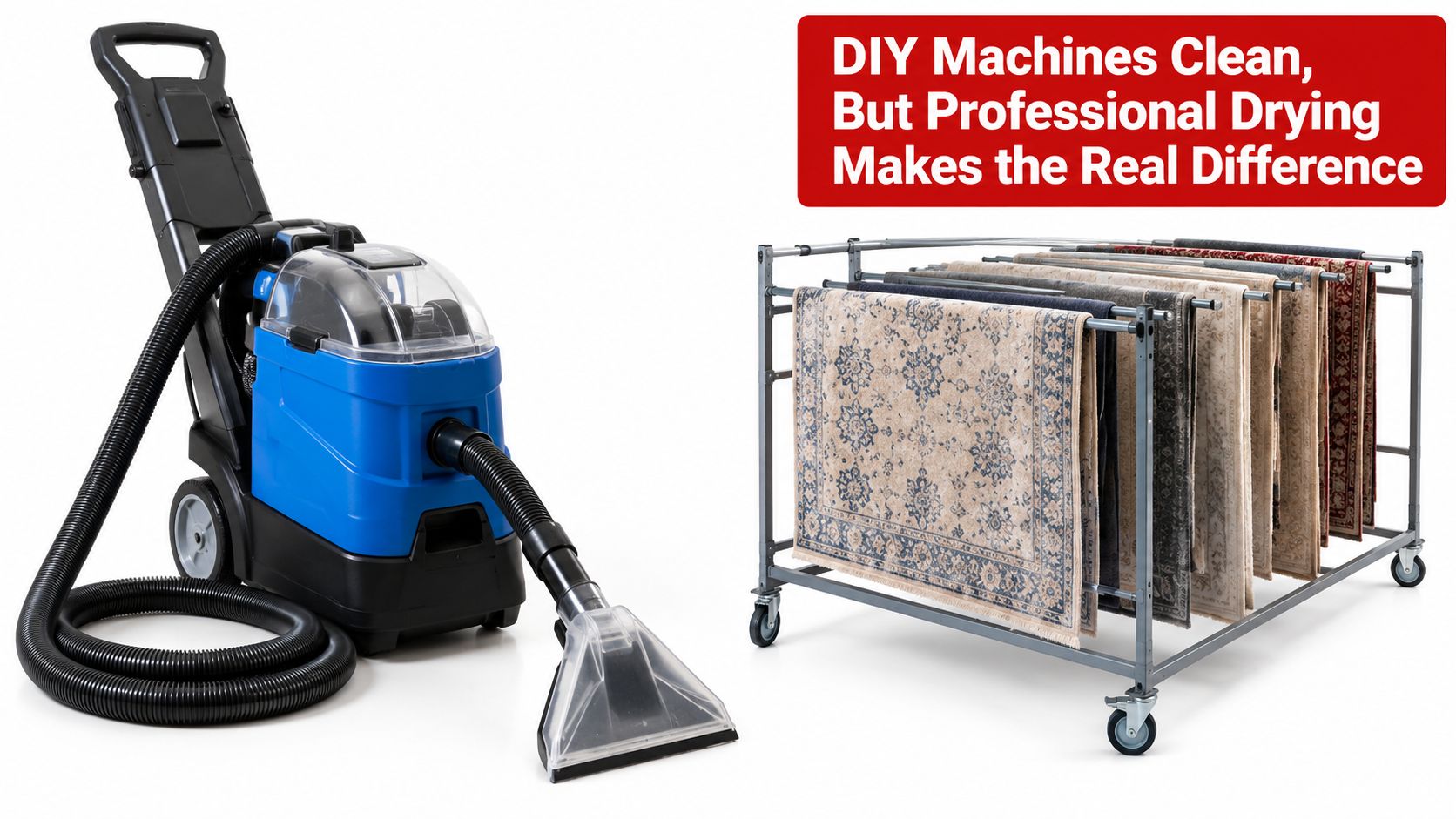
That's why hand-washing delicate rugs can be the more appropriate approach for certain constructions. Hand work is not automatically better, but it gives the cleaner more control when aggressive mechanical action would be inappropriate.
The practical dividing line
A home machine may make sense for a colorfast, machine-compatible synthetic rug with a stable backing and modest soil. It becomes a poor choice when the owner cannot verify the fiber, cannot test the dyes, or cannot provide a suitable drying environment.
Rubber Ducky Rug Cleaning Birmingham uses a staged facility process that includes mechanical dusting, immersion washing where appropriate, mechanical rinsing, centrifugal water removal, and controlled drying. Homeowners comparing that approach with carpet deep-cleaning machines in Birmingham should remember that installed carpet equipment and rug-washing equipment serve different constructions.
When More Machine Power Increases Risk
More agitation, higher heat, and additional water sound like signs of a deeper clean. On a rug, they can increase the chance of dye migration, shrinkage, texture change, backing failure, or prolonged dampness. Power only helps when the rug can tolerate the process and the operator can recover and dry the moisture properly.
Natural-fiber rugs deserve particular caution. Ohio State researchers report that fungi can burrow into natural-fiber rugs such as wool, while dust can increase retained moisture and mold-growth risk. Their guidance also stresses that steam-cleaned rugs must dry thoroughly, which makes equipment recovery and the drying environment central to the decision.
Practical rule: Don't choose an area rug cleaning machine until you know what the rug is made of, how its dyes react, and whether you can dry the entire construction quickly.
A sensible pre-cleaning triage starts with four checks:
- Identify the construction: Look for wool, silk, viscose, cotton, jute, glued components, handmade knots, and signs of previous repairs.
- Test dye transfer: Blot a hidden area with a suitable damp white cloth. Any transfer is a reason to stop and seek specialist handling.
- Inspect the foundation: Check for delamination, cracking latex, loose edges, brittle backing, and weakened fringe.
- Measure the drying capacity: Consider ventilation, humidity, air movement, and whether the rug can be lifted clear of the floor.
The American Lung Association notes that rugs can hold dust mites, pet dander, mold spores, pesticides, dirt, and other pollutants that may become airborne during walking or vacuuming. Its guidance supports HEPA-filter vacuuming, cleaning both sides of removable rugs, annual deep cleaning, and thorough drying to reduce mildew potential. That does not mean every rug should receive the strongest available wash. It means the cleaning method should remove contamination without creating a moisture problem.
For wool, viscose, antique, or glued-back rugs, the safest decision may be stopping before machine contact and arranging specialist pickup.
Maintenance, Safety, and Smart Cleaning Choices
Owning an area rug cleaning machine creates maintenance work before it creates convenience. Clogged filters reduce recovery, damaged hoses leak solution, worn seals allow air loss, and contaminated brushes can spread soil instead of removing it. Inspect the machine before each use, clean its filters after use, check hoses and fittings, and make sure brushes move freely without catching the rug.
Electrical safety matters around water. Use the equipment only as directed, keep connections away from wet areas, and stop if the cord, plug, hose, or housing shows damage. Open ventilation, controlled solution application, and immediate recovery are safer than flooding a rug and hoping airflow will solve the problem.
A sensible home-use checkpoint
Before using any machine, ask:
- Is the rug a durable, colorfast synthetic? If not, arrange an inspection before wet cleaning.
- Have you tested an inconspicuous area? Stop if dye transfers, fibers distort, or the backing softens.
- Can you recover moisture effectively? A wet surface is not proof of a deep clean.
- Can the rug dry fully on all sides? Keep it off the floor when construction allows and provide controlled airflow.
- Is the soil problem deeper than a surface refresh? Pet urine, persistent odor, water damage, and mold concerns usually need professional assessment.
Routine vacuuming remains important between cleanings. The Carpet and Rug Institute reports that a regular vacuuming schedule can remove approximately 90% to 95% of dry soil by weight from carpet, while also explaining that periodic deep extraction is still necessary because vacuuming doesn't remove all embedded material. Birmingham homeowners can use regular vacuuming to manage loose grit, but it isn't a substitute for washing and extraction when soil has migrated into the pile or backing.
Water-damaged rugs need faster action. The CDC homeowner guidance says wet materials should be dried as quickly as possible, ideally within 24 to 48 hours, and advises removing porous items that stayed wet for more than 48 hours when they can't be thoroughly cleaned and dried. After a leak or flood, arrange professional extraction and assessment promptly rather than repeatedly adding water with a home machine.
Why Birmingham Homeowners Choose Professional Rug Cleaning
For Birmingham homeowners, professional rug cleaning is less about finding the biggest machine and more about controlling the entire chain from dry soil removal to final grooming. A suitable facility can dust embedded grit before washing, inspect the fiber and dye, immerse compatible rugs in a controlled wash tank, rinse out detergent, remove excess water mechanically, and dry the rug in an environment designed for the material.
That process matters for local homes dealing with pet stains, red-clay soil, high traffic, older oriental rugs, wool pile, or water damage. A surface extractor may improve appearance while leaving contamination in the foundation. Repeated home wetting can also make a rug harder to dry, especially when the backing holds water.
Rubber Ducky Rug Cleaning Birmingham uses mechanical dusting tumblers, custom wash tanks, mechanical rinsing with adjustable conditions, centrifugal water removal, and climate-controlled drying rooms. Technicians inspect the rug before selecting the process, then groom and return it to its original location after cleaning. Pickup and delivery remove the practical burden for homeowners in Birmingham, Hoover, Vestavia Hills, Mountain Brook, Homewood, Trussville, Pelham, Alabaster, Gardendale, and Helena.
The right machine can be useful, but the operator's judgment and the drying setup determine whether it helps. For valuable, handmade, wool, oriental, antique, or heavily contaminated rugs, facility cleaning gives the rug a better chance of receiving the right treatment without forcing a household machine beyond its limits.
Rubber Ducky Rug Cleaning Birmingham provides home pickup, professional facility washing, deep stain and odor removal, fiber-safe methods, controlled drying, grooming, and return delivery for area rugs. Visit Rubber Ducky Rug Cleaning Birmingham to request a cleaning estimate or schedule your rug pickup.