If you're searching for how to remove mildew from an outdoor rug in Birmingham, you're probably dealing with a rug that smells musty, shows dark or greenish spotting, or stays damp beneath the backing after rain. Birmingham's warm, humid weather makes that problem persistent, and a quick surface scrub often improves the appearance without removing contamination held deeper in the weave.
DIY cleaning can be a useful first response for limited surface growth. It isn't a complete solution for embedded mildew, moisture trapped in the backing, color damage, or delicate fibers. Rubber Ducky Rug Cleaning serves Birmingham, Hoover, Vestavia Hills, Mountain Brook, Homewood, Trussville, Pelham, Alabaster, Gardendale, and Helena with pickup, professional rug washing, controlled drying, and return delivery.
Understanding Mildew in Birmingham's Climate
Outdoor rugs in Birmingham deal with a difficult combination of warmth, rainfall, shade, and slow evaporation. A rug may look dry on top while moisture remains underneath, especially when it lies directly on concrete, a covered porch, or a shaded patio. Leaves, pollen, and soil also collect in the weave, giving mildew residue and damp fibers a place to persist.
Spring storms can soak a rug repeatedly, while summer humidity slows drying after the rain passes. The practical problem isn't only the amount of water. It's the time the rug and its backing remain damp, particularly where air can't circulate. Georgia Extension guidance says mold can be avoided in rugs and padding when wet items are dried within 48 hours, and recommends water extraction, fans, and dehumidifiers to accelerate drying (Georgia Extension guidance).
What Birmingham homeowners should look for
Early signs include a musty odor, powdery or discolored patches, dampness beneath the rug, and mildew returning soon after cleaning. Check areas under furniture, along edges, and beneath the backing. Those locations receive less sun and airflow than the exposed face.
Practical rule: A rug isn't clean enough to put back simply because the visible stain has faded. Both the face and backing need to dry fully.
Moisture problems can extend beyond the textile itself. If the rug has been sitting on a wet deck, patio, or floor, the surface underneath may also need attention. Homeowners dealing with related concerns can review Rubber Ducky's information about whether water damage causes mold.
Why occasional rinsing often fails
A hose can remove loose soil and some surface residue, but it may push contamination farther into the weave or saturate the backing. If the rug then lies flat in humid air, the remaining moisture creates another opportunity for mildew to return.
That's why successful outdoor-rug care follows a complete sequence: remove loose debris, use a material-safe treatment, rinse until the water runs clear, and dry with strong sun or airflow. Birmingham homeowners should also set realistic expectations. A rug that repeatedly becomes wet may need professional washing and controlled drying rather than another quick rinse.
Safety Preparations and Initial Assessment
Before moving a mildewed rug through the house, take it to a well-ventilated outdoor area if the material and weight allow. Wear gloves, eye protection, and a respiratory mask, and avoid aggressive dry brushing that sends spores into the air. Keep children and pets away from the work area, and read the rug's care label before applying water or chemicals.
Start with a visual inspection. Look at the front, underside, seams, and backing, then note whether the discoloration is isolated or spread across broad sections. A persistent musty odor, even where staining is faint, can indicate that residue remains below the visible surface.
A simple pre-cleaning check
Use this sequence before choosing a solution:
- Identify the fiber. Look for polypropylene, polyester, nylon, jute, sisal, rubber, latex, or a blend on the label or manufacturer's care information.
- Inspect the backing. Lift a corner and check for dampness, cracking, flaking, odor, or discoloration.
- Test the structure. Handle a small hidden area gently. If fibers shed easily, the backing flakes, or the rug feels weak, stop home treatment.
- Mark the affected areas. Photograph or note where mildew appears so you can compare the rug after cleaning and drying.
- Check drainage. Make sure the surface beneath the rug allows rinse water to leave quickly.
Don't start by soaking the entire rug. First remove loose debris with dry brushing or a suitable vacuum, working carefully so you don't grind contamination deeper into the pile. A HEPA vacuum can help collect loose particles from a synthetic rug, but vacuuming alone won't address odor or mildew held in the backing.
Stop if the backing is deteriorating. Cleaning a structurally damaged rug can turn a repairable textile into a replacement project.
DIY treatment may be reasonable when mildew is limited, the rug is clearly washable, and the fibers and backing remain sound. Professional assessment is more appropriate when odor persists, the underside is affected, the rug has delicate construction, or repeated wetting has left it slow to dry. Rubber Ducky's pickup process also avoids carrying a contaminated, damp rug through your Birmingham home.
Choosing the Right Cleaning Solution
The safest cleaning solution depends on the rug's material and the manufacturer's instructions. No household product is universal, and a solution that works on a colorfast synthetic rug may discolor a natural fiber or weaken a rubber backing. Test every product on a hidden corner, let the test area dry, and check for bleeding, fading, stiffness, or surface changes.
Comparing common options
| Cleaning option | Practical use | Main trade-off |
|---|---|---|
| White vinegar and water | A spot treatment for compatible washable rugs | It still requires thorough rinsing and complete drying |
| Baking soda paste | A limited stain or odor treatment | Residue can remain if the rug isn't rinsed properly |
| Mild cleaner dilution | A controlled approach for washable synthetic rugs | The label must permit the product and dwell time |
| Hydrogen peroxide | Narrow spot treatment on suitable materials | It can affect color and should be tested first |
| Chlorine bleach | Only for rugs explicitly identified as bleach-safe | It can damage dyes, fibers, backings, nearby surfaces, or plants |
A practical historical benchmark remains straightforward: remove loose debris first, rinse until water runs clear, and dry completely in full sun. For a mildew spot, one recent guide recommends 1 cup of white vinegar to 1 cup of water in a spray bottle, or a paste of equal parts baking soda and water left on the stain for 20 minutes before rinsing (outdoor-rug cleaning guidance). Another guide advises 1 part white vinegar to 3 parts water for moss, mildew, or mold spot treatment (outdoor rug care guidance from Home Depot).
Other neutral references use a 4:1 water-to-vinegar mix with mild dish soap, or a dilution of 2 ounces of cleaner to 2 cups of water, followed by about 5 minutes of dwell time, as described in the same Southern Living guidance. Choose one method, not several mixed together.
Chemistry mistakes cause avoidable damage
Never combine bleach with vinegar or ammonia. A Georgia Extension benchmark describes 1 part 3% hydrogen peroxide to 5 parts water for spot treatment on the back of a rug, with direct sunlight for 1 to 2 days, while bleach guidance includes 2 tablespoons of liquid chlorine bleach per quart of water with about 15 minutes of dwell time, or roughly 1/2 cup of bleach per gallon of water for outdoor fabrics (Georgia Extension stain-removal guidance).
Those are not general permissions to use bleach. They're narrow benchmarks for compatible materials. For additional background on mildew treatment choices, South Mountain Window Cleaning on mildew offers a useful comparison of cleaning considerations, although rug labels and backing materials still control the decision.
For Birmingham homeowners unsure whether a rug can safely be saturated, Rubber Ducky Rug Cleaning Birmingham can evaluate the fiber, wash it with rug-specific products, and remove residue through professional rinsing. The company's carpet cleaning using vinegar guidance can provide additional context, but an outdoor area rug shouldn't automatically be treated like wall-to-wall carpet.
Fiber-Specific Cleaning Techniques
The same mildew treatment won't suit every outdoor rug. Polypropylene and polyester generally tolerate more water than jute or sisal, but they still need thorough rinsing and rapid drying. Natural fibers can absorb moisture, while rubber and latex backings may trap water against the floor.
Synthetic rugs need rinsing and airflow
For polypropylene or polyester, remove loose spores with dry brushing or a HEPA vacuum, then apply a manufacturer-safe cleaner and allow the stated dwell time. Agitate with a microfiber towel or soft brush rather than a harsh, stiff brush that can roughen the surface. Rinse until no cleaner remains, then dry the face and backing in strong airflow or sun.
One expert workflow recommends repeating the clean, rinse, and dry cycle at least two additional times when mildew remains a concern (synthetic outdoor-rug mildew guidance). That repeated cycle matters because visible staining can disappear before residual contamination and odor do.
Polypropylene can often handle a more direct wash than natural fiber, but the details still matter. Homeowners cleaning this material can review how to clean a polypropylene area rug before applying water or detergent.
Natural fibers require restraint
Jute and sisal are vulnerable to prolonged wetting. Use minimal moisture for a spot treatment, avoid saturating the foundation, and dry the rug immediately with air moving across both sides. If the backing feels damp for an extended period, home treatment may create more risk than the original stain.
For broader information about contamination on textiles, removing mold from clothes from AMPM Restoration Services explains why material and moisture conditions affect treatment choices. The same principle applies to rugs, but a rug's dense weave and backing make extraction and drying more demanding.
Backings can hide the real problem
Rubber-backed rugs deserve special caution. Water can collect between the rubber and the textile, and placing the rug flat while it's damp can trap that moisture. Flip the rug only when it can be handled safely, lift it to permit airflow, and don't return it to the patio until both sides are completely dry.
Blended rugs are harder to judge because one fiber may tolerate a treatment that another doesn't. Avoid very hot water, unapproved bleach, and forceful pressure washing unless the manufacturer specifically allows them. A professional wash separates dusting, cleaning, rinsing, extraction, and drying so the operator can control moisture instead of adding more of it.
When to Call Professional Rug Cleaners
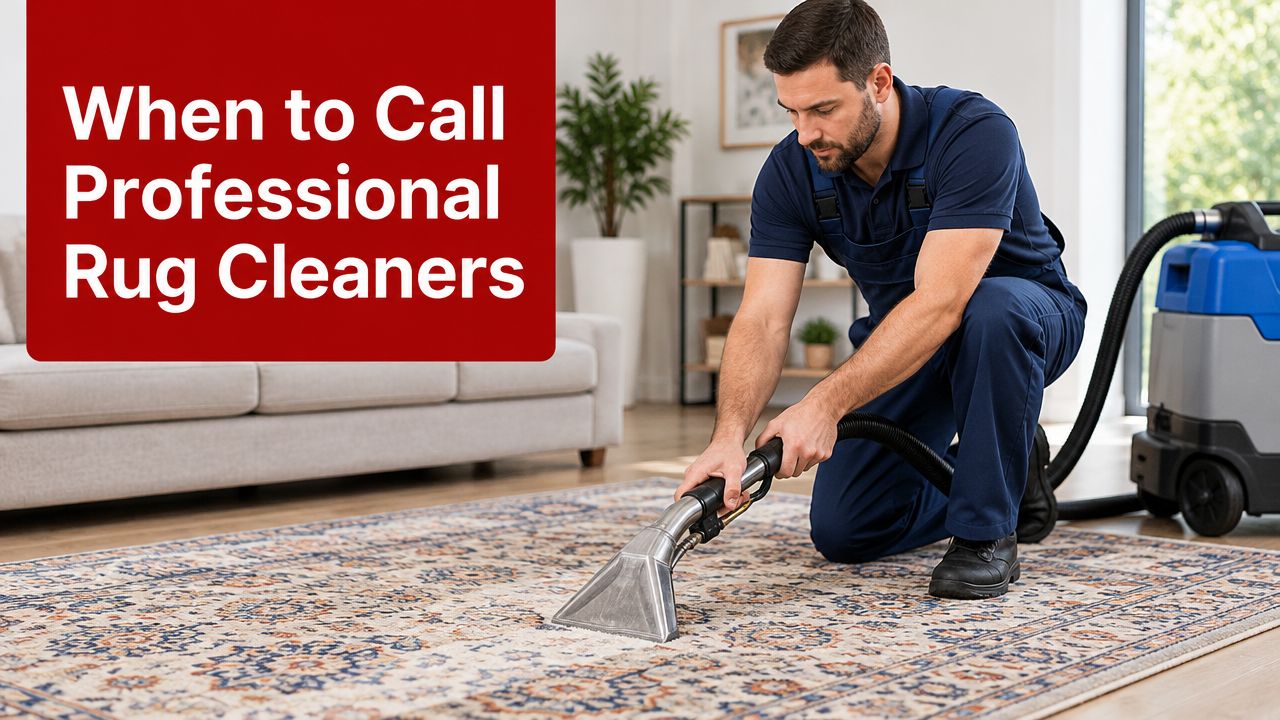
DIY cleaning reaches its limit when mildew has moved beyond the surface. Call a professional if the musty odor remains after cleaning, growth appears on both sides, the backing is affected, the rug dries slowly, or the material is delicate, antique, hand-woven, or otherwise difficult to identify. Repeated home scrubbing can spread moisture through the backing and leave detergent residue that attracts new soil.
Rubber Ducky Rug Cleaning in Birmingham uses a rug-specific process rather than treating every textile like carpet. The work begins with mechanical dusting tumblers that release embedded grit, sand, and allergens. Rugs then move through custom wash tanks with specialized detergents, mechanical rinsing, including a patented infusion rinse, and climate-controlled drying designed to balance temperature and humidity and help prevent shrinkage.
What professional intervention changes
A household hose adds water. Professional rug washing combines controlled application with extraction, rinsing, inspection, and drying. That distinction is important for mildew because the rug needs contaminants removed without leaving the backing wet.
Rubber Ducky's technicians can handle outdoor rugs alongside modern synthetics, oriental rugs, and other area rugs, using fiber-safe methods selected after inspection. Their pickup and delivery service means Birmingham homeowners don't have to load a wet or contaminated rug into a vehicle, and the rug can be returned to its original location after cleaning, grooming, and drying.
A clean-looking rug isn't the same as a fully restored rug. Odor, backing moisture, dye stability, and fiber condition all matter.
When comparing service providers, homeowners can also use practical guidance on choosing an exterior cleaning provider as a reminder to check process, safety, and scope rather than choosing on a vague promise. For stubborn mildew in Birmingham, professional washing is the sensible stopping point for DIY treatment and the safer route for valuable or moisture-sensitive rugs.
Rubber Ducky Rug Cleaning Birmingham offers home pickup, facility-based rug washing, deep stain and odor removal, fiber-safe treatment, controlled drying, grooming, and return delivery for outdoor rugs affected by mildew. Visit Rubber Ducky Rug Cleaning Birmingham to request a rug cleaning estimate, schedule pickup, or book professional rug restoration for your Birmingham-area home.