Yes, water damage can cause mold on a rug within 24 to 48 hours of damp conditions. The drying response, especially removing moisture from the rug's face fibers, backing, and pad, determines whether the rug can be salvaged.
A Birmingham homeowner may discover the problem under an ordinary-looking sink cabinet. A failed supply line in a Homewood kitchen can soak a Persian rug before anyone notices, leaving the face damp, the cotton foundation swollen, and the pad holding water against the floor. In a humid Central Alabama home, a rug can feel dry on top while moisture remains trapped underneath.
For homeowners searching “does water damage cause mold,” the practical answer is yes, but the more useful question is whether the rug was dried thoroughly and quickly enough. Professional rug pickup, washing, extraction, and controlled drying give a water-damaged rug a better recovery path than surface fans or an in-home carpet machine.
Why Birmingham Homeowners Are Asking This Question Right Now
A Persian rug under a failed sink line in Homewood can look like a simple cleanup job. In practice, the water travels through the face yarn into the foundation, backing, and pad. If the rug stays damp, mold can develop before the homeowner sees a single spot.
The EPA says wet or damp materials are usually preventable from developing mold when they're dried within 24 to 48 hours after a leak or spill, but mold may already have occurred when materials remain wet longer than 48 hours. That makes the drying clock more important than the apparent size of the spill. A small leak that sits beneath a rug can be more damaging than a larger spill that's extracted immediately. EPA guidance on mold, moisture, and homes explains why prompt drying matters.
Why local conditions change the decision
Birmingham homeowners deal with storm water, plumbing leaks, slab leaks, refrigerator lines, and HVAC overflows. Once a rug absorbs water, local humidity can slow evaporation and keep the backing damp after the surface appears manageable. That pressure is especially concerning for wool, cotton, jute, and other absorbent materials.
Water damage also raises practical insurance questions. Homeowners comparing cleanup options may benefit from understanding water damage and mold coverage before discarding a damaged rug or authorizing repairs.
The key decision is simple: get the rug separated from the wet pad and professionally assessed as soon as possible. Early action can preserve an heirloom. Waiting for visible mold often means the problem has already moved beyond surface cleaning.
How Water Turns Into Mold on a Rug
Mold spores already exist in household air and dust. They don't need to arrive with the leak. Water changes the environment, giving dormant spores the moisture and organic material they need to become active.
A rug supplies plenty of absorbent material. Wool and cotton can retain water within their fibers, while jute and cotton backings can hold moisture close to the floor. Dust, skin particles, and other soil trapped in the rug add further organic material. Humid air then slows the release of water, particularly when the rug is lying flat over a pad.
A damp shower curtain can develop a musty film during a humid Birmingham summer. A saturated area rug follows the same basic pattern, but its layered construction creates far more places for moisture to hide. The rug may have thousands of square inches of yarn, foundation, backing, and pad that dry at different rates.
Odor often arrives before visible growth
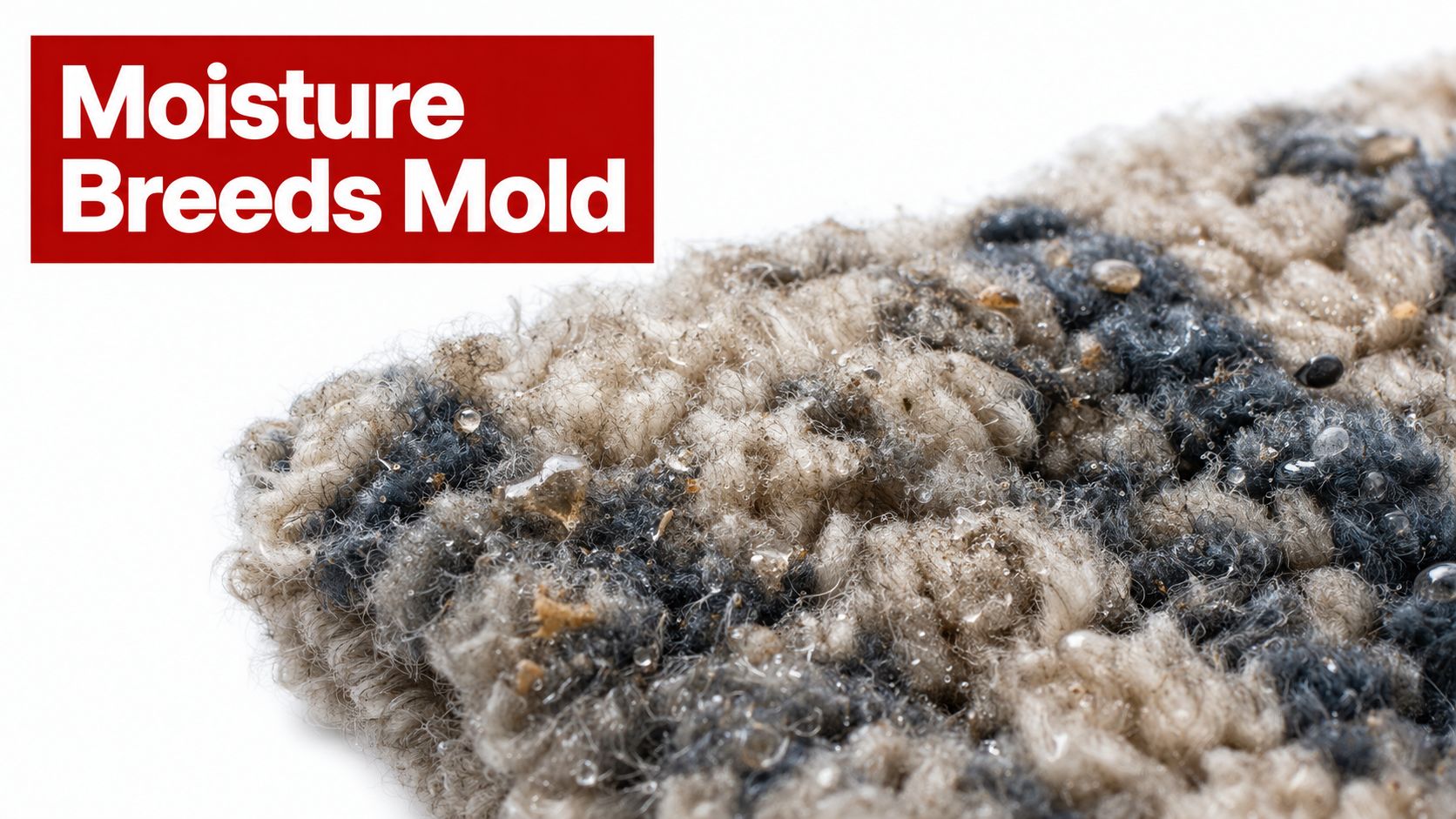
Visible fuzz or dark spotting is not the beginning of the problem. Musty odor, dampness along the edges, or discoloration on the backing can appear while growth remains hidden inside the rug system. A homeowner who waits for obvious colonies may be waiting too long.
The moisture source also matters. A one-time spill, a recurring plumbing leak, condensation, and poor ventilation create different drying challenges. This guide on moisture and mold growth provides useful background, but a rug still needs a material-specific inspection. Cleaning the face alone won't confirm that the foundation and pad are dry.
The 24 to 48 Hour Window That Decides Everything
The EPA recommends drying water-damaged areas, items, carpet, and backing within 24 to 48 hours. Its commercial-building guidance also warns that mold may have started even when drying occurs within that window, so the target is not merely making the surface feel dry. The goal is to remove moisture from every absorbent layer and control the source that caused the wetting.
The National Institutes of Health's Office of Research Facilities describes the first 24 to 48 hours after water infiltration as critical for mold prevention. When the duration is unknown, its guidance says to treat the affected area as though it has been wet for more than 48 hours. NIH moisture remediation guidance supports a cautious approach when a homeowner can't establish when the leak began.
Berkeley Lab's review shows that water intrusion is common in American buildings. Its housing review recorded exterior leakage in 9.9% of homes and interior leakage in 8.1% in 2009, while compiled studies estimated dampness or mold in 47% of U.S. homes. The review also found past water damage in 85% of surveyed commercial office buildings and current leaks in 45%. These figures don't predict what will happen to one Birmingham rug, but they show why water intrusion is a routine mold-risk condition rather than an unusual event. Berkeley Lab review of building dampness
Mold growth timeline after a rug gets soaked
| Time After Soaking | What Is Happening | Reversible? |
|---|---|---|
| Immediately after the leak | Water is moving through face fibers, foundation, backing, and pad. | Often, if the rug is separated and dried promptly. |
| Within 24 to 48 hours | Damp porous materials may support mold development, even without visible spots. | Sometimes, after professional inspection and thorough extraction. |
| Beyond 48 hours | Mold may already have occurred, and the rug requires a more cautious cleaning and restoration decision. | Depends on fiber, backing, odor, staining, and microbial condition. |
A household fan moves air across the surface. It doesn't reliably remove water from a dense pad or a tightly woven foundation. Homeowners dealing with this stage can also review mold prevention after water damage while arranging professional rug pickup.
Why Rug Construction Makes the Problem Worse
A water-soaked area rug is a layered object, not a wet sheet. Water wicks downward from the face fiber into the knot base, foundation, backing, pad, and sometimes the flooring beneath. Each layer can retain moisture after another layer appears dry.
Wool and silk face fibers can hold moisture deep in the yarn. Cotton foundations may swell and keep water against the base of the knots. Jute and latex-backed materials create additional concerns because the backing can trap humidity near the pad. The pad then acts as a reservoir, feeding moisture back into the rug from below.
Four failure points homeowners miss
- Face fiber: The top may feel nearly dry while deeper yarn remains damp.
- Foundation: Cotton and other absorbent foundations can hold water around the knot structure.
- Backing and pad: These layers often dry more slowly than the face and can hide odor or spotting.
- Dyes and finishes: Aggressive heat or uncontrolled drying can contribute to dye migration, especially when a rug is already saturated.
This is why surface-only drying fails. A homeowner may run fans over the rug, lift it briefly, and put it back when the face feels dry. That approach doesn't verify the backing, pad, or floor. The rug may continue to hold moisture in a warm, humid room.
Professional rug washing separates cleaning from drying. The cleaner must identify the fiber type, construction, dye stability, backing condition, and water category before choosing extraction and drying methods. An Oriental rug, a hand-knotted wool piece, and a synthetic area rug shouldn't receive identical treatment.
The Hidden Mold Problem After the Surface Looks Dry
A Mountain Brook homeowner may find this problem after an HVAC condensate line overflows in a basement storage room. The rug can look dry after sitting undisturbed, but lifting it may reveal dark spotting on the concrete and mildew across the cotton backing. The visible face provides no reliable answer about what happened underneath.
That hidden condition is why building-damage guidance focuses on moisture sources, ventilation, condensation, and damp indoor materials rather than visible mold alone. CDC building-damage guidance emphasizes that microbes can proliferate in damp conditions even after surface water disappears.
Signs the rug needs inspection
Look for practical clues rather than waiting for a dramatic colony:
- Musty odor: A persistent earthy smell can indicate moisture or microbial activity below the face.
- Selvedge discoloration: Darkening along the edges may show where water collected.
- Pad changes: A faint dark patch, tackiness, or odor under the rug deserves attention.
- Uneven feel: Stiffness, rippling, or a cool damp area can signal moisture trapped in the foundation.
A rug that appears dry isn't automatically safe. It needs evaluation from the face, reverse, pad, and floor. The cleaner also needs to determine whether the water came from a clean supply line, an appliance, a drain, or another contaminated source. The water type affects handling and restoration decisions.
Don't mask the odor with fragrance or place the rug back over the pad. That only hides a warning while leaving the moisture source unresolved. Professional inspection and controlled drying can identify whether the rug is a cleaning job, a restoration job, or a piece that needs specialized conservation advice.
What to Do in the First 48 Hours After a Rug Gets Soaked
Move quickly, but don't turn a leak into an electrical or handling accident. Homeowners in Birmingham, Hoover, Vestavia Hills, and Mountain Brook can follow this order:
- Stop the source: Shut off the supply if a pipe is still leaking. Keep clear of outlets or electrical equipment affected by water, and turn off power only if it's safe to do so.
- Separate the rug: Lift it from the pad immediately. Roll it carefully if necessary, rather than dragging a saturated rug across the floor.
- Protect the floor: Place the rug on a clean, hard, dry surface. A garage floor or concrete patio may work if the surface is clean and weather conditions won't add more moisture.
- Increase airflow: Use fans and a dehumidifier, but understand that Birmingham's humid air can limit what household equipment achieves.
- Call a rug specialist: Arrange pickup before using a carpet shampooer or soaking the rug again.
A standard carpet machine often makes the situation worse by adding water to a rug foundation it can't dry. It may also disturb dyes, leave detergent residue, and extract mainly from the face while the pad remains wet. Fans help with airflow, but they can't replace controlled extraction and drying.
Practical rule: If you can't confirm that the backing and pad are dry, treat the rug as wet.
For a step-by-step reference while arranging service, see how to dry a wet area rug. The best use of the first hours is source control, safe separation, documentation, and rapid professional assessment.
Why Rubber Ducky's Pickup and Facility Process Handles Water-Damaged Rugs
A soaked rug often needs more than a fan in a Birmingham living room. Rubber Ducky Rug Cleaning Birmingham uses a pickup-to-facility workflow that lets technicians inspect, wash, rinse, and dry the rug under controlled conditions. Birmingham's humidity shortens the safe-drying window, while the rug's face fiber, backing, and pad determine whether surface cleaning is enough or deeper restoration is needed.
Pickup begins at homes across the Birmingham metro area, including Hoover, Homewood, Mountain Brook, Vestavia Hills, Trussville, Pelham, Alabaster, Gardendale, and Helena. At the facility, a dust test separates dry soil from water-related contamination before washing starts. That information helps technicians choose a cleaning plan suited to the rug's contents, fibers, and construction.
What facility cleaning adds
- Mechanical dusting: Embedded grit, sand, and dry soil are removed before washing.
- Rug-specific washing: The rug is immersed in a system selected for its fiber and construction, rather than treated like wall-to-wall carpet.
- Deep extraction and rinsing: Specialized rinsing removes suspended soil and cleaning residue from the rug structure.
- Controlled drying: A climate-controlled drying room manages airflow and humidity so moisture leaves the backing as well as the face.
- Grooming and restoration: Once dry, the rug can be brushed, groomed, and checked for distortion, odor, edge issues, or other damage.
- Return delivery: The cleaned or restored rug is returned to its original location in the home.
If the first 48 hours have passed, technicians may consider an antimicrobial rinse as part of the restoration plan, depending on the rug and contamination. A soft-water rinse can reduce residue that attracts new soil. Neither treatment replaces physical drying, but each may support recovery when appropriate.
Homeowners can review water damage rug restoration when deciding whether pickup and facility care suit the rug's condition.
Getting Your Birmingham Rug Inspected and Backed by the Pros
The decision point comes before visible mold appears. A wet rug should be evaluated based on how long it was damp, what caused the water damage, how the moisture traveled, and whether the backing and pad remain affected.
Scheduling a pickup gives the cleaner access to the entire rug rather than just the visible face. During inspection, the technician can examine fiber type, construction, dye stability, odor, staining, backing condition, and signs of microbial activity. Dust testing also helps establish the soil load before washing begins.
What homeowners can expect
Rubber Ducky's service process is designed around the rug, not a one-size-fits-all carpet machine. The rug is collected from the home, assessed at the facility, cleaned with fiber-safe methods, rinsed thoroughly, dried in a controlled environment, groomed, and returned to its original location.
Ask for an estimate that addresses the actual condition. A clean supply-line leak may call for a different plan than water from a drain or an HVAC overflow. If the rug has been damp beyond the safe window, the cleaner may recommend additional inspection, odor treatment, antimicrobial work, or restoration rather than promising a routine wash.
A Google guarantee and BBB accreditation provide additional business proof points for homeowners comparing local providers, but the most important evidence is a clear explanation of what will happen to the rug's face, backing, pad, and dyes. Most water-damaged rugs have a better chance when drying begins within the first day or two, although no responsible cleaner can promise recovery without inspecting the material.
Don't wait for black spots or a strong odor. Contact a professional rug cleaner, schedule pickup, and let the inspection determine whether your Birmingham rug needs cleaning, water-damage restoration, or specialized care.
Rubber Ducky Rug Cleaning Birmingham offers home pickup, professional facility washing, deep stain and odor removal, controlled drying, grooming, and return delivery for area rugs affected by leaks or spills. Visit Rubber Ducky Rug Cleaning Birmingham to request an estimate and schedule pickup before trapped moisture turns a manageable rug problem into mold damage.