
If you're searching for the best cleaner carpet option for a Birmingham home, you may be dealing with a familiar combination: red-clay soil tracked into the pile, a pet accident that keeps returning, and a rug that looks clean on top but still smells when humidity rises. The right solution isn't the machine or product that makes a surface stain disappear. It's the method that removes contamination from the fibers, backing, and pad without creating shrinkage, dye bleeding, residue, or prolonged dampness.
Homeowners in Birmingham, Hoover, Vestavia Hills, Mountain Brook, Homewood, Trussville, Pelham, Alabaster, Gardendale, and Helena need cleaning that accounts for both fiber safety and the local environment. Area rugs, oriental rugs, wool pieces, synthetics, and wall-to-wall carpet each respond differently to moisture and agitation. A professional inspection helps determine whether a rug needs a controlled facility wash, specialized stain treatment, carpet extraction, or restoration rather than another round of surface cleaning.
Why Birmingham Homes Need Specialized Carpet Cleaning
A Birmingham homeowner may vacuum after a rainy week and still find a dull red cast along the hallway. Near the sofa, a dog's old accident may seem gone until the room becomes warm and humid. The rug looks acceptable from standing height, yet the backing and pad can continue holding fine soil, oils, pet residue, and odor sources that household equipment can't fully recover.
That combination makes cleaning a fiber-protection decision, not just a cosmetic one. Red clay can work down between tufts, while repeated foot traffic presses grit against the foundation of a rug or carpet. Pets add dander, oils, and urine contamination. Humidity then slows evaporation, giving residue and moisture more time to create recurring odor and re-soiling problems.
Surface appearance can mislead
Dust and mite allergen aren't distributed evenly across a carpeted room. In a study of 15 carpeted rooms, Der p 1 allergen was detectable in every bedroom and most living rooms. Within-room variation ranged from 0.9 microgram/g dust to 149.2 micrograms/g dust, a 192-fold difference, as reported in the PubMed study on carpet dust-mite allergen.
The same study reported mean coefficients of variation of 80.2% in living rooms and 88.7% in bedrooms. In practical terms, one clean-looking spot doesn't represent the entire rug or carpet. Spot cleaning can miss concentrated contamination, especially around entrances, pet resting areas, furniture edges, and high-traffic paths.
Practical rule: A stain is visible evidence of a problem, not a complete map of where contamination is located.
Cleaning method matters
A rental machine may improve appearance while leaving the backing too wet. A strong household chemical may lighten a mark but weaken color or leave detergent behind. A low-moisture product may be useful for maintenance, yet it won't necessarily address urine that has migrated below the face fibers.
Rubber Ducky Rug Cleaning's local service model is designed around that distinction. Rugs can be picked up from the home, inspected, washed at a professional facility, dried under controlled conditions, groomed, and returned to their original location. That process is especially relevant for homeowners who own hand-woven rugs, valuable oriental pieces, pet-damaged rugs, or textiles that shouldn't be saturated in a living room.
Professional cleaning also works best as maintenance rather than a one-time reset. In an Environmental Health Perspectives study, both intensive vacuuming and dry steam cleaning plus vacuuming significantly reduced carpet dust-mite allergen concentration and load, with p < 0.05 reported for the reductions. Allergen levels in the intensive vacuuming group returned close to pretreatment values by 4 weeks, while the steam-cleaning-plus-vacuuming group maintained a decrease for up to 8 weeks, according to the Environmental Health Perspectives research.
Comparing Carpet Cleaning Methods for Real Results
The best method depends on what you're cleaning, how the problem has traveled, and how safely the material can be dried. A fresh drink spill on synthetic carpet is a different job from a wool oriental rug with pet urine in the foundation.
| Method | Soil Removal Depth | Fiber Safety | Drying Time | Odor Elimination |
|---|---|---|---|---|
| Spot cleaner | Limited to the treated area | Depends on product and agitation | Usually localized, but can leave a damp patch | May reduce surface odor |
| Rental machine | Moderate on accessible carpet fibers | Risk rises with over-wetting or incorrect settings | Can be prolonged in humid conditions | Often incomplete when odor reaches backing or pad |
| Enzymatic solution | Targets organic residue chemically | Requires product compatibility and careful testing | Depends on application and extraction | Useful for organic odor, but weak without source removal |
| DIY mixture | Unpredictable | Vinegar, detergent, heat, or scrubbing may affect dyes and fibers | Variable | May mask odor or leave residue |
| Professional hot water extraction | Deep recovery on suitable carpet | Controlled when equipment and chemistry match the fiber | Managed through extraction and airflow | Stronger when suspended residue is fully recovered |
What each option actually accomplishes
Spot cleaners are appropriate for immediate containment. Blotting a fresh spill and applying a compatible product can prevent the liquid from spreading, but repeated wetting of the same spot may create a visible halo or leave cleaning agents behind.
Rental machines can remove loosened soil from resilient wall-to-wall carpet. Their weakness is control. The operator may not know the carpet's construction, may use too much solution, or may fail to recover enough water. That matters in Birmingham homes where humidity can slow drying.
Enzymatic products can help break down organic residue from urine and other biological soils. They aren't magic on their own. If the treated material remains in the backing or pad, the odor source may persist, particularly when moisture and warmth reactivate it.
DIY mixtures create the widest range of outcomes. A solution that seems mild on one synthetic carpet may affect another fiber, backing, or dye. Scrubbing can also drive liquid and soil deeper instead of lifting them out.
Professional hot water extraction injects heated solution under pressure and immediately vacuums it back out, lifting soil and oils while recovering suspended debris from the fibers, as described in this explanation of hot water extraction. Independent CRI testing evaluates hot water extraction cleaners for soil removal and appearance preservation, with gold-level performance requiring removal of 80% or more of test soil. The framework also measures water removal and appearance change with objective instrumentation, as outlined in the CRI testing document.
For a broader discussion of selecting methods in commercial environments, homeowners and property managers can also review select carpet cleaning methods for offices. The same practical questions apply at home: what is being removed, what remains behind, and how quickly can the material dry safely?
For Birmingham homeowners weighing rental equipment against specialist care, this comparison of professional carpet cleaning versus DIY offers useful decision context. In practice, DIY is most defensible for small, fresh, clearly localized spills on known, durable carpet. Deep odor, repeated staining, delicate rugs, and uncertain fiber content call for a professional assessment.
How Different Rug Fibers React to Cleaning
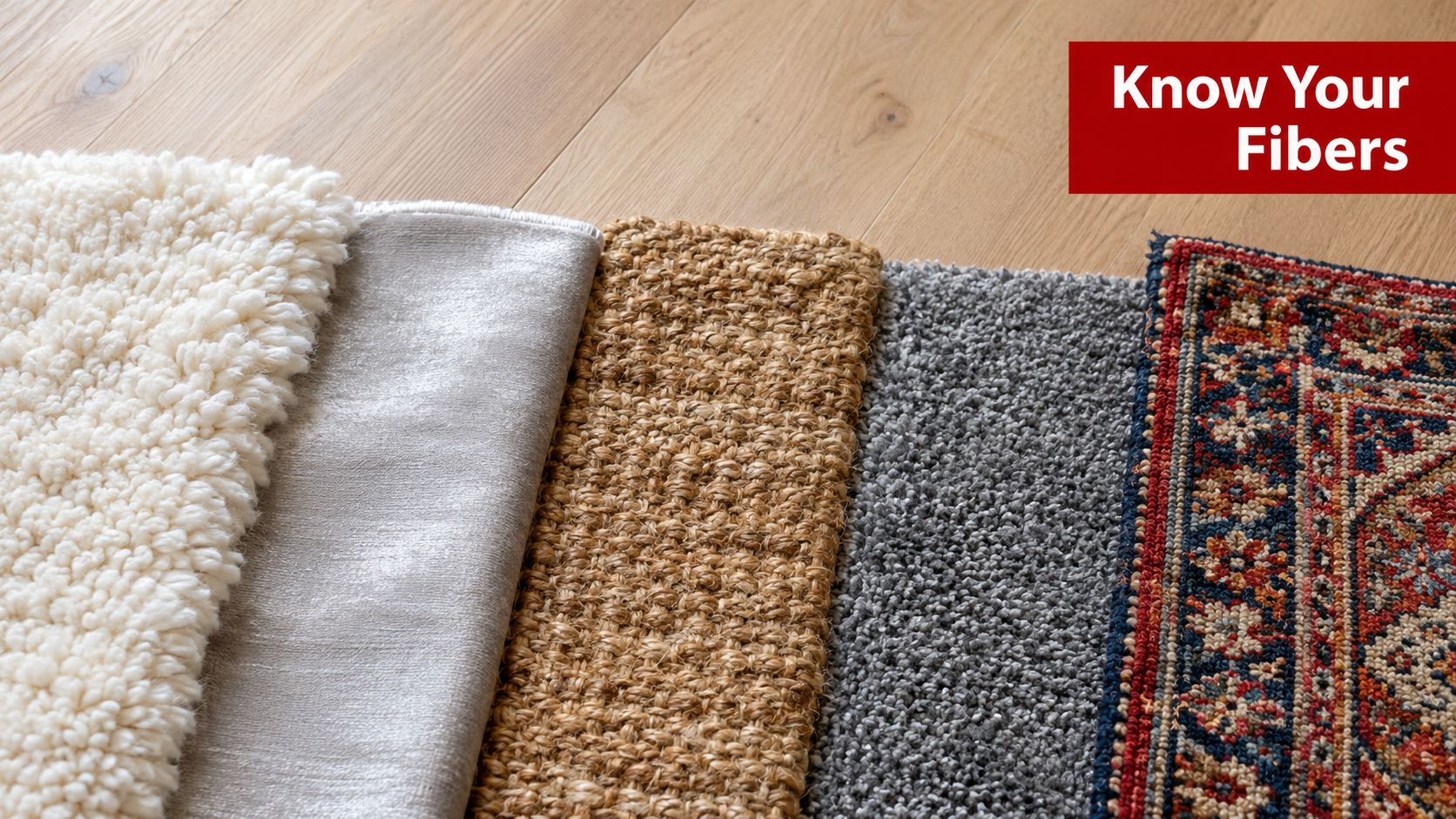
A rug's fiber, construction, dye stability, backing, and condition should determine the cleaning method. Wool can tolerate professional moisture when handled correctly, but excessive heat, aggressive agitation, or poor drying can distort the piece. Silk is more delicate and may require specialized low-impact treatment. Synthetic fibers are generally more forgiving, yet the backing and dyes still need evaluation.
Natural fibers need controlled moisture
Jute and other absorbent natural fibers can swell when wet and then shrink unevenly during drying. That movement can cause rippling, distortion, and edge pull, as explained in this guidance on jute rugs and water exposure. A home carpet extractor can't reliably manage that risk if the rug is cleaned on a hard floor and left to dry in a humid room.
Wool also needs careful chemistry. Strong alkaline products, over-aggressive brushing, and incomplete rinsing can change the hand and appearance of the pile. Hand-woven oriental rugs may contain multiple dyes and construction details that require pre-testing before washing.
Silk deserves even more caution. Its fine fibers can respond poorly to excessive agitation and uncontrolled moisture. A valuable silk or wool rug shouldn't be treated like a removable synthetic mat because the visible stain looks small.
Construction changes the risk
Tufted rugs, flatweaves, braided pieces, machine-made rugs, and hand-knotted orientals all have different relationships between face fiber, foundation, and backing. Water can travel through a face pile and affect the foundation or adhesive layer. Edges can pull, fringes can tangle, and unstable dyes can bleed into neighboring areas.
Rubber Ducky Rug Cleaning assesses construction before selecting a wash process. Its guide to rug construction types helps homeowners understand why the same cleaning approach shouldn't be applied to every area rug.
Moisture management is also distinct from the way fabrics are designed to move moisture. For general context on moisture behavior in materials, this moisture guide from Joey'z Shopping is useful, but rug cleaning requires more than knowing whether a material absorbs or releases water. The cleaner must control application, extraction, drying position, humidity, and temperature.
A professional rug facility can use controlled immersion, fiber-safe detergents, mechanical rinsing, and climate-regulated drying. That combination reduces the chance that a homeowner trades a stain for shrinkage, rippling, dye transfer, or a stiff residue.
The Professional Rug Washing Process Explained
Professional rug washing is a sequence of recovery and protection steps. It isn't the same as passing a portable machine over the face of a rug in the customer's home.
Pickup and inspection come first
Rubber Ducky Rug Cleaning begins with home pickup, which removes the practical burden of transporting a large or delicate rug. At the facility, the rug can be inspected for fiber type, construction, dye behavior, fringe condition, pet contamination, water damage, and existing wear before the cleaning method is selected.
That inspection matters because a stain may not be the primary risk. A rug with unstable dye, weakened edges, moth damage, or an aging backing needs a different approach from a durable synthetic area rug.
Dusting releases what vacuuming leaves behind
Mechanical dusting tumblers gently release embedded grit, sand, and allergens from the rug. This stage separates dry particulate contamination before washing, rather than turning every bit of soil into wet slurry inside the foundation.
The result is a cleaner starting point for immersion washing. It also helps protect the rug from unnecessary scrubbing, since the cleaning team isn't relying solely on surface agitation to dislodge compacted debris.
Washing and rinsing remove residue
The rug is immersed in a custom wash tank using specialized detergents selected to lift soil while safeguarding compatible fibers and dyes. Pet stains and odor sources receive focused treatment rather than a fragrance intended to cover the problem.
After washing, mechanical rinsing, including a patented infusion rinse, helps remove suspended soil and detergent residue. That step is important because leftover product can attract new soil and leave the rug feeling stiff or quickly appearing dirty again.
Drying, grooming, and return complete the service
Drying takes place in a climate-controlled room, where temperature and humidity are managed to reduce shrinkage risk. Rugs are hung to dry straight, then groomed and brushed to restore softness, direction, and visual luster.
Once the rug is ready, the pickup and return service brings it back to the home and places it in its original location. For busy households in Birmingham, Hoover, Homewood, or Mountain Brook, that full cycle is more practical than trying to move, wash, dry, and reposition a large rug without the right equipment.
Why DIY Methods Fail on Pet Odors and Deep Stains
Pet odor is often treated as a surface problem because the visible spot is easy to identify. The odor source may be below that spot, however, in the backing, underlay, or pad. A rental machine can make the face fibers look better while redistributing moisture through the foundation and leaving dissolved residue behind.
That residue creates two problems. First, it can continue releasing odor when the rug becomes warm or damp. Second, detergent left in the pile can attract fresh soil, so the same area becomes dark or sticky again after cleaning.
Enzymes need extraction
Enzymatic cleaners can be useful against organic contamination, but the chemistry still needs time, compatibility, and removal. Applying an enzyme product without extracting the broken-down residue doesn't complete the job. It may also introduce additional moisture into a rug that already has a compromised backing.
Repeated DIY attempts can make the situation harder. Each application may add water, fragrance, or detergent while failing to remove the material that caused the odor. In humid Birmingham weather, a rug that seems acceptable immediately after cleaning may smell worse later as trapped moisture moves through the foundation.
A professional service evaluates the contamination instead of assuming every pet stain is shallow. Depending on the rug, treatment may involve controlled washing, targeted odor treatment, thorough rinsing, and climate-managed drying. The aim is source removal, not perfume.
For homeowners comparing approaches, this practical resource on expert pet odor cleaning provides additional context about why pet odors require more than surface deodorizing. The central question remains the same: has the contaminated material been recovered, or has the smell only been covered temporarily?
When home equipment creates new damage
Over-wetting can lead to extended drying, dye movement, backing distortion, and shrinkage. Aggressive brushing can fuzz wool or disturb delicate pile. Household products can also alter the appearance of a rug before a professional has a chance to identify the original stain.
A fresh spill should be blotted carefully, not scrubbed. Once a rug has recurring odor, visible tide lines, color change, or a stain that reappears after drying, stop adding products and arrange an inspection.
How Birmingham Humidity Affects Carpet Drying and Results
Drying is part of cleaning performance. A rug isn't finished when the stain looks lighter. It's finished when the fibers, foundation, and backing have dried safely without leaving conditions that encourage odor, distortion, or microbial growth.
Industry guidance reports that carpet dry times can range from under 1 hour to more than 24 hours, depending on the method and environment. The same summary cites 2 to 4 hours at 30% to 40% relative humidity compared with 12 to 18 hours at 60% to 70% relative humidity, and IICRC-related guidance flags drying beyond 24 to 48 hours in humid conditions as a microbial risk, according to this carpet drying time guide.
Why indoor drying can fail
A Birmingham rug cleaned in a closed room may release moisture into air that's already humid. Without sufficient airflow and dehumidification, evaporation slows. The face may feel dry while the foundation remains damp, particularly where the rug was heavily soiled or treated for urine.
That's why controlled facility drying is more than a convenience. A professional rug-drying approach recommends keeping relative humidity below 50% and ambient temperature between 70°F and 85°F in the drying chamber to support evaporation while reducing shrinkage and fiber shock risk, as described in this professional rug-drying guidance.
Area-rug guidance also recommends a flat, well-ventilated setup with fans and dehumidification. One expert source notes that room humidity below 60% and stable temperatures between 65°F and 75°F help reduce fading, shrinkage, and uneven drying damage, as outlined in this area-rug drying advice.
For Birmingham homeowners, the method and drying environment should be selected together. A cleaning process that uses too much water can fail even if the detergent is appropriate. Rubber Ducky's carpet cleaning dry-time guidance explains why extraction, airflow, humidity, and material type all affect the final result.
When to Choose Professional Rug Cleaning in Birmingham
DIY spot treatment is reasonable when the spill is fresh, small, and on a known, colorfast synthetic carpet or rug. Blot the liquid, use a compatible product sparingly, and avoid aggressive scrubbing. If the area darkens, spreads, smells, or changes texture, further experimentation can increase the damage.
Choose professional cleaning when you notice:
- Recurring odor: The smell returns after the rug dries or becomes humid.
- Reappearing stains: A mark comes back because contamination remains below the face fibers.
- Fiber uncertainty: You don't know whether the rug is wool, silk, jute, hand-woven, tufted, or backed with adhesive.
- Visible distortion: Rippling, edge pull, dye transfer, stiffness, or fringe damage appears after cleaning.
- Deep soil: High-traffic paths remain gray or dull despite vacuuming and spot treatment.
- Valuable construction: The rug is oriental, heirloom, hand-knotted, or important enough that replacement would be unacceptable.
A rental machine may be suitable for limited maintenance on durable wall-to-wall carpet, but it isn't a substitute for facility rug washing when the foundation, backing, or odor source is involved. Birmingham homeowners can schedule a pickup, request a rug cleaning estimate, or arrange professional rug restoration when the issue involves pet damage, water exposure, fraying, or color and structure concerns.
Rubber Ducky Rug Cleaning Birmingham offers home pickup, facility washing, deep stain and pet odor treatment, fiber-safe methods, controlled drying, grooming, restoration, and return delivery to the rug's original location. Visit Rubber Ducky Rug Cleaning Birmingham to schedule a pickup or request an estimate for professional rug cleaning in the Birmingham area.