After having your area rug cleaned, the last thing you expect is a new, unpleasant smell filling your room. It’s a frustratingly common problem for homeowners in Birmingham, but it’s not the fault of your rug. The issue almost always stems from an improper cleaning method that fails to address the unique needs of an area rug.
The most common culprits are sticky detergent residue left in the fibers, moisture trapped deep in the foundation, or the reactivation of old spills like pet urine that were never fully removed. A surface-level "cleaning" often makes these problems worse, which is why a professional, rug-only specialist is the only guaranteed solution.
At Rubber Ducky Rug Cleaning, we specialize in solving these exact issues for clients throughout Birmingham and surrounding Alabama communities. Our expert process is designed to eliminate odors at their source, not just mask them.
The Common Causes of Post-Cleaning Rug Odors
When a homeowner here in Birmingham or Hoover calls us about a sour, musty, or ammonia-like smell coming from their freshly cleaned rug, we know exactly what’s going on. It’s a tell-tale sign of an incomplete cleaning process.
Many companies that primarily clean wall-to-wall carpet use the same surface-cleaning methods on area rugs, and it just doesn't work. Those techniques are not designed for the dense, intricate construction of a real rug, and they fail to tackle the root causes of persistent odors.
Let’s break down why these smells pop up and explain why our professional, rug-specific cleaning process is the only way to guarantee a truly deep clean that leaves your rug smelling fresh.
The Three Main Culprits Behind Lingering Smells
Getting to the bottom of the smell is the first step toward fixing it. Nearly every case of a rug smelling funky after a cleaning can be traced back to one of these three sources:
-
Detergent Residue: If the cleaning solution isn’t completely rinsed out, it leaves behind a soapy, sticky residue. This gunk acts like a magnet for new dirt and bacteria, quickly leading to a sour, stale smell.
-
Trapped Moisture: A rug’s dense foundation can hold onto water for days if not dried properly in a controlled environment. A damp rug is the perfect breeding ground for musty-smelling mold and mildew. This is the most common issue we see in Alabama's humid climate.
-
Reactivated Contaminants: This one is sneaky. Hidden spills, especially pet urine, contain salt crystals that lie dormant when dry. The moisture from an improper cleaning reactivates these salts, releasing potent ammonia odors that are often much stronger than the original accident.
At Rubber Ducky Rug Cleaning, our entire system is built to prevent these problems from ever happening. From our deep dusting and full immersion washing to our climate-controlled drying rooms, every step ensures your rug is returned to you genuinely clean and odor-free.
For our neighbors throughout the Birmingham area, from Vestavia Hills to Trussville, choosing a rug-only specialist makes all the difference. Our professional rug washing service doesn't just mask smells with perfumes; it completely eliminates the source for a clean you can both see and smell.
How Detergent Residue Creates Lingering Smells
One of the most common culprits behind a sour-smelling rug is leftover cleaning solution. It's a frustrating cycle—you pay for a cleaning, only to have a funky odor show up a few days later. This happens when cleaning solutions aren't thoroughly rinsed out, leaving behind a sticky film deep within the rug's fibers.
This isn't just a minor oversight; it's the primary reason a "clean" rug smells bad. That detergent residue acts like a magnet for new dirt, dust, and odor-causing bacteria. So, while your rug might look clean on the surface, that hidden layer of residue causes it to get dirty and smelly again in record time.
Many standard cleaning methods, especially those used by non-specialists, only skim the surface. They simply don't have the right equipment to fully saturate and then flush out a dense area rug, leaving behind the very source of the problem.
The Science of Sticky Fibers
The core issue is that incomplete rinsing traps contaminants. An improper cleaning kicks off a vicious cycle of odors from soap, lingering moisture, and even old pet messes that get reactivated. Our professional rug washing process, on the other hand, is designed to break this cycle entirely.
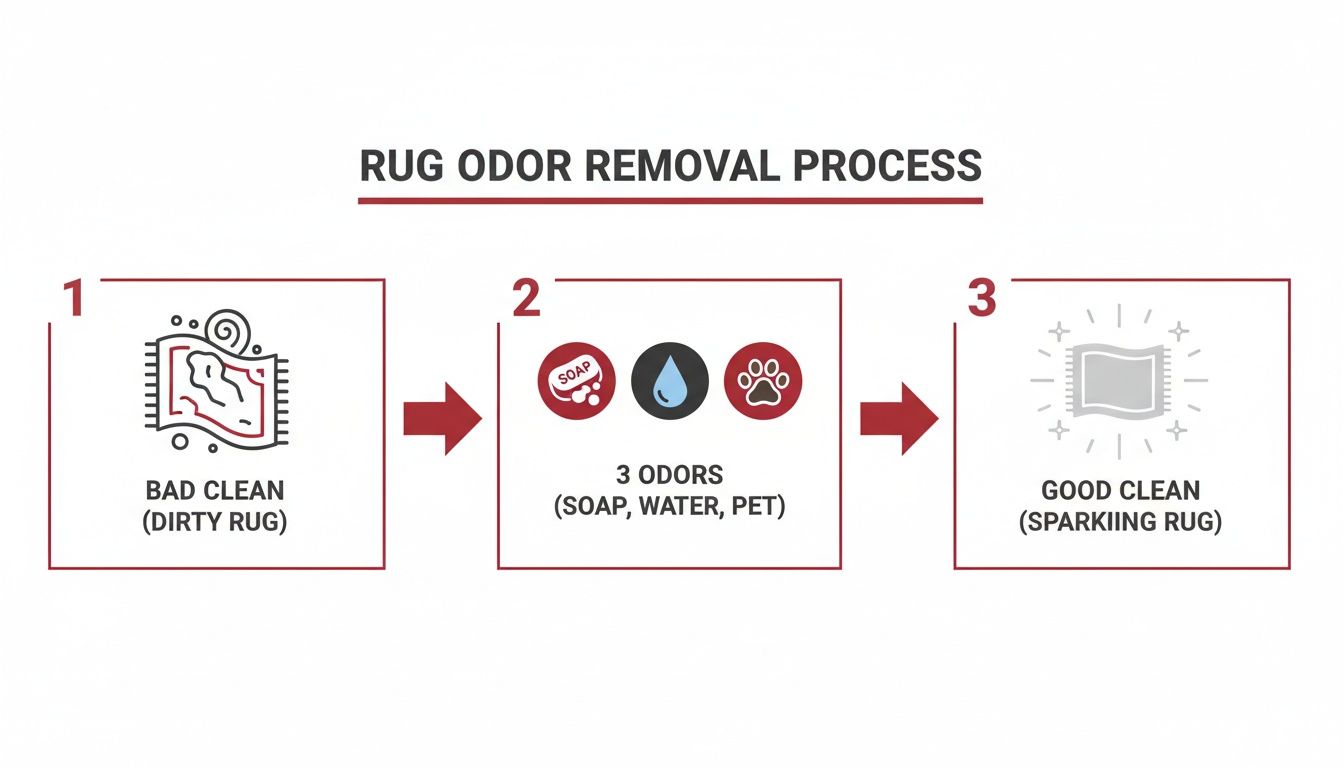
This process really highlights how a poor cleaning just sets the stage for future odors, while our proper, thorough wash eliminates the source for a genuinely fresh result.
Industry experience shows that a staggering number of odor complaints after cleaning—up to 75% in some estimates—stem directly from this residue issue. Residue from common alkaline cleaning agents, if not fully rinsed, traps airborne dirt and bacteria, leading to musty odors in as little as 48 to 72 hours. This widespread problem, detailed in reports on global rug shampoo market trends, forces homeowners into repeat cleanings to fix the smell from the last one.
The smell isn't a sign that your rug is permanently damaged. It's a clear signal that it was never truly cleaned in the first place. The soap residue must be completely flushed out by a professional.
Our Professional Solution to Residue Buildup
At Rubber Ducky Rug Cleaning, we tackle this problem head-on with a process built for deep, thorough rinsing. Unlike surface-level methods, our professional immersion washing and patented infusion rinse process is fundamentally different. It's all about getting to the root of the problem.
We created the following table to show the clear difference between a surface clean and our professional approach.
Comparing Rinsing Methods for Odor Prevention
This comparison illustrates why professional rinsing is critical for preventing the detergent residue that causes post-cleaning odors.
| Cleaning Feature | Typical Surface Cleaning | Professional Immersion Washing |
|---|---|---|
| Method | Top-down spray and vacuum extraction | Full submersion in specialized wash tanks |
| Water Penetration | Reaches only the top layer of fibers | Saturates the entire rug, from tip to foundation |
| Rinsing Action | Limited suction, often leaves soap behind | High-volume, clean-water flush removes all residue |
| Odor Outcome | High risk of musty or sour smells | Genuinely fresh, clean scent with no residue |
As you can see, the methods are worlds apart. We submerge the entire rug, allowing our tailored cleaning solutions to work their way to the very base of the fibers and dislodge trapped contaminants. This is followed by a high-volume, clean-water rinse that ensures every trace of detergent is completely removed.
This meticulous process is what prevents the rapid re-soiling that plagues improperly cleaned rugs in Birmingham, Hoover, and Vestavia Hills. For homeowners searching for "professional rug cleaning near me in Birmingham," our method guarantees that your rug is returned not just looking clean, but being genuinely clean, fresh, and free of any lingering smells.
Why Trapped Moisture Is The #1 Cause of Musty and Mildew Smells
If your rug develops an earthy, "damp basement" smell a day or two after cleaning, you've experienced the number one problem we see: trapped moisture. The very thing that makes a rug so durable—its thick, dense fibers and tightly woven foundation—also makes it a perfect sponge for holding water.
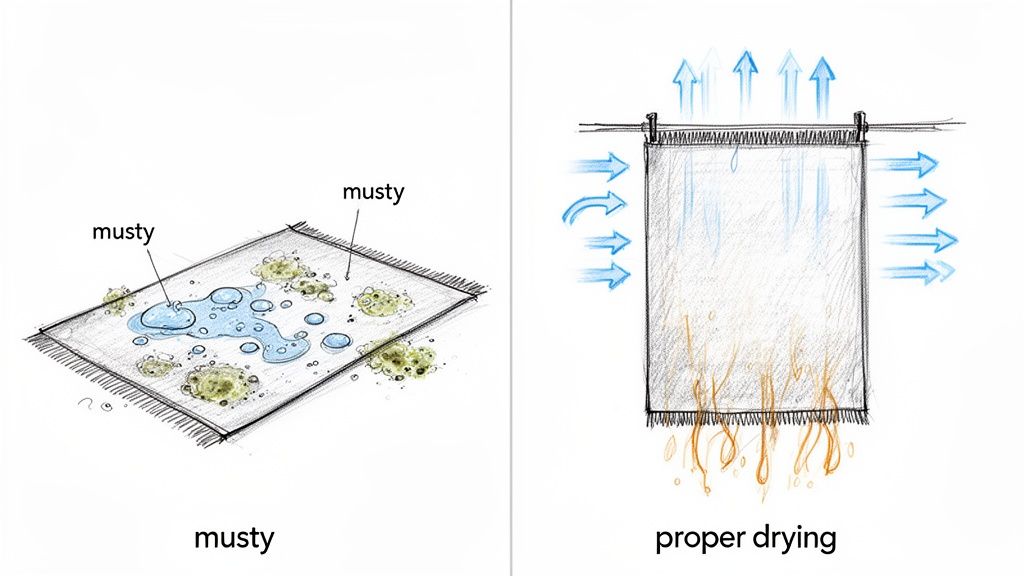
Simply laying a damp rug flat on the floor to "air dry" is a recipe for disaster. Without proper airflow hitting every single inch of that rug, especially the backing, the moisture gets locked in. And when that happens, a musty smell is almost guaranteed.
The Problem With Slow, Uncontrolled Drying
When a rug stays damp for too long, it’s basically an open invitation for mold and mildew to move in. Here in Alabama, where the humidity can be relentless, this process kicks into high gear. A poorly dried rug can start growing mildew in as little as 24 to 48 hours.
This isn't just a small problem; it's a huge one in our region. In fact, some industry data suggests that 30-40% of cleaned rugs in humid climates like the Southeast end up with smells from mold growth simply because they weren't dried properly. When you don’t dry rugs in a controlled environment—ideally around 70-80°F with 40-50% humidity—those spores have a field day. It's precisely this risk that our professional process is built to eliminate.
That musty odor isn't just an unpleasant smell. It's a clear signal of active microbial growth deep within your rug's fibers. This can damage your home's air quality and, over time, even weaken the rug itself.
Our Professional Drying Solution
At our Birmingham facility, we tackle drying completely differently. We know from experience that how a rug is dried is every bit as critical as how it's washed. It's the final, crucial step to getting a rug that is genuinely clean and fresh-smelling. You can learn more about our process in our guide on how long professional rug cleaning takes.
Every single rug that comes through our doors is moved into a dedicated, climate-controlled drying room where we meticulously manage everything:
- Temperature: We keep the room at the perfect temperature to speed up evaporation without risking any heat damage to the delicate fibers.
- Humidity: Industrial-grade dehumidifiers run constantly, pulling gallons of moisture out of the air and, in turn, out of the rugs.
- Airflow: We use powerful, high-volume fans to keep air moving all around the rug, from top to bottom and front to back.
By hanging rugs vertically, we achieve true 360-degree air circulation, which is the only way to effectively pull moisture from the deepest part of the rug's foundation. This professional technique is how we can guarantee your rug is 100% bone dry before it ever comes back to you. It's how we prevent mildew and protect the beautiful rugs of our clients from Trussville and Alabaster to Mountain Brook and Hoover.
While our professional process solves rug-specific issues, managing home humidity is also key. For persistent issues, installing a dehumidifier for central air can improve overall air quality.
The Science of Reactivated Pet Odors
If you're a pet owner anywhere from Pelham to Gardendale, you’ve probably experienced this frustrating mystery: a rug is cleaned, and suddenly, the smell of pet urine is back with a vengeance. This isn't your fault. You're experiencing a chemical reaction, and the real problem isn't the fresh cleaning; it's the invisible culprits left behind from old accidents.
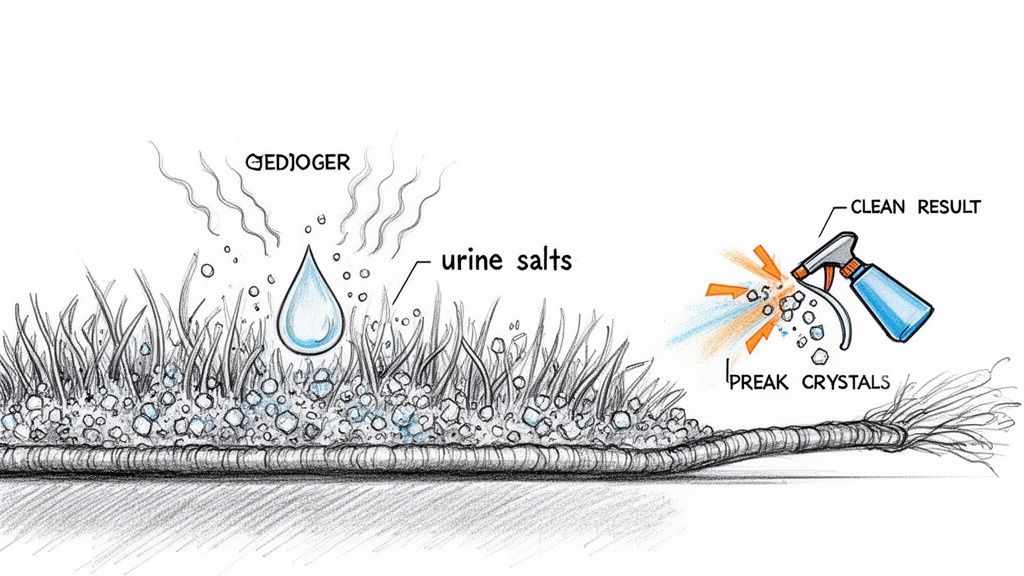
Pet urine is more than just liquid. It contains uric acid, which forms stubborn, salt-like crystals as it dries. These crystals are sneaky. Once dry, they don't have much of a smell. But the moment you add moisture—say, from an improper cleaning—they spring back to life, releasing a powerful ammonia gas. That’s why a surface-level cleaning can make the problem feel a hundred times worse.
Why Surface Cleaning Fails
A standard cleaning that only wets the surface reactivates the urine crystals but doesn't actually remove them. It’s like adding water to a concentrated smell bomb. Worse, the moisture can push the urine salts deeper into the rug’s foundation and create a perfect breeding ground for odor-causing bacteria. It's a common headache for the nearly 50 million US households with pets.
Believe it or not, a staggering 65% of post-cleaning rug odors can be traced back to these reactivated urine crystals. This is a massive issue and a big reason for the growing carpet cleaner market, as companies try to tackle a problem that only professional techniques can solve.
The powerful ammonia smell after cleaning isn't new; it’s the ghost of old accidents. The only way to win is to eliminate the source at a molecular level, not just get it wet.
Our Scientific Approach to Pet Odor Removal
At Rubber Ducky Rug Cleaning, our pet stain and odor removal service is built to tackle this problem head-on. Our specialists understand that the real work happens before the main wash even starts. We also recognize that sometimes recurring accidents can be linked to health issues like Feline Lower Urinary Tract Disease, which makes a truly deep clean absolutely essential.
Here’s a look at how our process gets to the root of the problem:
- Targeted Pre-Treatment: We don't start with water. First, we apply a professional-grade enzymatic treatment that zeroes in on the contaminated areas.
- Molecular Breakdown: These aren't just soaps. The powerful enzymes are designed to find and destroy the uric acid crystals and the bacteria that cause the odor. They break them down completely.
- Complete Elimination: By neutralizing the source first, we guarantee it can't be reactivated when we move on to our full immersion washing process.
This scientific method doesn't just cover up the smell—it eliminates it for good. It's a permanent solution that brings relief to pet-loving families from Hoover to Homewood, and across the entire Birmingham metro area.
Our Expert Process for Guaranteed Odor Removal
When a rug still smells after you’ve had it cleaned, it’s a massive red flag. It tells you a crucial step was missed or performed incorrectly. This is exactly where our expertise at Rubber Ducky Rug Cleaning makes all the difference. We’ve built our entire professional washing process to tackle the root causes of those lingering smells—leftover residue, trapped moisture, and reactivated contaminants.
We don't do surface-level cleaning. Our approach is a complete, multi-step treatment that gets into every single fiber of your rug, all the way down to the foundation. We’re not just cleaning the tips of the yarn; we're restoring the entire piece from the inside out. Each step is specifically designed to counteract the common reasons rugs hold onto odors, ensuring we eliminate the source for good, not just cover it up. For our clients from Birmingham to Montgomery and Huntsville, this is the final word on post-cleaning rug smells.
A Meticulous Approach to Odor Elimination
Our process is a system, and it starts well before your rug even sees a drop of water. It's built on a deep understanding of rug fibers and uses specialized equipment that you just won't find with a standard cleaning company. We know an antique wool Oriental can't be treated the same as a modern synthetic shag, and our methods are tailored accordingly.
Here's a look at how we get it done:
-
Pre-Inspection and Mechanical Dusting: First, our trained specialists give your rug a thorough hands-on inspection to identify its fiber type, construction, and any problem spots like old pet stains. Then, our mechanical duster gently but firmly removes pounds of dry, gritty soil that vacuums can't touch. This is huge, because that hidden dirt is a breeding ground for odor-causing bacteria.
-
Full Immersion Wash: After dusting, your rug gets a full bath in a specialized wash pool. The cleaning solutions we use are chosen specifically for your rug’s fibers—strong enough to dissolve years of grime but gentle enough to keep the colors vibrant and true. This full immersion guarantees that the cleaning agents reach every part of the rug, not just the top layer.
-
Patented Infusion Rinse: This is our secret weapon against the sticky residue that causes so many problems. Our patented infusion rinse pushes clean, soft water through the rug, flushing out every last bit of dirt and cleaning solution from deep within the foundation.
Climate-Controlled Drying and Expert Finishing
The last steps—drying and finishing—are arguably the most important. Preventing mold and mildew is everything, which is why we would never just leave a rug out to air dry. Instead, every single rug goes into our climate-controlled drying room. Here, we have complete control over the temperature, humidity, and airflow to pull moisture out quickly and, more importantly, safely.
By hanging your rug vertically, we create 360-degree air circulation around it. This makes it physically impossible for moisture to get trapped in the backing or foundation. It’s the only way to guarantee your rug is 100% dry and won't develop that dreaded musty smell.
With our trained specialists and custom-built equipment, we deliver results that protect your investment. We’re proud to be the trusted local authority on rug cleaning for communities throughout Birmingham, Hoover, Vestavia Hills, and the surrounding Alabama region. If your rug smells after cleaning, stop trying temporary fixes. Call, text, or book online with Rubber Ducky Rug Cleaning for a true, deep clean that you can smell—or rather, can't smell.
Common Questions We Hear About Lingering Rug Odors
Our team in Birmingham gets asked about post-cleaning smells all the time. It’s a frustrating problem, so we wanted to answer a few of the most common questions we hear from homeowners across Alabama. Let’s clear up the confusion and explain why a professional deep clean is the only real fix.
Can I Just Air Out the Rug to Get Rid of the Smell?
Airing out a damp rug might provide temporary relief, but it won’t solve the underlying issue. When a rug smells musty, it means moisture is still trapped deep within the foundation fibers, far beyond what a ceiling fan or an open window can reach.
The same goes for leftover detergent residue, which often creates a sour smell. The only way to truly eliminate these odors for good is with a professional immersion wash and a controlled drying process—exactly what our Birmingham facility was built for. While some home remedies seem promising, our article on using white vinegar for rug odors explains why they often don't deliver lasting results on their own.
My Rug Still Smells After I Had It Cleaned. Why?
We hear this story far too often. Many cleaning companies use methods fine for wall-to-wall carpeting but disastrous for area rugs. They inject hot water and solution but lack the power to rinse it all out, leaving the rug’s dense foundation soggy and full of residue.
They simply don't have the specialized equipment—like rug dusters, full immersion wash pits, and climate-controlled drying rooms—that are essential for a proper rug cleaning.
As rug-only specialists, our entire process at Rubber Ducky is designed to avoid these exact problems. We don’t just adapt carpet cleaning methods; we use time-tested, rug-specific techniques to guarantee a true deep clean from the inside out.
How Can I Tell if the Smell is Mildew or Old Pet Stains?
The two smells are quite different. Mildew has a very earthy, musty smell, almost like a damp basement after a heavy rain. Pet urine, on the other hand, gives off a sharp, acrid ammonia smell that gets much stronger when the rug gets wet.
Our trained technicians can pinpoint the source of the odor during our initial inspection. From there, we know exactly which professional pre-treatment to use to break down and neutralize that specific smell before the main wash even starts.
Is Your Cleaning Process Safe for My Delicate Oriental Rug?
Absolutely. Fiber knowledge and safety are at the core of everything we do. We don’t believe in a one-size-fits-all approach. Whether you have a delicate silk heirloom, a sturdy wool Oriental, or a modern synthetic, we tailor our cleaning solutions and methods to match.
Our gentle immersion washing and controlled drying techniques are specifically designed to prevent problems like dye bleed and shrinkage. It’s this careful, expert approach that gives homeowners from Hoover to Huntsville the confidence to trust us with their most valuable rugs.
If a foul odor is hanging around after a cleaning, it's a sure sign the job wasn’t done correctly. You don’t have to live with it. Let the experts at Rubber Ducky Rug Cleaning Birmingham deliver a true, restorative clean that removes the source of the problem for good. Call, text, or book your service online today at https://www.rubberduckyrugs.com/birmingham.