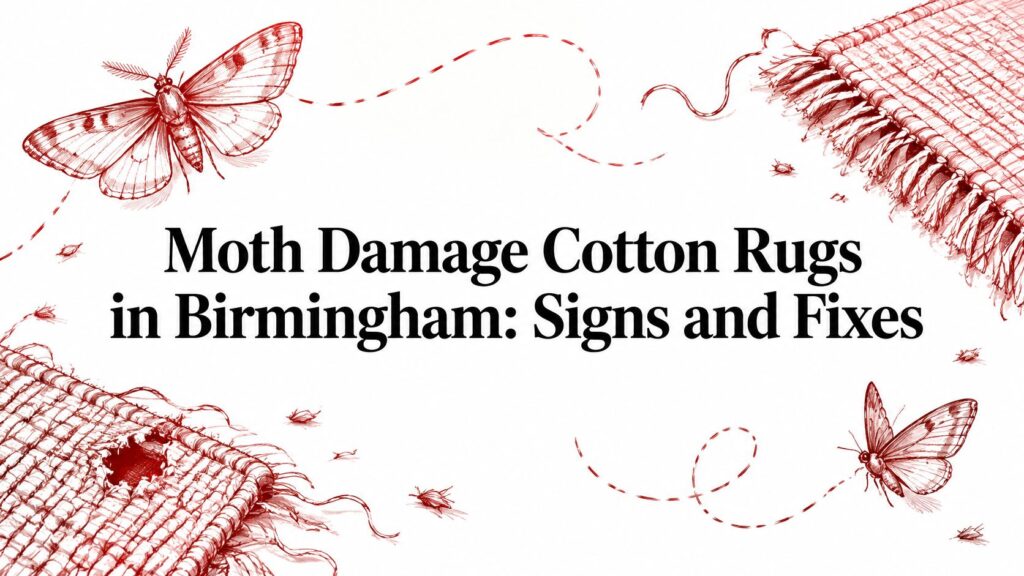
You move the coffee table and find a bald patch where your rug looked fine from across the room. If you're searching for professional rug cleaning in Birmingham because of suspected moth damage, don't assume the rug is ruined, and don't spray it before someone checks the fibers. The useful questions are whether insects are still active, what they're feeding on, and whether the missing pile needs restoration rather than cleaning alone.
Signs of Moth Damage in Birmingham Cotton Rugs
A patch beneath furniture deserves a closer look than ordinary flattening beside a doorway. Clothes-moth larvae cause the fiber damage, not the flying adults, and they can feed in protected areas you rarely disturb. A cotton label doesn't rule out activity, particularly when the rug contains other fibers or has accumulated organic soil.
Look for a combination of signs rather than diagnosing a hole by itself. The Anchor Pest Services guide to moth damage in carpets identifies irregular holes, thinning, webbing, and silken cases among the clues associated with larval feeding.
Moth damage signs and what they mean
| Sign | What It Usually Means | Where to Check |
|---|---|---|
| Small irregular holes with ragged edges | Larvae may have clipped fibers and fed | Under furniture and in fold lines |
| Thinned or bare patches in the pile | Feeding may have removed fiber near the base | Center of traffic-free areas and rug edges |
| Silken webbing or small tubes in the fibers | Larvae have formed protective webbing or cases | Seams, fringe and the underside |
| Dark granular droppings called frass | Larval feeding has occurred; newly appearing deposits suggest activity | Along edges, corners and beneath the rug |
| Shed fibers and debris along the edges | Possible feeding at the perimeter, although ordinary shedding can look similar | Fringe, binding and the floor beneath |
| Cocoons tucked into folds | Insects have reached the pupal stage; check for continuing activity | Fold lines, corners and seams |
| Damage with no adult moths visible | Larvae may still be present despite the absence of adults | Hidden areas beneath furniture |
Photograph the patch before disturbing the debris. Include a wider view showing its position relative to furniture, then a close-up of the fibers and underside. That gives our Birmingham team a clearer starting point for assessing the rug.
Practical rule: A bare patch is evidence of missing fiber, not proof of its cause.
Moth damage is often patchy and clustered in sheltered spots. Foot-traffic wear generally follows walkways, doorways, and repeated turning points. Neither pattern is conclusive without examining the fibers, but it helps separate a likely feeding site from routine abrasion.
Don't pull loose threads to test their strength. A weakened foundation can unravel, making an otherwise limited repair more involved.
Why Moths Attack Cotton Rugs and What They Eat
Clean cotton isn't the preferred food of clothes-moth larvae. The University of Kentucky clothes-moth guide identifies the webbing clothes moth, Tineola bisselliella, and casemaking clothes moth, Tinea pellionella, as textile pests whose larvae favor animal materials such as wool, fur, feathers, and felt.
Cotton becomes more vulnerable when it's blended with wool or contaminated with food residue, perspiration, body oils, or other nutrient material. Think of moths as guests drawn to the crumbs rather than the table. What's caught in or touching the rug can matter more than the cotton itself.

The blended-rug trap
A rug described as cotton-backed may have a wool pile. A family-room rug may hold food particles and pet debris, while a stored cotton rug may sit against wool blankets. In each case, the visible damage can mislead you about the actual food source.
Check the label, but also distinguish the pile, foundation, backing, and fringe. They aren't necessarily made from the same material. A cotton foundation beneath damaged wool pile doesn't mean larvae preferred the cotton.
If the moths appear mainly around food cupboards rather than textiles, FullScope Pest Control's explanation of signs of pantry moth infestations provides useful context for avoiding the wrong diagnosis. A moth seen elsewhere in the house doesn't automatically explain a rug's bald patch.
For homeowners in Hoover or Homewood, the cleaning decision starts with identifying those materials and residues. Cleaning removes soil that can support feeding, but it isn't an insect-control guarantee. Any continuing infestation also needs its source addressed.
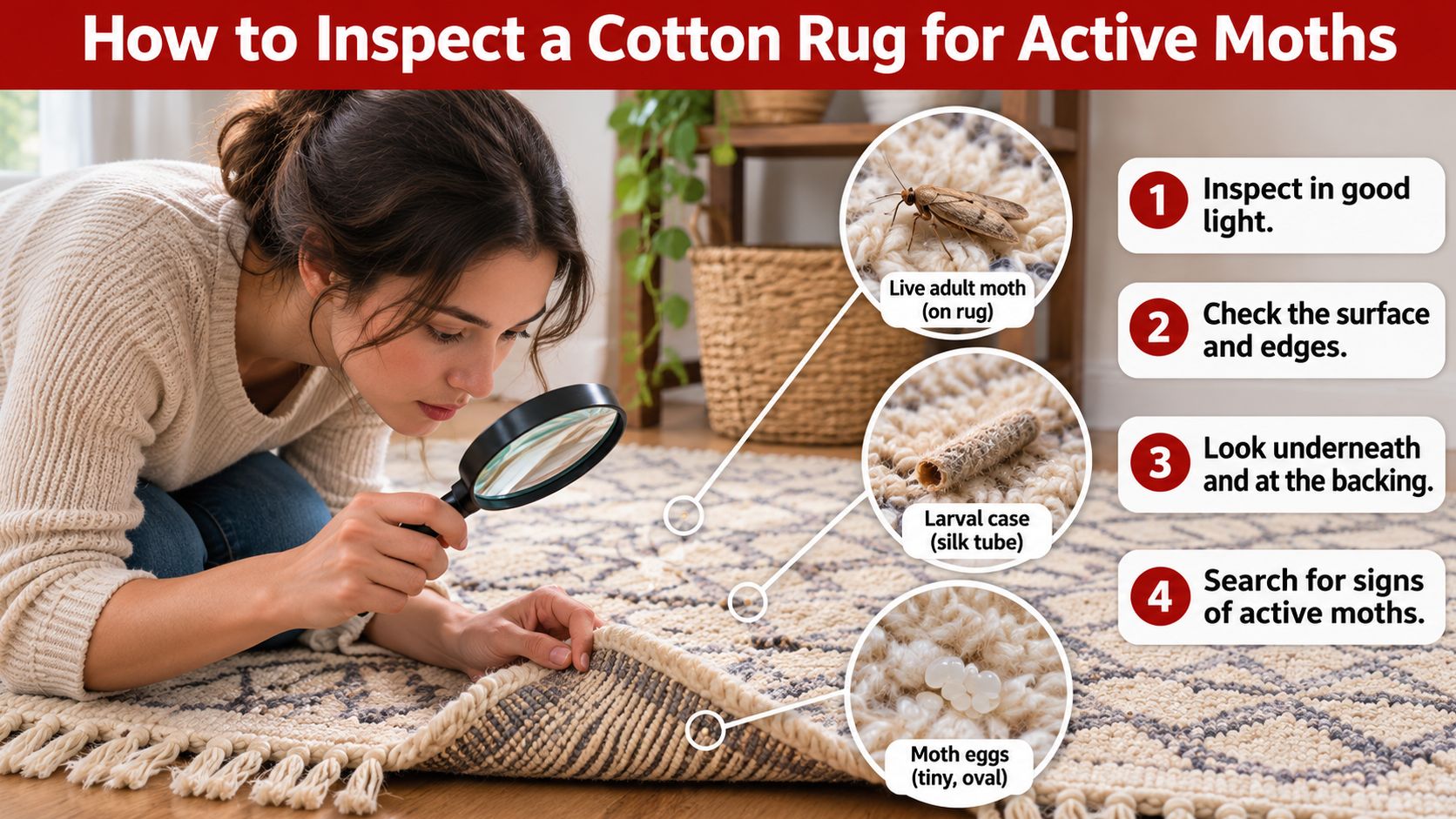
How to Inspect a Cotton Rug for Active Moths
Hidden activity matters more than the number of flying moths. The National Park Service guidance on textile pest management emphasizes physical evidence such as frass, webbing, cocoons, and localized grazing, alongside inspection and monitoring.
Use good lighting and a flashlight, and avoid forcefully folding a brittle or valuable rug. If it's too heavy to turn safely, leave the underside inspection for pickup.
A practical inspection routine
Identify the materials. Check the label and note any wool, felt, or fur in or beside the rug. Don't assume a cotton backing describes the entire construction.
Examine the underside. Turn back a manageable corner and inspect seams, backing, and fold lines under bright light. Looking only at the decorative face misses protected places where debris collects.
Lift the perimeter. Inspect fringe, binding, and the floor beneath. Use care around loose edge stitching rather than tugging it aside.
Check sheltered areas. Look beneath furniture and in corners that don't receive foot traffic. Don't limit the inspection to the bald patch you first noticed.
Angle the flashlight across the pile. Low light makes clipped fibers, webbing, and granular debris easier to distinguish from flat pile. Photograph suspicious material before removing it.
Inspect neighboring textiles. Check nearby wool rugs and stored animal-fiber items, so cleaning one rug doesn't leave another source untouched. If you're also investigating insects around seating, The Sofa Cover Crafter on sofa checks concerns a different pest problem, not a method for diagnosing rug moths.
Vacuum gently and establish a clean baseline. Bag collected debris and dispose of it outside, then arrange a follow-up inspection. Don't aggressively vacuum fragile fringe or an exposed foundation.
Reading the result
Moving larvae, fresh webbing, or newly deposited frass indicate continuing activity. Old holes and empty cases can remain after insects are gone, so their presence alone doesn't establish that feeding continues.
One moth with no holes calls for inspection, not automatic treatment of every rug. Holes without moths still deserve attention because adults may be absent.
A clean-looking surface isn't the same as a confirmed insect-free rug.
Cleaning can be the last intervention when monitoring finds no renewed signs and nearby food sources have been addressed. If fresh evidence appears, arrange professional rug assessment and appropriate pest management rather than repeating surface cleaning indefinitely.
Treatment Options for Moth-Damaged Cotton Rugs
The useful order is remove loose debris, address the infestation and affected materials, then assess restoration. Reversing that order can mean repairing a rug while insects remain nearby.
Cleaning and insect treatment serve different purposes. Washing can remove embedded soil and reveal the true extent of damage, but it can't grow missing fibers back or substitute for a confirmed pest-control method.
Moth damage treatment options compared
| Option | Works Best For | Main Limitation |
|---|---|---|
| Professional cleaning and restoration | Rugs with embedded debris, odor or unclear damage | Needs a full inspection and a controlled drying plan |
| Properly managed freezing | Small, sealed, unbacked items assessed as suitable | Not automatically suitable for large, damp, dyed or backed rugs |
| Vacuuming with bag disposal | Removing loose frass, cocoons and debris | Can miss larvae and eggs in folds and rug edges |
| Repellent sprays | Limited preventive use on suitable stored items after treatment | Don't reliably resolve larvae already feeding in a rug |
At our facility, mechanical dusting tumblers gently tumble suitable rugs to shake out sand, dust, pet hair, and grit trapped deep in the fibers. They remove debris that ordinary vacuuming cannot reach. Inspection comes first, particularly where moth damage may have weakened the foundation.
What home methods can't fix
Vacuuming is useful preparation, provided the rug can tolerate it. Use a suction attachment around vulnerable edges, avoid a powered brush over loose fringe, and empty the canister or dispose of the bag outside immediately. Don't interpret an empty vacuum pass as proof that hidden insects are gone.
Properly managed freezing can kill insect life stages, but successful treatment requires control of temperature, packaging, and condensation. A household freezer isn't automatically a safe treatment chamber for a rolled rug. Don't wet the rug first or force a damp, fragile piece into a freezer.
Spraying the visible patch is another poor shortcut. A repellent doesn't repair damage, and an unsuitable product may leave residue or affect dyes. Avoid applying pesticides to a rug unless the product specifically permits that application and the material has been assessed.
Treatment boundary: Washing removes contamination. Restoration repairs missing or weakened structure. Pest management addresses continuing insects.
For a Birmingham homeowner, the sensible split is straightforward: vacuum accessible loose debris, use professional cleaning for embedded contamination, and reserve freezing for items a qualified specialist considers suitable. Restoration decisions should follow inspection and cleaning, when the remaining pile and foundation can be evaluated.
How to Stop Moths From Coming Back
Prevention means making the rug and its surroundings less suitable for feeding. It doesn't replace inspection, particularly after a previous infestation.
Keep wool, fur, and felt items from resting against a vulnerable cotton rug. Separate stored wool-blend pieces from cotton-backed rugs, and deal promptly with food spills, pet accidents, and body-oil residue rather than allowing soil to build up.
A repeatable rug-care routine
- Clean the hidden edges. Vacuum the fringe area, perimeter, and floor beneath furniture, using gentle suction where stitching is loose.
- Move rugs carefully. Lift and rotate suitable rugs periodically so you can inspect concealed surfaces and avoid leaving the same areas undisturbed.
- Store clean and dry. Use breathable cotton covers for dry rugs, keep storage conditions moderate, and never pack them against soiled or suspect wool items.
- Monitor vulnerable textiles. Use clothes-moth pheromone traps as an inspection prompt, not proof that a rug is damaged or that treatment has succeeded.
- Inspect incoming pieces. Keep a secondhand rug or wool textile separate until its seams, folds, and underside have been checked.
Our preventive maintenance guidance for rugs can help organize ongoing care. For broader housekeeping context, The Green Advantage's sanitation checklist for Northwest Indiana homes complements, but doesn't replace, rug-specific inspection.
Keep a simple seasonal checklist: clean concealed edges, address spills promptly, inspect traps and storage, and investigate any new frass. Schedule professional washing when embedded soil or persistent odors remain beyond routine care.
When Moth Damage Needs a Professional Cleaner
Arrange a professional assessment when the problem exceeds loose debris and a clearly isolated patch. For homeowners in Vestavia Hills and Mountain Brook, a valuable rug deserves the same caution as one with obvious widespread damage.
- Spreading damage: Holes or thinning extend across several areas.
- Continuing activity: Fresh frass, webbing, larvae, or new cocoons appear after cleaning.
- Unclear construction: The pile may contain wool or a wool blend, but its composition isn't certain.
- Delicate materials: The rug is hand-woven, oriental, silk, or an heirloom with vulnerable dyes or stitching.
- Unsuitable home treatment: The rug is too large, backed, fragile, or damp for safe handling.
- Combined moisture damage: The rug has also been wet and needs prompt drying assessment.
Wet rugs shouldn't wait for moth monitoring. CDC guidance on flood cleanup recommends cleaning and drying wet building materials within 24–48 hours, with carpet and padding among the porous materials requiring attention.
What professional care changes
We inspect before cleaning so weakened foundations and concealed affected areas can be considered before choosing a method. That also separates a grooming issue from damage requiring handmade rug restoration. Brushing can improve surviving pile, but it cannot replace eaten fibers.
After washing and water removal, each rug is hung to dry so the fibers settle naturally. Our drying rooms are large, climate-controlled spaces where temperature and humidity are balanced to protect the fibers. Once dry, the pile is brushed to restore softness, texture, and shine.
Pet odor deserves its own assessment. A study of cat-urine-contaminated carpet and subflooring found persistent odor-related contamination and that several marketed products initially masked odors that later returned. The practical lesson for rugs is to treat the contaminated layers rather than add fragrance, and to recognize when the floor beneath also needs attention.
Choose home care for loose debris with reassuring follow-up observations. Choose professional care for spreading, active, structurally weakened, or valuable damage.
Book a Rug Pickup for Moth Damage in Birmingham
A moth-damaged rug does not need a ride in your car to get assessed. Rubber Ducky offers home pickup and return for customers in the Birmingham area, so a heavy rolled piece goes straight from your floor to the wash facility without the lifting.
Before pickup, gather a few details:
- Photograph the evidence. Capture holes, thinning, frass, and webbing with a light angled low across the pile.
- Identify the room and fibers. Note where the rug sat and whether the label mentions cotton, wool, or a blend.
- Record nearby materials. Check the underside and fringe, and mention any wool, felt, or fur items touching the rug.
Those details matter more than they look. A rug that sat under a wool sofa throw, for example, points the inspection toward a wider affected zone than the bald patch alone suggests.
Our area rug cleaning pickup process covers collection, an inspection before cleaning, and a wash path matched to the fiber, with the rug returned to its original spot in your home.
Give the team the complete picture
The booking form lists fraying edges or moth damage alongside food or drink stains, pet urine or odors, and mold, mildew, or water damage. Select every concern that applies. A rug with moth damage plus a pet accident or a damp-storage history needs more than one thing assessed, and flagging them upfront keeps the estimate honest.
Email photos to info@rubberduckyrugs.com when requesting an estimate. Collection and return spare you the transport, while the pre-cleaning inspection establishes what washing can improve and whether restoration needs separate consideration.
Rubber Ducky Rug Cleaning Birmingham offers home pickup, professional facility washing, controlled drying, and restoration assessment for moth-damaged rugs. Visit Rubber Ducky Rug Cleaning Birmingham to schedule a pickup.