A bottle of polish tips over on the coffee table, one bright drop lands on the rug, and your hand is already on the acetone under the bathroom sink. Stop there. A wool Persian in a Mountain Brook living room and a polypropylene runner in a Hoover mudroom are not the same problem, and the solvent that rescues one can wreck the other. That gap is where most nail polish advice fails, and it's the reason so many small spills end up as a reweave or a replacement.
The fiber decides which solvent is safe. Not the bottle, not the price tag, not how fast you move. Everything below follows that order, starting with what the rug is made of and stopping early on the pieces that shouldn't be treated at home in Birmingham at all.
Check the Rug Fiber Before Any Solvent
Nail polish is a solvent-based lacquer, and a review of its formulation published in PubMed Central estimates solvents account for approximately 70% of the composition, with film-forming polymers around 15%, thermoplastic resins about 7%, plasticizers about 7%, and pigments less than 1%. That ratio explains everything you feel through the cloth. While solvent is still present, the polish behaves like a liquid and lifts onto fabric. Once it evaporates, the polymer and resin share takes over and cures into a film that grips the pile.
So a fresh drop softens with the right product, and a dried one has to be loosened in stages. Scrubbing a cured film only pushes pigment deeper and roughs up the fiber surface, which is how a coin-sized mark becomes a dull patch.
The University of Georgia Extension puts fiber identification ahead of product choice. Its guidance is to lift excess polish carefully, then use a small amount of non-oily remover or acetone substitute only after checking what the rug is made of, and it warns that commercial removers aren't pure acetone and may contain ingredients that worsen staining. Test a hidden area, blot from the outside toward the center, and never soak the backing.
| Fiber | Common Rugs | Solvent Risk | First Safe Step |
|---|---|---|---|
| Wool | Oriental and Persian pile, wool area rugs | High. Limit agitation, heat and moisture | Pretest, then blot only |
| Silk and silk blends | Hand-knotted and silk-pile rugs | High. Avoid solvent | Lift residue, then get specialist assessment |
| Cotton | Flatweaves, braided and cotton rugs | Moderate. Limit wetting | Pretest a hidden corner, then dab |
| Viscose or rayon | Blended and tufted rugs | High. Fibers weaken when wet | Pretest and blot without soaking |
| Acetate or triacetate | Blended rugs and some older pieces | Severe. Never use acetone or lacquer thinner | Stop and seek professional help |
| Polypropylene (olefin) | Indoor-outdoor rugs | Lower. Pretested solvent on a small area | Pretest, then work from the outside in |
| Nylon | Machine-made and synthetic area rugs | Lower. Pretested solvent on a small area | Pretest, then work from the outside in |
| Polyester | Machine-made and synthetic area rugs | Lower. Pretested solvent on a small area | Pretest, then work from the outside in |
The Rule That Overrides Every Other Rule
Acetone or lacquer thinner must never touch acetate or triacetate, where fibers can rapidly turn to froth. That's not a caution about being careful. It's a hard stop, and some older blended pieces in Birmingham homes are exactly this fiber.
Viscose and rayon deserve their own warning, because they look like silk and behave badly when wet. Our guide to how to clean a viscose rug walks through the wet-strength problem in detail before you put anything on the pile.
The fiber-first habit travels past the floor, too. The method behind removing stains without ruining blanket softness rests on the same principle: match the product to the material before it touches fabric.
Before you open a bottle, run this short list:
- Read the label or ask the seller. If the fiber isn't stated, assume it's the least forgiving option.
- Check for dye and backing risk. Test a corner that faces the wall, and look at the backing edge afterward, not just the surface.
- Judge the age of the piece. Vintage, hand-woven, dyed or blended rugs are where solvent migration damages color, adhesive and texture.
- Make the call. If the rug is old, hand-knotted or silk, home removal should stop before it starts.
Choosing a Solvent for Dried Nail Polish
A dried spill is a cured film, and cured films don't dissolve in one pass. The common mistake is escalating to something harsher after a single attempt, which is how fibers and dyes get hurt. Treat the options as a ladder. Start with the weakest one your fiber tolerates, move up only after the pretest passes, and stop as soon as pigment stops transferring to the cloth.
| Option | Best For | Dwell or Limit | Watch For |
|---|---|---|---|
| Acetone | Pretested non-acetate synthetic rugs | Short controlled applications, blotted between passes | Never on acetate or triacetate; can damage latex backing if it soaks through |
| Non-acetone remover | Light residue on pretested synthetic rugs | Follow the label on a small area only | Often contains additives that can worsen staining |
| Amyl acetate | Resinous, dried polish on colorfast rugs | Work under a moist pad, checking progress as you blot | Apply to a cloth, not the rug; test dye first |
| Cold water rinse | Final residue after any solvent | Blot until nearly dry | Doesn't dissolve dried polish on its own |
Acetone earns its place on nylon, polyester and olefin after a clean pretest, and WoolSafe's wool guidance treats it as a controlled application to the stained area alone, then blotted, never poured. Amyl acetate is the University of Georgia Extension's option for resinous stains, worked under a moist pad so the solvent stays where you put it. Non-acetone remover is gentler, but it's a formulation rather than a single chemical, and the additives are the reason it sometimes leaves a worse mark than the polish.
Repeat, don't escalate. A faint ring after one controlled pass usually means another pass with the same product, not a jump to a stronger solvent.
Cold water isn't a remover. It's the finish, used to lift residue so the area doesn't dry tacky or attract soil.
One check often skipped: once the rug is dry, fold back the corner and look at the backing. Polish can look gone from above while solvent has already reached the latex adhesive below. If that edge feels soft, crinkled or tacky, the spot needs professional attention.
The same thinking applies off the floor. If you're weighing options for how to treat sofa spills without damaging fabric, you'll see the identical sequence: weakest product, hidden test, blot, dry, then reassess.
Safety Rules for Solvent Use at Home
Acetone changes the job from stain removal to fire control. NOAA's chemical data sheet for acetone lists a flash point of 0°F, so vapor from a small open bottle can ignite from a pilot light, a candle, a cigarette, a space heater or a spark at a wall switch.
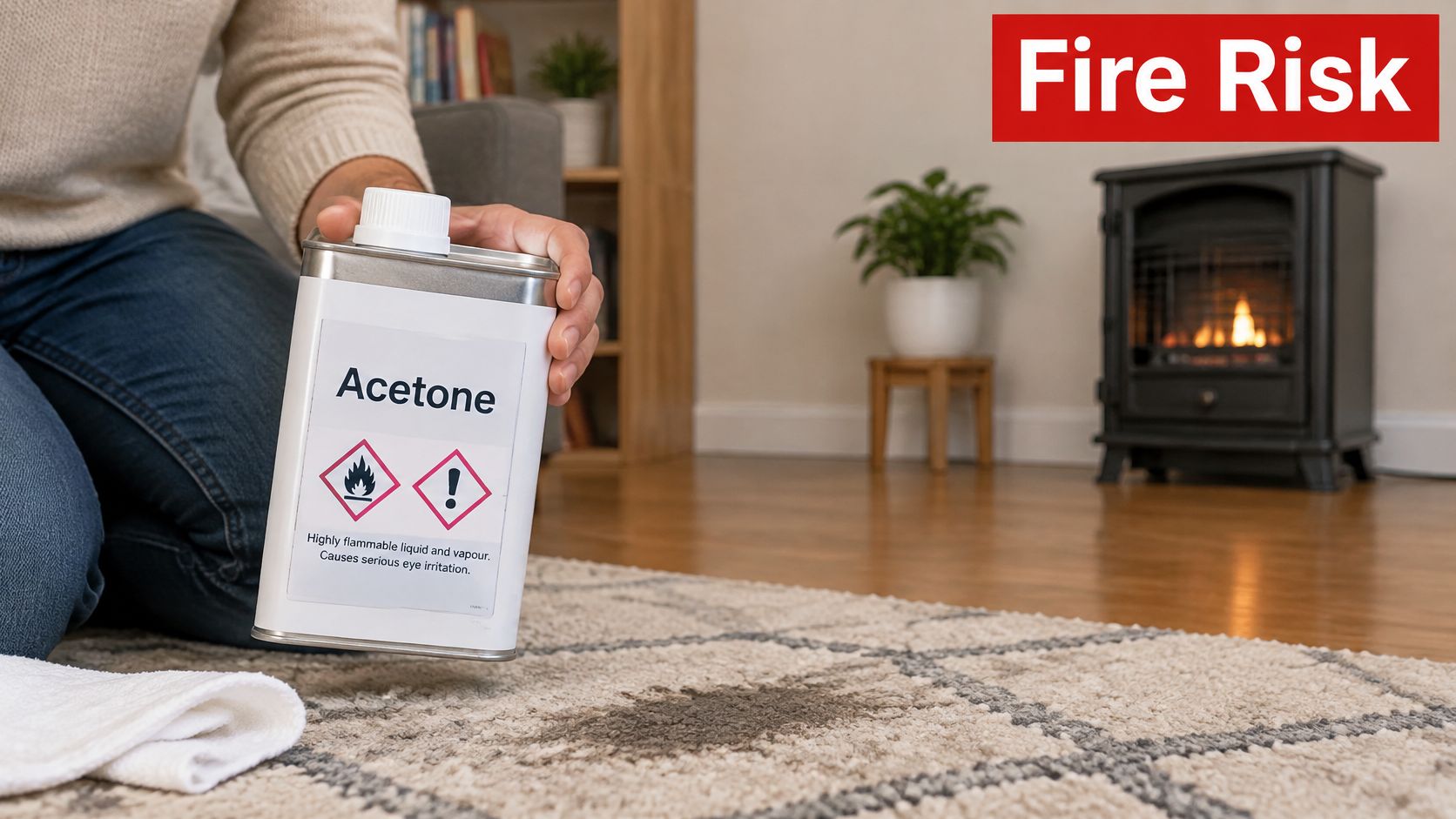
Work in a room you can flush with air. Acetone evaporates readily at room temperature, and spraying or dispersing the liquid raises vapor concentration faster than dabbing a cloth does. Its boiling point, vapor pressure and flammable range all point the same way: a closet, a half-bath or a closed laundry room is the wrong workspace.
NIOSH and OSHA both publish workplace exposure limits for acetone. Those ceilings are written for occupational settings, not for a homeowner kneeling over a rug with an uncapped bottle. At home the margin is simpler: keep air moving, close the bottle between applications, and stop if solvent odor builds instead of thinning out.
- Ventilate first. Windows open, doors open, a fan blowing air out of the room.
- Clear every ignition source. Candles, cigarettes, pilot flames, heaters and anything that sparks.
- Empty the room. Children and pets out, and the door closed behind them.
- Keep the dose small. Solvent goes on a cloth or cotton swab in drops, never poured onto the rug.
- Seal the waste. Used cloths go into a sealed container, outdoors and away from heat, not into a bin with dry rags.
If you've worked with isopropyl alcohol for carpet stains before, you already know the discipline of a few drops on a white cloth. Acetone calls for the same restraint plus stricter ignition control, because its flash point sits far lower than rubbing alcohol's.
The stop condition: if the fiber is wool, silk, vintage or hand-woven, or if polish has reached the backing, professional assessment is safer than another drop of solvent.
How to Remove Nail Polish Step by Step
The order matters more than the product. Work through these in sequence and the stain comes up without collateral damage to dye, pile or backing.
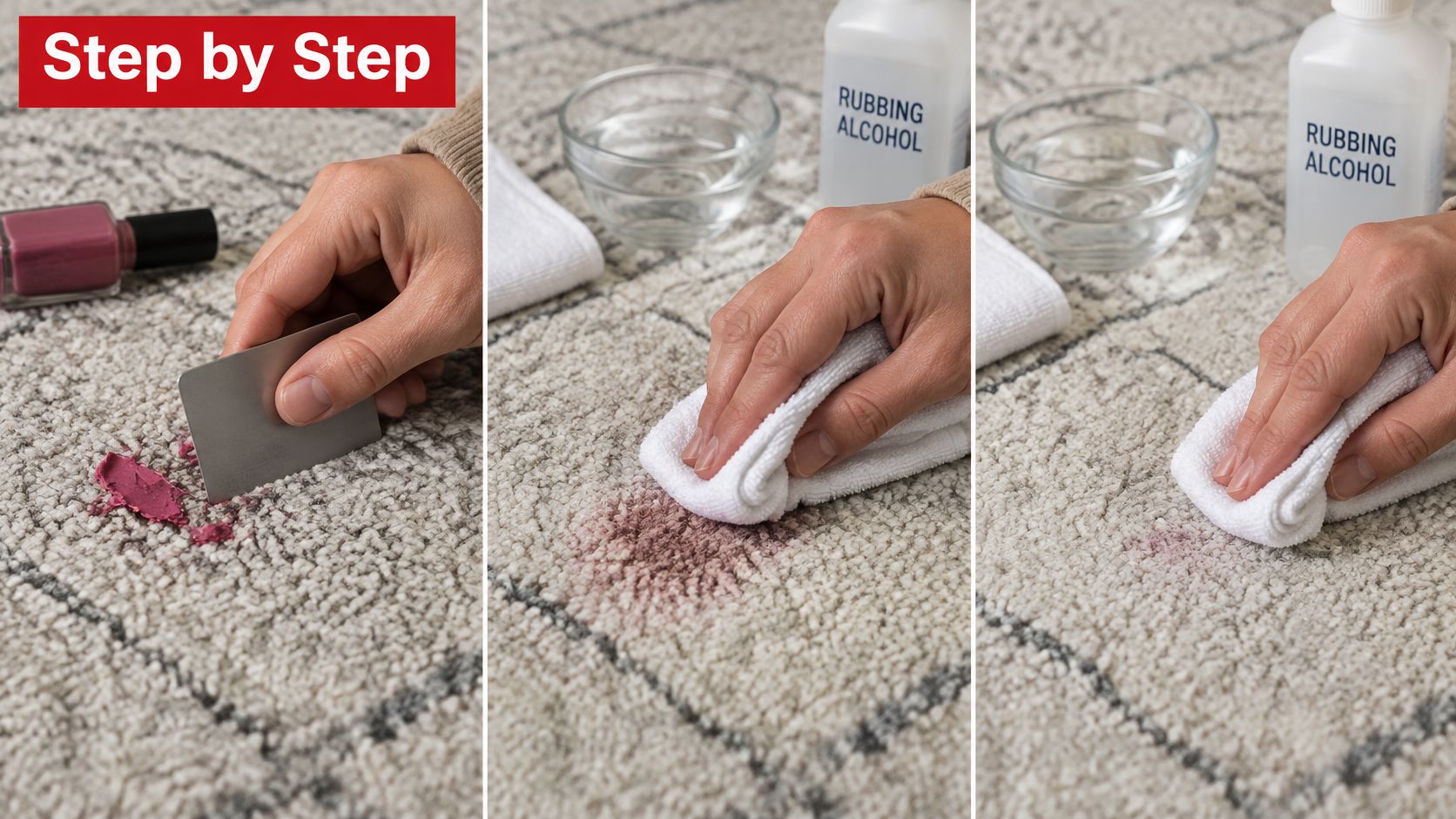
- Lift the excess. Use the dull edge of a card or table knife on dried solids and a dry white cloth on wet polish, pressing straight down from the outside in. Rubbing spreads the resinous film deeper into the pile, which is the single most common way homeowners make this worse.
- Photograph the spot in daylight. Do it before another product touches the area, so a specialist can see the original condition and judge how much the fiber has changed.
- Pretest a hidden corner. Apply the chosen solvent, let it dry completely, then check the cloth for dye, the fiber for fuzzing and the backing edge for a tide mark. Only a clean test counts as a pass.
- Load the cloth, not the rug. University of Georgia Extension's removal guidance for fingernail polish and lacquer passes along the Carpet and Rug Institute's warning that solvent must never be poured onto carpet or allowed to reach the backing, where it can damage the latex adhesive holding the layers together.
- Dab from the rim inward, and rotate. Switch to a clean section of cloth every time pigment transfers. Working outward from the center just pushes dissolved polish into fresh fiber.
- Respect the dwell limit. Hold to the time on the label or the professional guidance for your fiber, then blot. Leaving solvent to sit longer doesn't lift more polish, it just gives the liquid more time to travel.
- Rinse and blot nearly dry. Sponge with clear water and press out the moisture so no residue is left to attract soil. The same outside-in discipline shows up in removing blood and soda carpet stains, where cold water and blotting beat scrubbing every time.
- Reset the pile. Brush against the nap and let the rug dry flat and away from heat, then vacuum once it's fully dry.
A successful pass looks like this: no color on the cloth, no tacky film when you press a dry finger to the spot, and pile that lies flat and matches the surrounding area in direction and sheen.
For dried polish, add one branch after step 8. Lift the hardened film first, then return to the solvent table and work in the same outside-in order. Expect a faint ring after the first pass, and repeat a controlled pass rather than reaching for something stronger. When pigment no longer transfers to the cloth, you're done.
When to Stop and Call a Birmingham Rug Cleaner
Home treatment ends at the first test if any of these is true.
- The fiber can't be identified. No readable label, no seller confirmation, no confidence means no solvent.
- Polish reached the backing or the adhesive reacted. Soft, crinkled or darkened backing is a professional problem.
- The stain is larger than a coin. Broad solvent work on a wool or silk pile risks the surrounding dye.
- Dye transfers onto the cloth. Color on the cloth means the rug is telling you to stop.
- Repeated passes changed the texture or color. Dull patches and matted pile don't reverse with more product.
- Another spill sits nearby. Pet urine or an old drink mark near the polish mark is a job for one controlled treatment, not two home attempts.
For wool, Oriental, Persian, silk and hand-woven rugs, WoolSafe's wool carpet care guidance makes the reasoning clear. It emphasizes chemical compatibility testing so treatment doesn't cause color bleeding, bleaching or other damage, and it treats solvent as something applied carefully to the stained area alone. Fiber sensitivity plus dye risk plus a limited treatment window is exactly the combination that calls for a trained rug cleaner rather than a household bottle.
That's where Rubber Ducky Rug Cleaning Birmingham comes in. We inspect fiber, dye and backing before choosing a method, so a stained rug gets treated on its own terms instead of a generic schedule. If your rug is already past the point of a home attempt, the next step is our rug stain removal service, where the polish, the dye and any older spill get handled together.
Until then, keep the rug flat, keep the spot dry, and keep the solvent label handy. Prepare those three things and the assessment goes faster.
Book a Rug Assessment Before the Stain Sets
Make the decision first, then act on it. Stop applying solvent, keep the rug flat, and book an assessment before the film sets deeper into the pile, because a stain treated once and assessed early is far easier to work with than one treated five times.
Have four things ready when you call:
- The fiber label or the seller's description, including whether it's hand-knotted.
- A clear photo of the spot taken in daylight, with the pile direction visible.
- The rug's dimensions, since size affects how the piece is handled.
- What you've already tried, including the product name and how long it stayed on the rug.
We collect rugs from the home, and pickup is handled by team members who transport each piece to our local cleaning facility and then schedule its return. At the facility, rugs are inspected, dusted in mechanical tumblers, washed in a custom wash tank, rinsed with hi-tech mechanical rinsing machines, and dried in a controlled chamber before the pile is brushed. Rugs are completed in minutes, not hours, which limits how long they're exposed to water and detergent, and the rug comes back to its original spot in the house. If you'd rather talk it through first, call (205) 329-6488.
If nail polish has already met a wool, silk or hand-woven rug in your Birmingham home, Rubber Ducky Rug Cleaning Birmingham can take it from here. We pick up the rug from your door, wash it with fiber-safe methods, dry it in a controlled chamber, brush the pile back to life and return it where it belongs, and we'll tell you what the stain is likely to leave behind before you commit. Visit Rubber Ducky Rug Cleaning Birmingham to request an estimate or schedule a pickup in Birmingham, Hoover, Vestavia Hills, Mountain Brook, Homewood or anywhere nearby.