

Your handwoven rug looks clean after vacuuming, but a pet odor returns when the room feels damp, or a spilled drink has left a dark patch across the weave. If you're searching for professional rug cleaning in Birmingham, the important question isn't simply whether the rug is wool. It's whether the foundation, dyes, edges and surface can tolerate the proposed cleaning method.
Rubber Ducky's pickup-to-return service takes the washing and drying out of your home. For a handwoven Scandinavian rug, that convenience matters, but the priority that counts most is treating it as a textile with a structure to protect, not just a decorative floor covering.
Handwoven Scandinavian Rug Types, Materials and Weave
Scandinavian handwoven rug types compared
| Type | Construction | Pile height | Typical fibers | Care sensitivity |
|---|---|---|---|---|
| Röllakan flatweave | Reversible flatweave with interlocking wool weft over linen or cotton warp | None (flat) | Wool, linen or cotton | High at edges and loosened warp |
| Tapestry-woven flatweave | Tightly interlaced weft in geometric or pictorial designs | None (flat) | Mostly wool | Medium to high; dye and edge sensitive |
| Rya pile | Knotted or looped long pile on a woven base | Long, deep pile | Wool | Medium; holds more soil and needs deeper cleaning |
| Contemporary wool-linen handwoven | Dense handwoven construction, wool weft over linen warp | About 8 mm in the documented specification discussed below | Wool and linen | Moderate; brush-free vacuuming advised |
These categories help a cleaner select an inspection and handling method. They aren't permission to wash every rug in a category the same way. An intact contemporary flatweave and an older example with weak foundation yarns can require very different treatment.
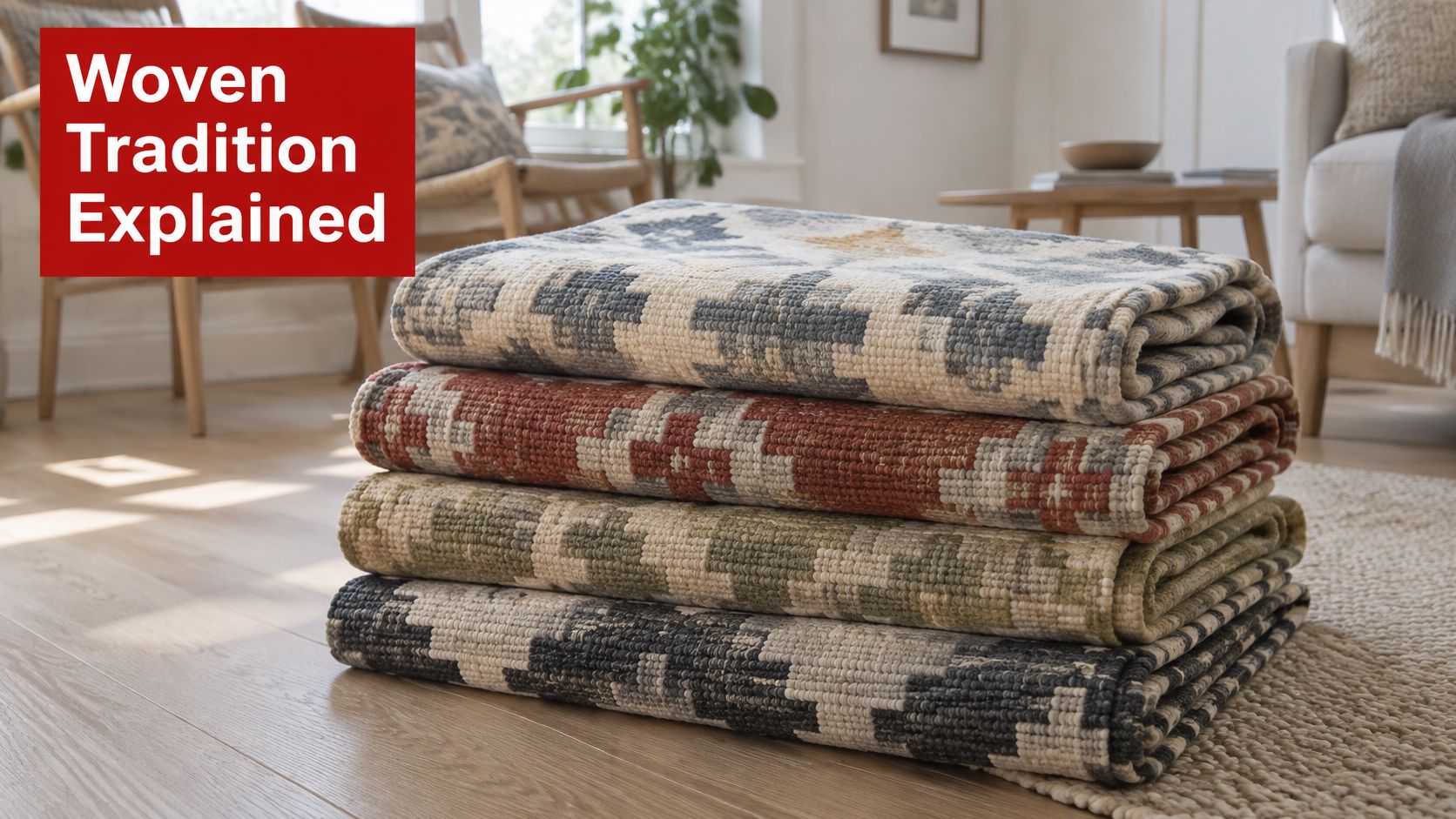
Folded rugs can look similar from above while concealing different foundations and edge finishes.
The foundation controls the shape
In a wool-and-linen rug, wool weft supplies the visible surface, texture, resilience and underfoot comfort. Linen warp forms the lengthwise foundation that helps keep the textile square. Think of a window: the frame controls the shape, while the glass supplies most of what you see.
That analogy has limits, because both yarn systems move and carry tension. Still, it explains why cleaning only for the visible wool can go wrong. A rug may feel soft and look bright after treatment while its foundation has tightened unevenly.
Cotton foundations need attention too. A wool surface doesn't tell you everything about the materials underneath, and a label that says wool may describe the face rather than every structural component.
Rubber Ducky's guide to rug construction types helps distinguish a woven foundation from other backing systems before choosing a cleaning service.
Flatweave and pile need different handling
Rugs on Net's description of Scandinavian rugs identifies röllakan as a low-profile, reversible flatweave, generally made with wool weft over linen or cotton warp, with interlocking color areas rather than raised pile. Both faces can be usable, but the edges, selvedges and loosened foundation areas remain vulnerable.
The absence of pile doesn't make a flatweave indestructible. A rotating brush can catch a lifted yarn, while scrubbing across a weakened color junction can widen an opening. Pulling a saturated rug by its corners can distort an otherwise sound textile.
A rya presents another problem. Long wool pile can conceal grit near the base even when the tips feel clean, so cleaning must reach beneath the surface without tangling or roughening the yarn. Aggressive brushing isn't a substitute for controlled soil removal.
Practical rule: Choose the cleaning method for the weakest part of the rug, not its strongest-looking area.
Geometric grids, diamonds, stripes and bold color relationships make flatweave patterns easy to read. Those same straight lines can reveal skew after an unsuitable wash. Pattern scale, weave density, wool quality and finishing differ between makers, so the individual rug matters more than the style name.
What the fibers actually tolerate
Wool's keratin fibers and residual natural lanolin can slow initial liquid penetration. They don't make the rug stainproof or prevent unstable dyes from moving. A spill left in place can still reach the foundation and leave a permanent mark.
Controlled agitation and suitable wool-cleaning chemistry are preferable to stiff brushing or strongly alkaline household cleaners. Thorough rinsing matters because leftover cleaning solution can leave the surface sticky or stiff.
Before wet treatment, the most useful checks are straightforward:
- Edge alignment: Look for curling, stretched corners and selvedges that no longer lie straight.
- Broken warp threads: Separate the surface gently to identify gaps, exposed foundation and fragile fringe roots.
- Color migration: Check for existing halos or transferred color, then have the cleaner test dye stability before washing.
Authenticity Checks Before You Buy
According to 1stDibs' handwoven Scandinavian rug listings, the average listed price was $2,479 in 2026, with listings ranging from $288 to $85,000. Those are asking prices, not a valuation of your rug or proof of authenticity.
A price far below that listed range deserves questions, but an expensive rug needs documentation too. For a Birmingham homeowner arranging cleaning or restoration, correct identification matters because a mistaken fiber or construction description can lead to the wrong treatment.
Authenticity checks and what they indicate
| Check | Genuine handwoven sign | Warning sign |
|---|---|---|
| Back side | Visible weft and warp with irregular hand-worked variation; hand-tied variation where the construction uses knots | Printed pattern or uniform machine-like backing |
| Edges and selvedges | Slight hand-finished irregularity, tight and straight | Glued or machine-stitched binding, or wavy edges that won't lie flat |
| Fringe | Knotted or woven ends integrated into the base | Fringe glued or stitched on separately |
| Pattern symmetry | Small variations between motifs, without mechanically identical repetition | Identical repeat across the whole rug |
| Fiber test using a loose fringe thread | Wool smells of burnt hair, tends to self-extinguish and leaves crumbling ash | Synthetic material melts into a hard bead and smells of plastic |
| Label and provenance | Weaver or workshop mark, documented origin | No maker named and only a vague Scandinavian style claim |
Read the signs together
None of these checks proves authenticity alone. A genuine rug may have replacement fringe or machine-sewn repair binding, and a skilled weaver can produce remarkably regular patterns. Wavy edges may indicate damage rather than imitation.
A fringe fiber test also identifies only the sampled thread. Linen or cotton fringe won't behave like wool, even when the rug's visible weft is genuine wool.
If a burn test is appropriate, use only an already detached thread in a fireproof dish, away from the rug and other combustible materials. Never cut a visible area, test an attached fringe or inhale the smoke deliberately; professional fiber identification is preferable for a valuable piece.
If several physical signs conflict, pause the purchase or cleaning decision until the construction is identified.
As a buying rule, conflicting results from two or more checks justify seller documentation and an independent inspection. For an existing rug, give Rubber Ducky any labels, receipts or restoration history before pickup so those details can inform the cleaning assessment.
Routine Care and Allergen Control Between Cleanings
Use a suction-only vacuum without a rotating brush on handwoven surfaces. Mechanical brushing can lift fibers, catch loose yarns and disturb fringe, even when it makes the surface look freshly groomed.
The Classic Collection wool-and-linen specification on Nordic Nest lists approximately 8 mm height and 2,000 g/m² mass for a contemporary example, alongside brush-free vacuuming advice. That's a dense textile, not a loose throw that can be treated casually.
Weekly and seasonal habits
The EPA's indoor particulate matter guidance recommends vacuuming carpets and furniture weekly or more often and notes that HEPA-filter vacuums can reduce dust escaping back into the air.
For routine weekly care:
- Vacuum gently. Use suction without a brush and keep the nozzle clear of fringe.
- Blot fresh spills. Use a clean white cloth rather than rubbing the weave.
- Check for dampness. Investigate a musty smell instead of covering it with fragrance.
For seasonal maintenance:
- Rotate periodically. Balance traffic wear and light exposure.
- Limit direct sunlight. Prolonged exposure can cause uneven fading.
- Inspect edges and fringe. Arrange attention before loose foundation threads spread.
- Ventilate during humid weather. Address room moisture rather than relying on the rug to absorb it.
- Plan professional cleaning. Match the schedule to pets, soil loading and household sensitivity.
Wool isn't an air purifier
A 2024 peer-reviewed study in Indoor and Built Environment found wool carpets could adsorb odors, but room-scale results were less conclusive when wool covered only the floor, with adsorption working best near the odor source. A review in Applied Sciences also describes carpets as reservoirs for dust, allergens and mold-related contaminants.
Holding a pollutant isn't the same as eliminating it. Vacuuming is maintenance, not decontamination, and professional allergen-reduction rug cleaning should complement ventilation and moisture control.
Where nearby window textiles contribute dust around the rug, CleanOnline, North York's Premium Dry Cleaners, offers a separate resource on safely cleaning heavy drapes. Don't transfer a drapery treatment to a handwoven rug.
Home Treatment or Professional Cleaning for Stains and Odors
A dense weave can hold soil and detergent below the visible surface. Home spot-cleaning may remove the mark on top while leaving contamination or sticky residue in the base, which can make the patch attract dirt again.
The safe home response is limited and reversible. It shouldn't turn a small spill into a fully saturated rug.
Common rug problems and the right first step
| Problem | Safe first step at home | Call a professional when |
|---|---|---|
| Fresh spill such as wine or coffee | Blot with a clean white cloth; use a little cold water only if color stays stable | Stain persists after one careful attempt or spreads through the weave |
| Pet urine | Blot and use a limited cold-water rinse if safe; test only a wool-approved enzyme cleaner on a hidden corner | Odor returns in humidity or urine has reached the backing |
| Muddy grit and dust | Let mud dry, then suction vacuum without a brush; gently shake outdoors only if the rug is small and structurally sound | Grit remains after vacuuming or fibers show abrasion |
| Dye bleeding or fading | Stop wet treatment and blot only | Any color migration appears on natural dyes |
| Musty smell after dampness | Ventilate and move the rug away from humid areas if it can be handled safely | Smell returns or growth is visible |
Where home care stops
Don't assume a pet-product label means an enzyme cleaner is suitable for wool. Some formulations can affect protein fibers or dyes, and a hidden test doesn't guarantee that a saturated treatment will behave the same way throughout the rug.
Urine that reaches the foundation needs more than a surface deodorizer. The cleaner must assess the affected depth, remove contamination where feasible and rinse out treatment residues. Permanent discoloration can remain even after the odor source has been addressed.
For another explanation of why washable and non-washable rugs need different decisions, Tip Top Furniture & Mattresses provides rug care advice for Upstate homeowners. For a handwoven piece, its specific foundation and dye response should decide whether home washing is appropriate.
Stop signal: Color on your blotting cloth may be rug dye, not just spilled liquid.
Households in Hoover, Homewood and Vestavia Hills with pets, allergy concerns or heavy traffic benefit from a planned cleaning assessment rather than waiting for a dramatic stain. Book sooner when embedded grit remains, edges show abrasion or an odor returns after treatment.
Repeated remedies can spread a stain, alter its chemistry or weaken the surface. A careful professional assessment usually leaves more options than another round of scrubbing.
Drying a Soaked Rug Within 24 to 48 Hours
After water intrusion, the CDC's homeowner and renter mold guide advises removing standing water and wet materials and drying the home and contents as quickly as possible, within 24 to 48 hours when possible; it also calls for taking outside materials that can't be cleaned and dried completely in that period and identifies wet-vacuum extraction for carpets. The CDC's mold-remediation guidance says failure to dry within 24 to 48 hours should lead homeowners to assume mold growth may have occurred.
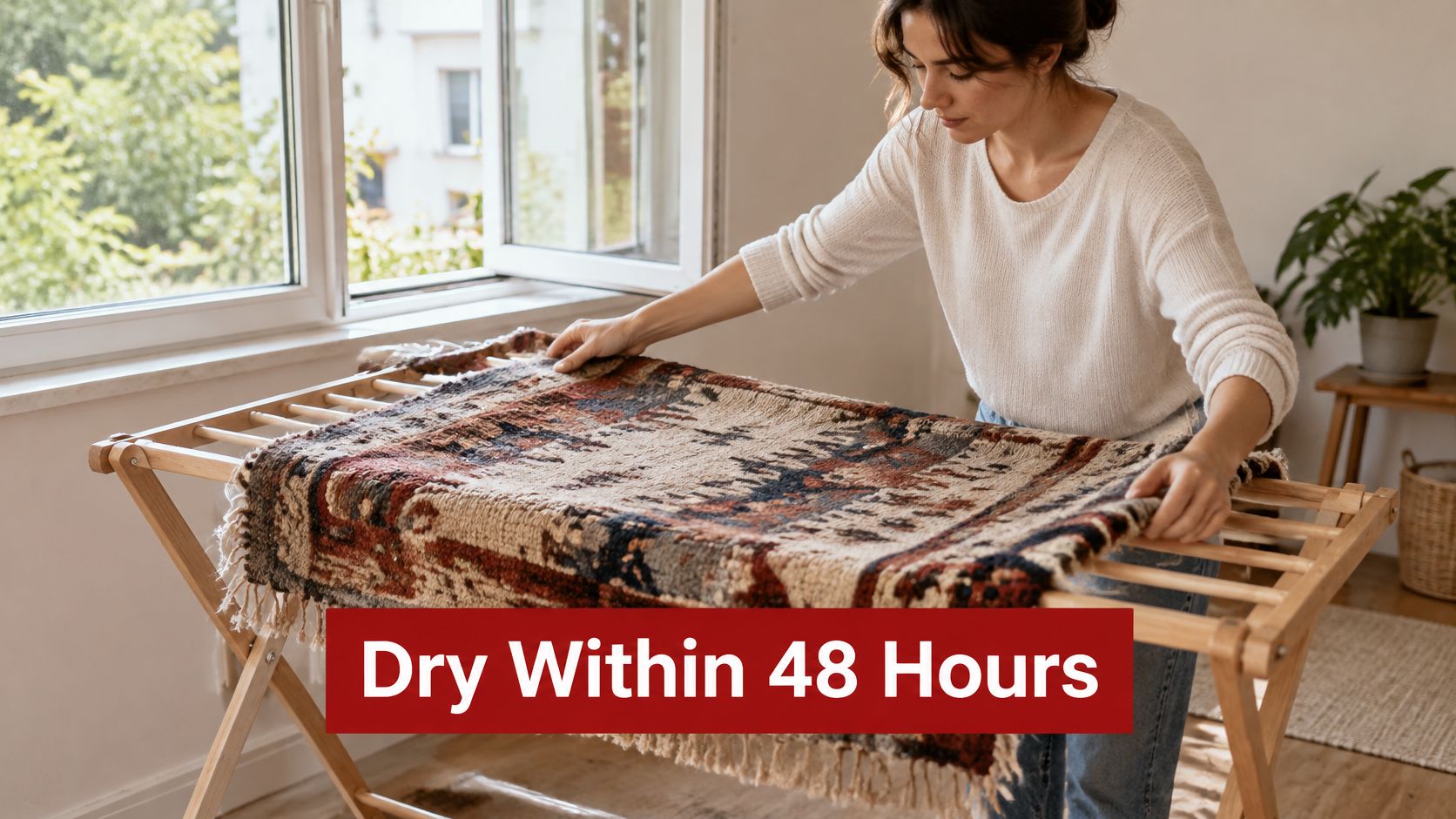
Even support matters when moving and drying a water-heavy textile.
Protect the rug while removing moisture
For clean-water exposure, take these steps only when the area is electrically safe. Sewage, contaminated floodwater and visible microbial growth require professional handling rather than household extraction.
- Separate the rug from the wet floor. Support its weight and remove standing water with a wet vacuum suitable for water pickup.
- Document before drying. Photograph color, edges and damage. Measure length, width and diagonals so the cleaner can assess later distortion.
- Keep it unfolded. Folding or stacking traps moisture and can transfer unstable dyes.
- Support it evenly. Lay it flat on a clean, ventilated support away from direct heat, with airflow available underneath.
- Check underneath regularly. Carefully turn it only if the foundation can tolerate handling; a dry face doesn't prove a dry base.
- Arrange professional extraction promptly. Don't wait for the public-health drying window to expire before requesting help.
Wool and linen respond differently to moisture. Uncontrolled heat, uneven support and hanging a saturated rug from narrow contact points can cause shrinkage, rippling or skew.
Rubber Ducky's guidance on drying a wet area rug explains the handoff from immediate water removal to controlled drying. Tell the team when the leak occurred and where the water came from so they can assess restoration options.
Rug Size and Placement by Room Based on Traffic
Think of the rug as a stage for furniture, but assess that stage for wear rather than appearance alone. Furniture feet, chair movement and daily walking routes determine where yarns receive the most pressure and where a cleaner should look for embedded grit.
Rug size and placement by room
| Room or layout | Size and placement rule |
|---|---|
| Living room, seating for four to five | Keep the seating group's front feet supported, with no loose edge across the main walking route |
| Living room, two-seat sofa | A hypothetical 160 x 230 cm rug works only if the front legs sit securely on it and the remaining sofa feet stay off |
| Dining room | Extend the rug far enough that pulled-back chairs remain on it |
| Bedroom | Keep bedside walking areas supported and leave accessible edges for vacuuming and inspection |
| Hallway | A hypothetical margin of about 10 cm can provide clearance, provided doors open freely and the runner stays secure |
Plan access for cleaning
Woodstock Furniture & Mattress Outlet's living room rug sizing tips can help assess furniture fit. For cleaning purposes, avoid arrangements that make routine vacuuming or safe rug removal impractical.
A dark, dense rug in a busy Birmingham family room can hide substantial soil. Households in Mountain Brook or Trussville should judge cleaning needs by traffic and contamination, not color alone.
In pet households, note where regular walking routes cross the rug and tell the pickup team about those areas. Predictable soil concentrations help guide inspection, while heavy furniture and restricted access should be discussed before collection.
Book Professional Rug Cleaning in Birmingham
Ordinary vacuuming doesn't reliably remove all embedded dust or allergen-containing soil. The EPA's guidance for health professionals identifies carpets as pollutant reservoirs and warns that cleaning can temporarily re-suspend fine particles, recommending reduced exposure for sensitive people and HEPA-filtered vacuuming.
Moving the work to a facility keeps washing, rinsing and drying out of your living space entirely. A dense handwoven rug also tolerates equipment no home setup can match. Dusting releases grit that suction leaves between warp and weft, immersion washing reaches soil locked deep in the structure, and controlled drying prevents the shrinkage wet wool risks on a household floor.
The pickup-to-return sequence is practical:
- Home pickup and inspection: Identify weak areas, dyes and contamination before treatment.
- Facility soil removal and washing: Use mechanical dusting when structurally appropriate, fiber-safe washing, targeted stain and odor treatment, and thorough rinsing.
- Controlled drying and finishing: Support the rug appropriately, hang straight only when safe, groom suitable surfaces and assess restoration needs.
- Home return: Place the finished rug back in its original location.
A soaked rug is awkward to move, and wet wool stretches under its own weight. Collection removes that risk.
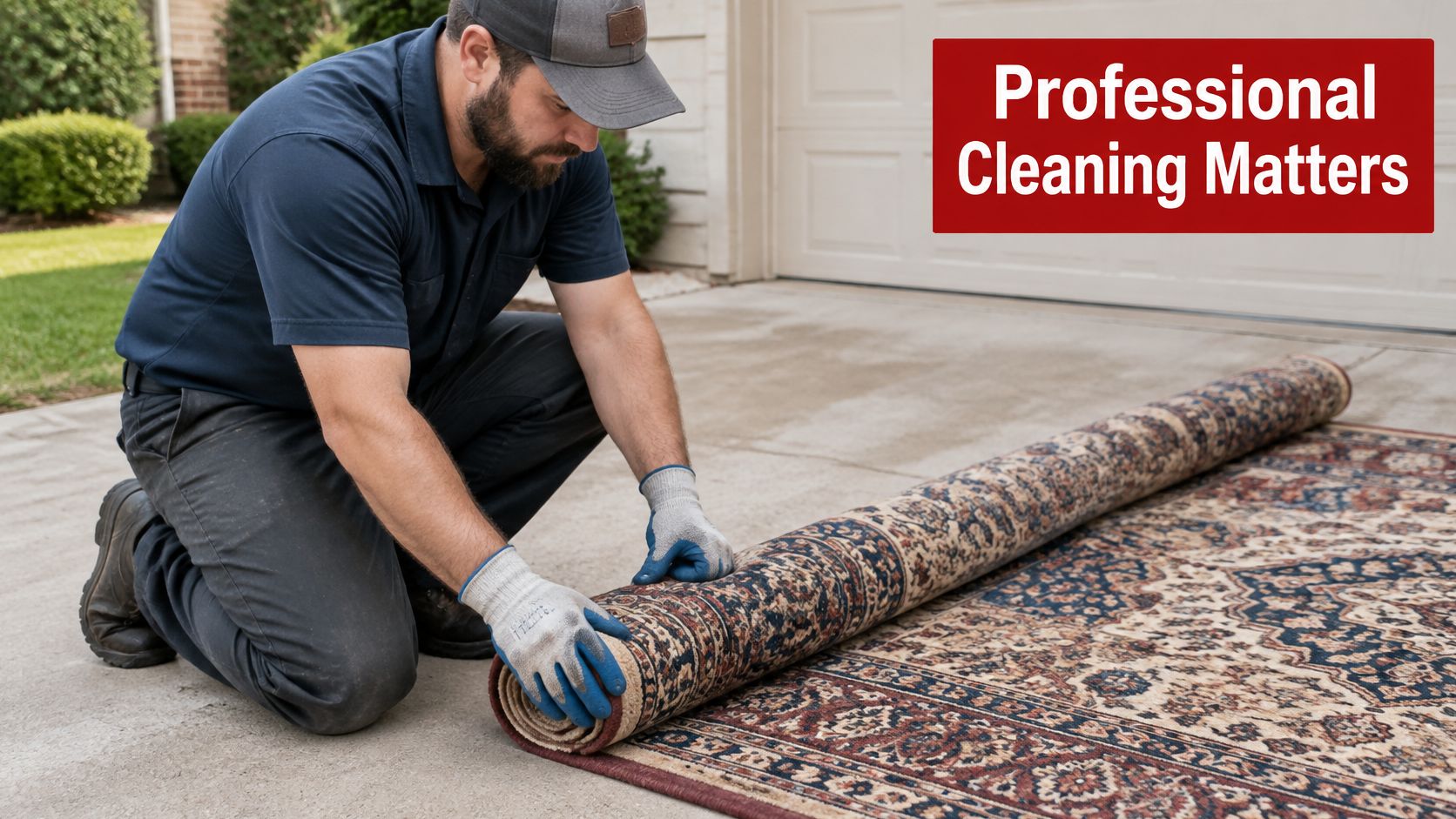
Pickup and return are available for Birmingham-area homes. Request an estimate or schedule pickup, and flag wet or freshly stained rugs immediately rather than waiting.
Rubber Ducky offers professional rug washing, stain and odor treatment, controlled drying and restoration assessment, with pickup and return for Birmingham-area homes. To arrange construction-sensitive care for your handwoven Scandinavian rug, visit Rubber Ducky Rug Cleaning Birmingham and request an estimate or pickup appointment.