

A Mountain Brook homeowner tracks red-clay soil onto a hallway rug. In Homewood, a Golden Retriever settles on a living-room flatweave, leaving behind hair and odor. In a Vestavia Hills bungalow, humid air reaches a stored wool rug and the piece comes back smelling musty. If you're searching for a hand woven kilim rug cleaning service in Birmingham, these problems need more than a quick pass with a household vacuum.
A kilim is a flatweave, not a small version of wall-to-wall carpet. Grit, moisture, pet residue, and foot traffic interact directly with its dyed warp and weft. The safest approach is to remove dry soil first, test the dyes, wash the rug with fiber-appropriate solutions, rinse thoroughly, and dry it under controlled conditions. For Birmingham homeowners, that means using professional off-site washing rather than gambling with a hose, steam machine, or supermarket spot remover.
Why Your Birmingham Kilim Needs a Different Approach
A hallway kilim in Birmingham can look clean while holding red-clay grit deep between its threads. Regular vacuuming removes loose debris from the surface, but it doesn't fully extract the fine particles that work against wool whenever someone walks across the rug. Birmingham homes also contend with pollen, pets, tracked soil, and damp conditions that can turn a light flatweave into a stale, discoloured, or distorted one.
Flat construction leaves less room for error
A hand woven kilim rug has no thick pile to cushion spills or hide wear. Its visible design comes from interwoven warp and weft yarns, and traditional slit-weave construction can leave small vertical openings where colour blocks meet. Those openings are part of the technique, but they can widen when the rug is stressed.
A pile carpet may hold liquid in its tufts. A kilim lets moisture travel through and across the weave. That matters when a pet accident, drink spill, or damp cleaning cloth reaches the fibres. The rug can absorb the problem quickly, and surface wiping won't address what has moved into the foundation.
Birmingham care rule: Treat a kilim as a textile with structural seams, not as a disposable carpet that can tolerate aggressive equipment.
The right first step is controlled dry-soil removal. Professional rug facilities use dusting and agitation equipment to release grit before water touches the rug, a process described in professional rug-cleaning guidance from Home Depot. After that, trained cleaners can assess the selvedges, fringes, slits, and dye behaviour before choosing a wash method.
Homeowners comparing methods should also understand why professional carpet cleaning differs from DIY cleaning. A home machine may add moisture without removing the soil that caused the problem. For a kilim, that can leave the rug heavier, dirtier, and less stable than before.
What Makes a Hand Woven Kilim Rug Unique
A true kilim begins on a loom with vertical warp threads and horizontal wefts. Weavers build the pattern by packing dyed yarn across the structure, changing colours to form diamonds, stepped borders, ram's horns, elibelinde figures, or running-water motifs. Kilim weaving has deep archaeological roots, with evidence from Egypt and Anatolia dating to the fourth and fifth centuries CE, while the slit-weave technique itself has been dated to around 1000 BCE in the historical overview from IMP Art.

The pattern is part of the structure
In Anatolian, Persian, Caucasian, and North African traditions, motifs often carried cultural meanings connected with protection, fertility, identity, nature, or household life. The design isn't printed onto a finished rug. It is created as the weaver places and reverses the weft, so the colour arrangement and the construction remain inseparable.
Traditional kilims are commonly handwoven from yarn-dyed wool by women in nomadic communities, particularly in present-day Türkiye, Iran, and Afghanistan. That background helps explain why older examples can be rare and historically important. It also explains why two apparently similar rugs can respond differently to moisture, agitation, and cleaning products.
Vegetal and mineral dyes may include madder root, indigo, or walnut husks. Their appearance can shift over time through sunlight and use, and a cleaner must test colour stability before washing. Alkaline products and untested stain removers can push dyes into adjacent areas.
Don't confuse every flat textile with a kilim
A kilim is a slit-weave flatweave. A sumak uses a wrapping technique, while cicim and zilu use other supplementary or patterned weaving methods. The distinctions matter during cleaning because the back, surface, fringe, and exposed yarns may react differently to agitation.
The fringes on a kilim aren't merely decorative trim. They extend from the warp and help identify how the rug was finished. Loose fibres may shed when handled, especially if the foundation has already been weakened, so a professional inspection should happen before washing.
How Kilim Construction Affects Durability
Kilim strength comes from weft packing, warp tension, fibre quality, and seam integrity, not from knot density. Owners familiar with pile rugs often look for a dense knot count, but that measurement doesn't translate directly to a flatweave. A tightly packed weft can create a compact, stable textile, while open slits and uneven tension can leave specific areas vulnerable.
All-wool kilims usually have resilient, elastic fibres, although wool remains vulnerable to moth activity when stored poorly. Wool-and-goat-hair blends can handle abrasion differently, but drier animal hair may become brittle. Cotton warps appear in newer or mixed constructions and can respond poorly when tension, moisture, or handling puts stress on the foundation.
Inspect the weak points before cleaning
Look closely at the places where the rug changes direction or carries repeated traffic. In a Birmingham hallway, those areas often include the central walking lane, the ends near doors, and the outer edges where vacuum heads turn.
- Open slits: Colour boundaries with visible gaps can widen under repeated foot traffic or forceful washing.
- Fringe warps: Fringe threads may snap when a vacuum is pulled across the short edge.
- Selvedge cords: Side edges can unravel once a final weft thread or securing cord has been disturbed.
- Warp tension: Ripples, skewed borders, or a wavering edge can indicate existing strain.
A professional cleaner should document these conditions before immersion. The construction principles discussed in this guide to rug construction types help explain why a flatweave needs a different process from a tufted or knotted rug.
Compare the construction choices
| Fiber / Weave Feature | Durability Impact | Cleaning Sensitivity |
|---|---|---|
| All-wool warp and weft | Resilient and elastic when the weave is tight | Sensitive to heat, moisture imbalance, and unstable dyes |
| Wool and goat-hair blend | Can resist abrasion, but dry hair may become brittle | Needs controlled moisture and gentle handling |
| Cotton warp | Provides a firm foundation in many newer pieces | Can weaken or distort under excessive tension and wet handling |
| Slit-weave colour changes | Creates crisp geometric patterning | Gaps may open if stressed |
| Interlocking weft construction | Eliminates open slits and generally improves durability | Still requires dye testing and controlled drying |
The key question isn't whether a kilim looks thick. It's whether its structure remains even, its edges remain secure, and its colour boundaries stay stable during washing.
The Hidden Weaknesses of Flatweave Rugs
Many homeowners call kilims low-maintenance because they're thin, reversible, and easy to move. That assumption is wrong where Birmingham homes expose them to clay soil, pets, concentrated traffic, and damp conditions. A flat surface reduces bulk, but it also places the working parts of the rug directly under every footstep.
Grit reaches the foundation quickly
Without pile, red-clay particles can settle against the warp and weft rather than resting above a cushion of tufts. Repeated walking presses those particles into the yarns, where they act as abrasive material. A rug can look bright on top while the foundation carries the damage.
Spills spread differently too. Instead of pooling inside a dense pile, liquid can move laterally through the open weave. Pet urine and other residues can reach the foundation immediately, making odour treatment more demanding than surface deodorising.

A smooth face also makes uneven fading obvious near windows. Furniture legs can catch loose selvedge fibres, and dragging or rolling heavy furniture across the rug can set creases into the weave. Moisture beneath the rug can wick upward, especially when the piece lies directly on a floor with poor ventilation.
The practical issue: A kilim is visually light, but its weak points are exposed rather than protected by pile.
Birmingham homes add pressure
Pet hair can lodge between wefts. Oak pollen and household dust can settle through both faces. High-traffic lanes darken as soil accumulates, while a flatweave's lack of height makes distortion and colour changes easier to see.
If you own a dhurrie or another flatwoven rug, the same structural concerns apply. This Birmingham dhurrie rug cleaning service guide provides useful context, but a handwoven kilim still needs an individual inspection because its dyes, slits, fringe, and selvedges may differ from another flatweave.
Spotting an Authentic Hand Woven Kilim Rug
Start with the fringe. On an authentic kilim, the fringe usually extends from the rug's warp threads and is knotted, twisted, or braided as part of the finishing process. A machine-made rug may have imitation fringe sewn onto the edge, which can look neat but doesn't form the same structural connection.
Turn the rug over and compare the pattern. Hand weaving generally produces a recognisable design on the reverse, with small variations in spacing and tension. A power-loomed piece often shows a mechanically uniform surface or a less distinct mirror image.
Look for human construction marks
Slight irregularity isn't automatically a defect. Changes in weft spacing, tiny slubs, uneven borders, and subtle shifts in colour can reflect hand production. Natural-dye variation, known as abrash, may appear as gentle changes within one colour family rather than a perfectly flat block.
Check the wool with your hands. A sound piece should feel supple and spring back rather than staying crushed. Wool may carry a lanolin-like scent, and occasional variations in the yarn are normal. None of these signs proves age or origin by itself, so don't authenticate a valuable rug from texture alone.
| Feature | Hand-Woven Kilim | Machine-Made |
|---|---|---|
| Fringe | Extends from structural warp threads | May be attached as imitation trim |
| Reverse pattern | Crisp design with human variation | Often blurred or mechanically uniform |
| Weft spacing | Slight irregularity is common | Consistently repetitive |
| Colour | Abrash and nuanced variation may appear | Often flat and saturated |
| Wool surface | May show slubs and fibre variation | Usually more uniform |
Motifs can suggest a regional tradition, but identification should include documentation, provenance papers, and reputable dealer verification. Authenticity affects cleaning decisions because a handwoven textile with natural dyes and older fibres may need a more conservative wash than a modern replica.
Why DIY Cleaning Falls Short for Kilims
Household methods usually fail because they treat the visible stain while ignoring the construction underneath. An upright vacuum with a beater bar can catch exposed warp threads, and a canister vacuum set too low can pull at fringes or selvedges. For routine upkeep, suction-only cleaning on an appropriate bare-floor setting is safer, but it isn't a substitute for deep soil removal.
Store-bought spot products create a separate problem. A cleaner may leave residue that attracts more dirt or react with a natural dye. Bleach, ammonia, and all-purpose sprays are particularly poor choices for wool, as consumer guidance from Lowe's rug-cleaning resource warns.
Common home methods versus controlled washing
| Home method | What can go wrong | Professional alternative |
|---|---|---|
| Beater-bar vacuuming | Snags warp threads and damages fringe | Controlled suction and fibre-aware dust removal |
| Baking soda and vinegar | Adds moisture and may leave the foundation damp | Targeted cleaning with a suitable solution |
| Garden-hose rinsing | Uneven pressure can distort the weave | Controlled submersion and measured rinsing |
| Steam cleaning | Heat and moisture can destabilise fibres and dyes | Temperature-controlled washing and drying |
| Household stain spray | May bleach, bleed, or leave soil-attracting residue | Dye testing and wool-safe treatment |
A garden hose also exposes the rug to pollen and humid outdoor air while it dries. Hanging a wet kilim can stretch the warp, while folding or rolling it before it is fully dry can trap moisture. Professional guidance for wool rugs recommends low heat, flat or carefully controlled drying, and complete dryness before storage, as explained in this wool-rug dye-care guidance.
A steam machine guide can still help you compare equipment and understand general limitations. This low-waste steam cleaner guide is useful background, but a domestic steam cleaner isn't designed to inspect a kilim's dyes, slits, foundation, or selvedges before saturating it.
Professional washing offers a more controlled sequence: mechanical dusting, dye-stability checks, custom wash-tank treatment, thorough rinsing, and climate-controlled drying. That sequence removes embedded grit without asking a homeowner to guess how much pressure, heat, detergent, or moisture the rug can tolerate.
Caring for Your Kilim Year-Round
Use a simple routine, but don't confuse routine care with restoration. Once a week, inspect the rug for clay grit, pet hair, new spills, and edge movement. Vacuum in the direction of the weave with the beater bar switched off, and avoid dragging the machine across the fringe.
Rotate the rug 180 degrees to distribute traffic instead of allowing one walking lane to carry all the wear. If the rug is small and safe to handle, take it outside and shake it gently to release loose grit. Don't beat an older or weakened kilim aggressively.
Respond to spills without setting the damage
Blot liquid with a clean, absorbent cloth. Don't scrub, flood, iron, or apply vinegar. If you use a spotter, choose a product labelled pH-neutral and wool-safe, and test it in an inconspicuous area first.
Pet accidents deserve faster escalation. Blot what you can, keep heat away from the area, and contact a professional before the odour becomes embedded. Guidance from professional kilim-care specialists also stresses suction-only cleaning and attention to both faces because grit can pass through a reversible flatweave.
Adjust care through Birmingham's seasons
Summer humidity calls for ventilation and, where necessary, a dehumidifier. A musty smell, damp underside, or new waviness means the rug needs inspection rather than more fragrance spray. During colder storage periods, check folded or rolled edges for moth activity and never store a rug while it still holds moisture.
Send the rug for professional attention when you notice:
- Traffic-lane darkening: Soil remains after careful vacuuming.
- Persistent pet odour: The smell returns after surface treatment.
- Fringe discolouration: The edge looks grey, yellowed, or weakened.
- Pre-storage soil: The rug needs a deep clean before being put away.
Schedule Your Birmingham Kilim Cleaning
After a careful home routine, professional washing is the sensible next step for a hand woven kilim rug that carries embedded soil, pet residue, or visible traffic wear. A proper facility process should remove dry grit before washing, test a hidden corner for dye stability, use wool-safe detergents, control water temperature, rinse away residue, and dry the rug under conditions that reduce shrinkage and distortion.
Rubber Ducky Rug Cleaning Birmingham handles pickup, facility washing, controlled drying, grooming, and return delivery for area rugs in Birmingham and nearby communities. Homeowners in Hoover, Vestavia Hills, Mountain Brook, Homewood, Trussville, Pelham, Alabaster, Gardendale, and Helena can arrange service without trying to transport a wet, fragile flatweave themselves.
What the service should include
Expect the cleaner to inspect the rug before immersion, identify vulnerable slits and edges, and choose treatment according to fibre and dye behaviour. The facility process can include:
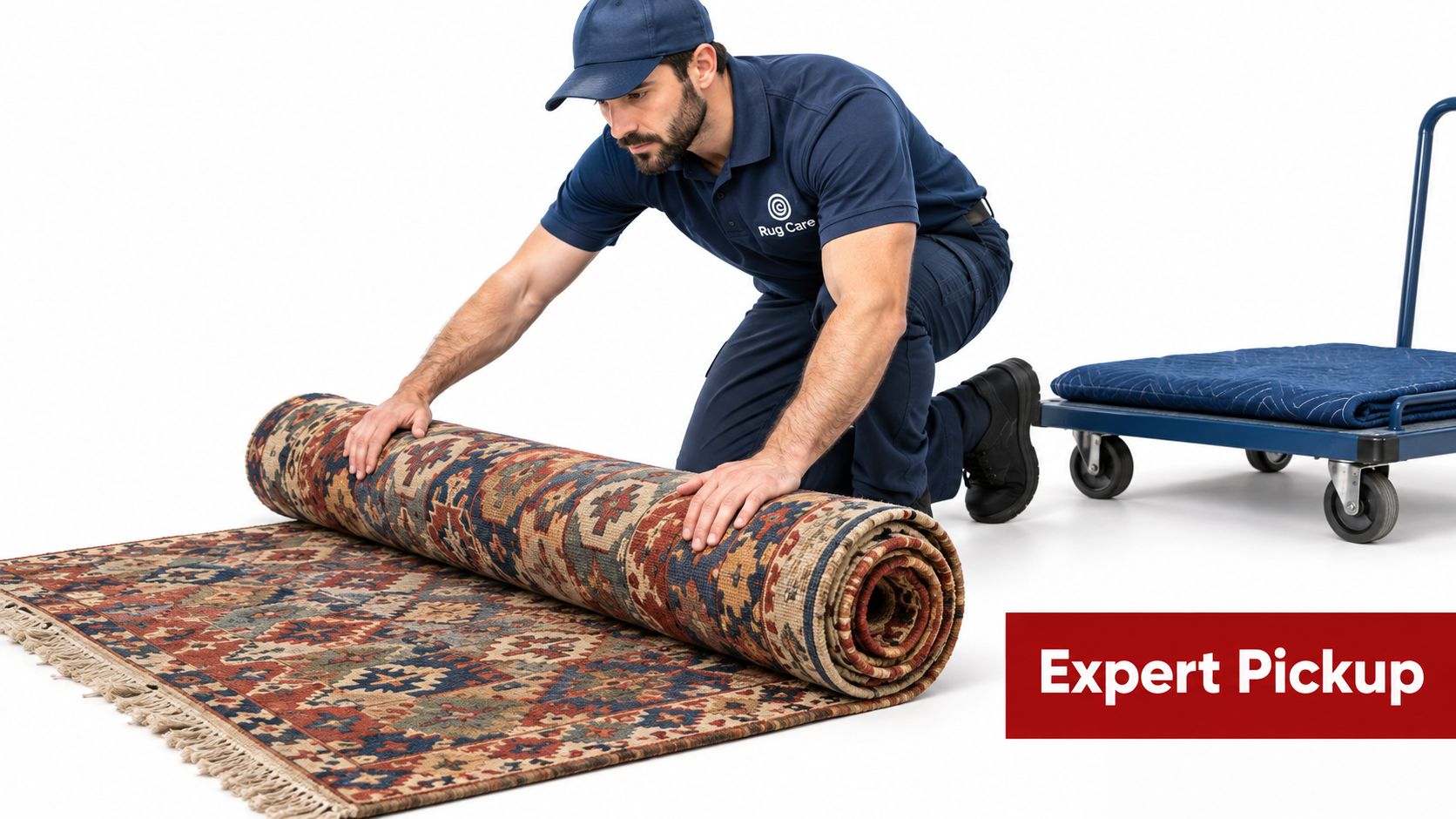
- Home pickup: The rug is collected from its current location.
- Mechanical dust removal: Embedded sand, clay, dust, and allergens are released before water treatment.
- Custom washing: The rug is cleaned in a wash tank with a solution matched to its fibres.
- Deep stain and odour treatment: Pet residue and stubborn spills receive more than surface spraying.
- Controlled rinsing: Residual detergent and loosened soil are removed thoroughly.
- Climate-controlled drying: The rug dries under managed conditions before grooming.
- Restoration work: Overcast edge re-stitching, fringe restoration, and moth-damage patching can be discussed when needed.
- Return placement: The clean rug is delivered back to its original location in the home.
A typical turnaround is 5 to 7 business days, depending on inspection, cleaning needs, drying, and any repairs. For recurring care, a professional wash every 12 to 24 months is a practical interval stated in this service recommendation, particularly for rugs exposed to pets, heavy traffic, or Birmingham soil.

The value is straightforward. Replacing a faded, distorted, or odour-saturated kilim costs more than preserving a sound one, and professional care can protect an heirloom or resale piece from avoidable damage. When you call, provide the rug's fibre, dimensions, current location, and the problem you're seeing. Ask about storage wrapping if the rug will spend the humid season in storage.
Rubber Ducky Rug Cleaning Birmingham offers home pickup, facility washing, stain and pet-odour treatment, controlled drying, grooming, and rug restoration for hand woven kilim rugs. Request a pickup estimate through Rubber Ducky Rug Cleaning Birmingham, and describe the rug's fibre, dimensions, and cleaning concern so the team can recommend the right service.