
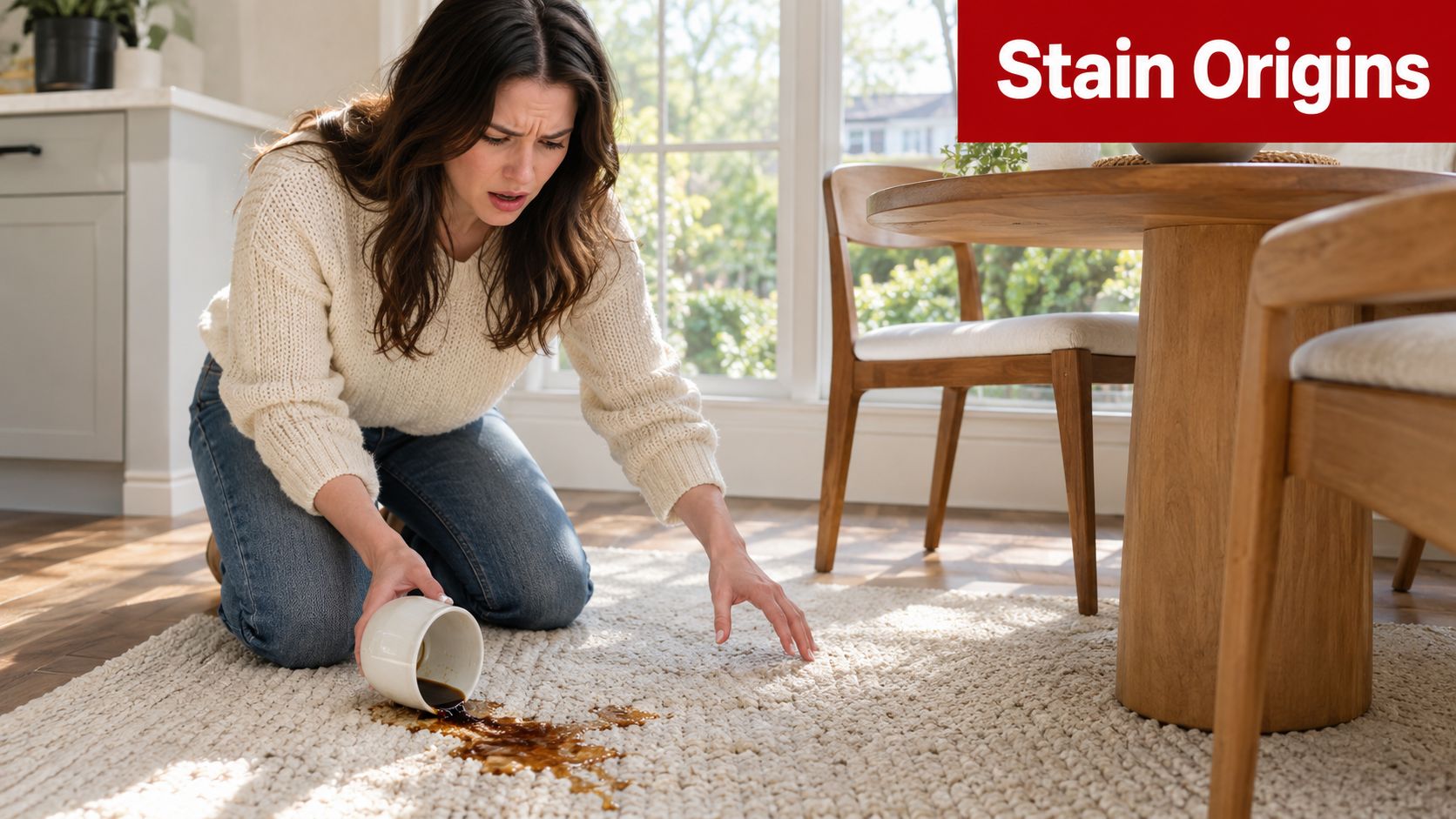
You've just lifted a dripping coffee mug from the edge of a cream rug in your Birmingham kitchen. The first instinct is to grab a coloured towel, scrub hard, and pour on whatever cleaner is nearby. Resist that urge. How to get coffee stains out of a rug depends on the rug's fibre, construction, dye stability, and how much liquid has already reached the backing.
Fresh coffee is generally easier to remove than a dried mark because prompt blotting limits how far the coffee travels into the pile. The safest immediate sequence is to blot, dilute carefully, treat lightly, rinse, and dry, not scrub until the surface looks clean. That distinction matters even more with wool, hand-woven, oriental, and silk rugs, where excessive water or friction can create a larger problem than the original spill.
For Birmingham homeowners, the practical question isn't only whether the stain can be lifted. It's whether a kitchen remedy will leave behind detergent, spread moisture into the backing, or disturb the rug's dyes. The right response starts with identifying what's under the coffee.
Why Coffee Spills on Rugs Are Not All the Same
A Birmingham homeowner sees one dark splash. The rug sees something more complicated. Coffee contains dark colouring compounds, and milk or sugar can leave additional residue. Once the liquid reaches the pile, the fibre underneath determines whether it stays near the surface, travels sideways, or sinks toward the foundation.
A wool rug can absorb coffee and hold moisture between its scales. A hand-knotted oriental rug may release colour when it's over-wet or treated with the wrong product. Cotton flatweaves often release liquid more readily, but their construction can let the stain wick outward. Polypropylene and other synthetic rugs tend to keep more of the spill near the surface, making careful home treatment more practical, although aggressive scrubbing can still roughen the pile.
Identify the rug before applying cleaner
Look at the back, fringe, and surface sheen before reaching for vinegar or peroxide.
- Back: A woven or knotted structure suggests a more sensitive construction than a simple latex-backed machine-made rug.
- Fringe: Wool or cotton fringe can absorb liquid quickly and may show colour bleed before the main field does.
- Sheen and feel: A soft, variable surface can indicate wool or another natural fibre, while a uniform, slick pile often points toward a synthetic material.
- Label: If the care label names wool, silk, viscose, jute, or an oriental construction, treat the rug as delicate until tested.
The cleaning liquid, dwell time, and water temperature should follow that identification. A mild solution that behaves acceptably on a polypropylene runner can disturb dyes in a valuable hand-knotted rug. Rubber Ducky's rug construction guide can also help Birmingham homeowners understand why construction affects cleaning decisions.
Practical rule: If you can't confidently identify the fibre and backing, use dry blotting only and arrange a professional assessment rather than experimenting.
The First Hour After a Fresh Coffee Spill
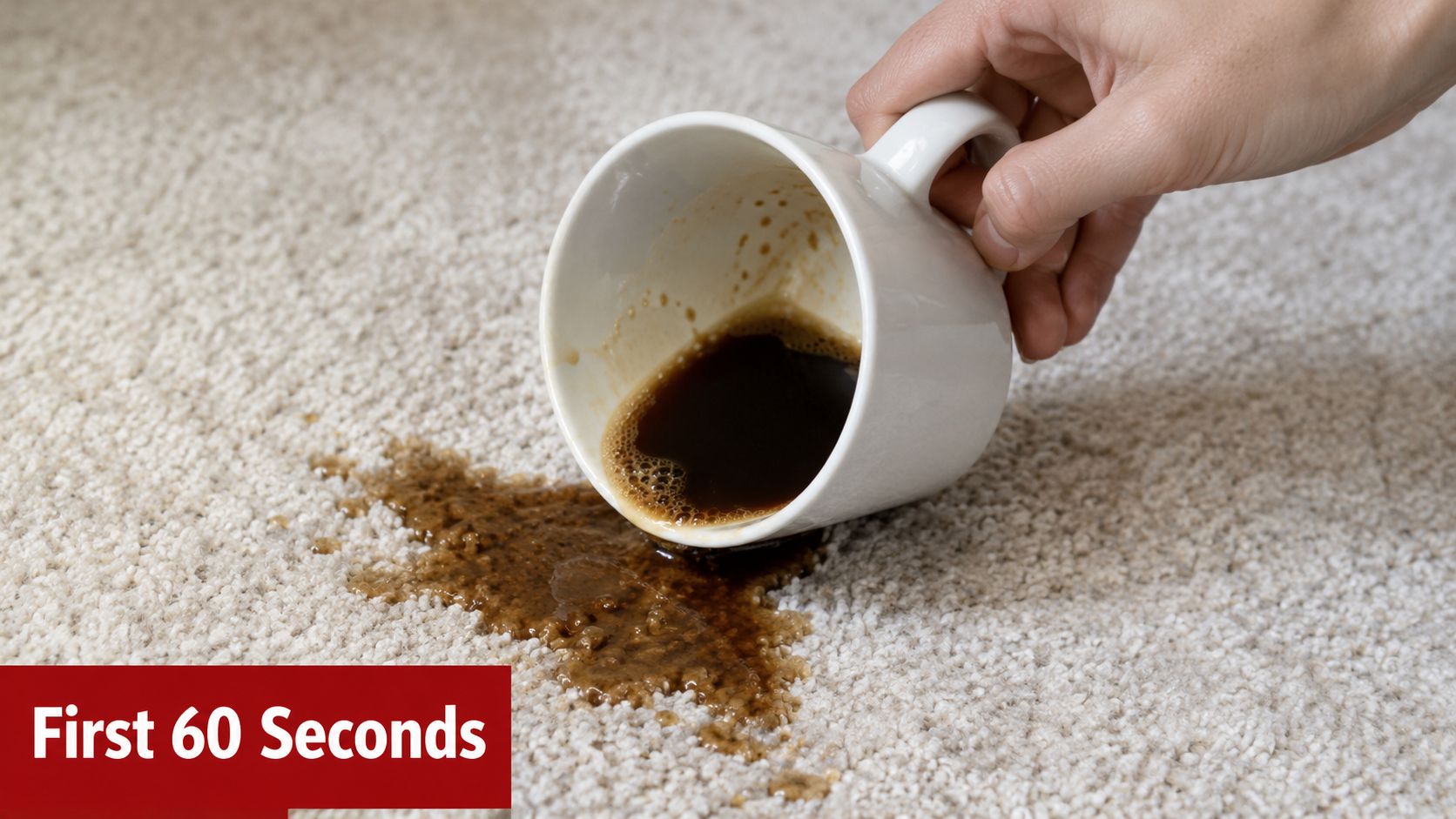
The first response should remove liquid, not work it deeper. Put the mug somewhere safe, lift away any coffee grounds or solid debris, and keep people from walking across the wet area.
The first minute
- Blot from the perimeter inward. Use a clean white cotton cloth or plain white paper towel. Start at the outer edge, press straight down, and lift straight up. Working inward helps limit sideways migration.
- Change the cloth surface often. A saturated towel only moves coffee around. Use a dry section for every pass, and watch for colour transferring onto the cloth.
- Keep friction out of the process. Rubbing can push coffee into the pile and distort the surface. It can also spread a small mark into a wider ring.
During the following hour
Once the loose liquid has been absorbed, add a small amount of cold water to the stained area, working from the outside toward the centre. Blot immediately after each small application. The purpose is to rehydrate coffee that has begun to set and pull it upward into the cloth, not to soak the rug.
Keep a fan moving air across the spot, but don't use a hairdryer, radiator, iron, or other heat source. Hot water can make coffee pigment harder to remove, and floor-covering care guidance from Sherwin-Williams also emphasises blotting, outside-in work, and cold water.
Avoid club soda and salt on natural fibres at this stage. They can add moisture or residue without solving the underlying fibre and dye problem. After an hour, inspect the cloth and the rug. If colour remains clearly visible, stop adding household products and move to a controlled treatment, or contact a rug cleaner before the mark sets further.
DIY Cleaning Solutions That Actually Work on Rugs
DIY treatment should be a ladder, not a random collection of bottles. Start with the mildest option that matches the rug, apply it with a cloth rather than pouring it on, and rinse every treatment with plain cool water.
For a fresh spill on a synthetic or most cotton rugs, begin with one teaspoon of clear dish soap in one cup of cool water. Dampen a white cloth, press it onto the stain, and lift. Don't flood the surface. If coffee colour remains on a suitable synthetic rug, add one tablespoon of white vinegar per cup of the soap solution, leave it for about five minutes, and blot again.
A baking soda paste can address lingering moisture or odour on synthetic and cotton rugs. Mix three parts baking soda with one part water, spread it lightly over the affected area after blotting, allow it to dry, and vacuum it carefully. This isn't a substitute for rinsing, because powder won't remove dissolved detergent from the backing.
Hydrogen peroxide is the point where many online recipes become unsafe. Use it only on a white or demonstrably colourfast synthetic rug, after testing a hidden area. It can bleach wool and oriental dyes. Skip enzyme cleaners and oxygen bleach on wool and silk unless a professional has confirmed that the product is appropriate.
DIY Coffee Stain Cleaning Ladder for Rugs
| Level | Solution | Safe Fibers | Mix Ratio | Dwell Time | Rinse |
|---|---|---|---|---|---|
| 1 | Clear dish soap | Synthetic and most cotton | 1 teaspoon soap in 1 cup cool water | Blot promptly | Plain cool water |
| 2 | Soap with white vinegar | Suitable synthetics | 1 tablespoon vinegar per cup of soap solution | About 5 minutes | Plain cool water |
| 3 | Baking soda paste | Synthetic and cotton | 3 parts baking soda to 1 part water | Until dry | Vacuum, then assess residue |
| 4 | Hydrogen peroxide spot treatment | White or colourfast synthetics only | Follow the product label | Product-dependent | Plain cool water |
Use the same finishing rule after every wet treatment. Make rinse-only passes with a clean cloth, then press with dry towels. Advice on keeping carpet cleaning low-moisture can be found in HomeProBadge carpet advice, but area rugs still require fibre-specific caution.
Rinsing matters: A stain that looks gone while wet can return as a dark or stiff patch when detergent remains in the pile.
Fiber-Specific Approaches for Wool, Oriental, and Synthetic Rugs
The same coffee mark needs different handling on a wool oriental rug and a polypropylene outdoor rug. Wool and hand-woven rugs require a conservative approach because their fibres, dyes, fringe, and foundation may react differently to water. Synthetic rugs usually tolerate a broader cleaning range, but they still need controlled moisture.
Wool and hand-woven oriental rugs
Use cool water only and choose a pH-neutral, wool-safe detergent. Test colourfastness in a hidden corner first, using a damp white cloth and checking for transferred dye. On undyed wool, don't introduce vinegar without professional guidance. Blot rather than scrub, and keep the cleaner concentrated on the affected surface.
Fringe and selvage can absorb quickly, so touch them with a barely damp cloth before treating the main field. If colour begins moving into the cloth, stop. A set-in mark, visible dye bleed, or dampness reaching the backing is a strong reason to use professional oriental rug stain removal in Birmingham.
Synthetic and outdoor rugs
Polypropylene and similar synthetics may accept a dilute dish-soap solution or diluted white vinegar after testing. A soft brush can help on a durable synthetic surface, but pressure should stay light and local. Outdoor rugs still need thorough drying because moisture trapped beneath them can create odours and encourage soil to collect in the damp area.
Coffee Stain Removal by Rug Fiber
| Rug Fiber | Water Temp | Recommended Cleaner | Agitation | Avoid |
|---|---|---|---|---|
| Wool | Cool | pH-neutral wool-safe detergent | Blot only | Vinegar on undyed wool, scrubbing, saturation |
| Hand-woven oriental | Cool | Fibre-appropriate neutral detergent after testing | Blot only | Unchecked chemicals, hot water, colour bleeding |
| Cotton flatweave | Cool or lukewarm | Mild dish-soap solution | Gentle cloth work | Excess moisture and rough brushing |
| Synthetic polypropylene | Cool or lukewarm | Dilute dish soap, tested vinegar solution | Light soft-brush work if needed | Harsh scrubbing and peroxide without a colour test |
| Outdoor synthetic | Cool or lukewarm | Mild synthetic-safe cleaner | Light surface agitation | Leaving the rug over a wet pad |
The decision is simple. If the rug is valuable, natural, dyed, hand-made, or unfamiliar, the safest DIY method is limited blotting while you arrange an inspection.
The Drying and Residue Problem Most Guides Skip
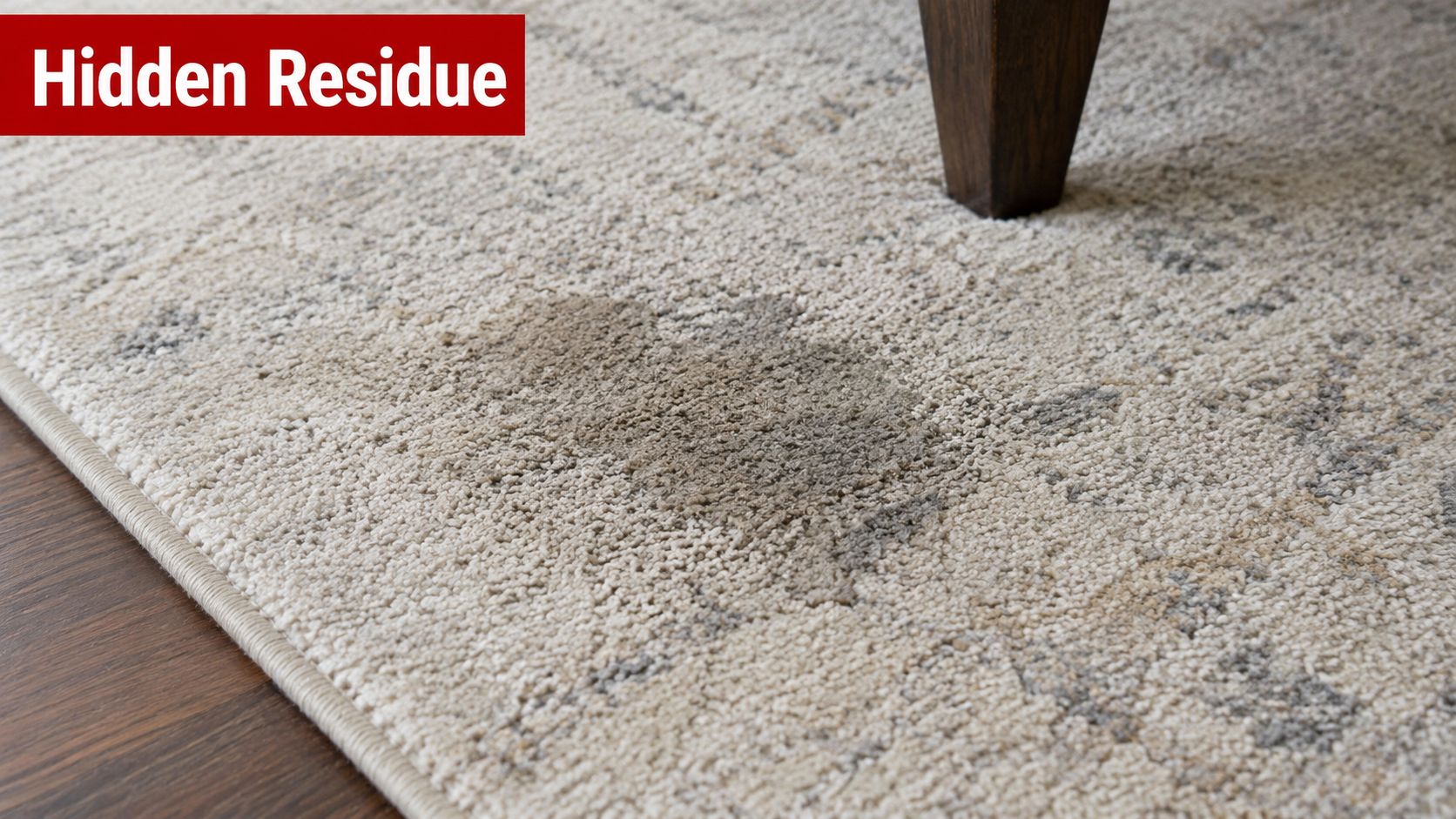
A coffee spot can look successful while it's wet and return as a brown outline during drying. That usually points to one of two problems, residual coffee in the backing or detergent left in the fibres. Sticky surfactant residue attracts soil, while hidden moisture can contribute to odours and mildew concerns.
After treatment, make repeated rinse-only passes with a clean white cloth. Use small amounts of plain cool water, then press the area with dry towels. Don't pour water over the rug in an attempt to “flush” it. A rug-care guide warns that too much moisture can leave a spot vulnerable to dirt aggregation and odours, which is why removal must include extraction and drying, not just surface appearance.
Dry the rug without creating a second problem
Lift the rug away from any wet pad or floor. Use fans or a dehumidifier to keep air moving through the room, and avoid placing dyed wool or oriental rugs in direct sun. Independent rug-care guidance recommends relative humidity below 50% and an ambient temperature between 70°F and 85°F during drying, conditions described as helping evaporation while reducing the risk of mould or fibre shock. See the rug drying guidance for those specific conditions.
Watch the rug as it dries. A stiff hand, a dark outline reappearing, or a musty smell within 24 hours indicates that residue or moisture remains. Low-moisture methods can lessen, but not eliminate, shrinkage risk, as noted in the IICRC area-rug tip sheet. If the rug won't dry evenly, stop treating the spot and arrange professional extraction.
When Birmingham Homeowners Should Call a Professional Rug Cleaner
DIY treatment reaches its limit when the stain is no longer only on the surface. After more than 24 hours, coffee may be set into the pile and backing. Wool and silk deserve particular caution because repeated wetting, unsuitable pH, and friction can affect both the fibre and the dye. Household steam cleaners add heat and moisture without giving you the controlled washing, rinsing, and drying needed for a delicate rug.
Repeated spot treatments can create another failure point. Each application may leave detergent behind, and a dark ring can keep returning as moisture moves upward during drying. A professional wash addresses the whole rug rather than forcing more chemistry into one isolated patch.
What a pickup-and-delivery service changes
Rubber Ducky Rug Cleaning Birmingham uses a staged process built around inspection and controlled moisture:
- Home pickup in Birmingham: The rug is collected from the home, including properties in Hoover, Vestavia Hills, Mountain Brook, Homewood, Trussville, Pelham, Alabaster, Gardendale, and Helena.
- Inspection and quote: The team examines fibre, construction, dyes, backing, fringe, and stain condition before choosing a wash method. A free in-home quote is available.
- Dry dust removal: Professional cleaning commonly begins with dry dusting. One rug-care source reports that a tumbling duster can remove up to 80% of dry dust and particulate matter before wet cleaning, as described in this rug-cleaning guidance.
- Fibre-matched washing: The rug receives a cold-water submersion wash with agents selected for its construction, rather than a one-size-fits-all carpet treatment.
- Controlled extraction and drying: Mechanical rinsing removes loosened soil and residue, followed by flat drying in a climate-controlled room.
- Grooming and return: The rug is groomed, checked, and returned to its original location in the home.
Read more about how a rug is professionally cleaned before deciding whether another home treatment is sensible.
Stop DIY when: the stain has set, the rug is wool or silk, colour has bled, or a dark ring returns after drying.
Your Coffee Stain Action Plan and Next Steps
Start with the action that matches the rug, not the cleaner sitting under your sink.
- Lift and blot: Remove the mug and solids, then use a clean white cloth from the outside inward.
- Use cool water sparingly: Rehydrate a beginning-to-set mark in small amounts and blot each pass.
- Check the fibre: Treat synthetics more broadly, but keep wool, silk, oriental, and hand-woven rugs to conservative blotting and testing.
- Rinse and dry: Remove solution with plain cool water, press with dry towels, and keep air moving.
- Book pickup: Arrange professional service if the stain is set, colour is bleeding, moisture remains, or the mark returns.

Birmingham homeowners don't need to guess whether a coffee stain is safe to treat at home. If you're holding a delicate rug, seeing a spreading ring, or dealing with a mark that survived the first response, pickup-and-delivery cleaning gives the rug a controlled path from inspection through washing, drying, grooming, and return.
Rubber Ducky Rug Cleaning Birmingham provides professional rug pickup, fibre-specific washing, deep stain and odour removal, controlled drying, grooming, and rug restoration for homes across the Birmingham area. Schedule a rug pickup or request an estimate by visiting Rubber Ducky Rug Cleaning Birmingham before another round of DIY treatment leaves residue or moisture behind.